


Respect is an important part of communication, relationships, and professional life. However, repeating the word respect can make your writing sound less precise. Choosing the right alternative helps you express admiration, consideration, honor, or recognition more clearly.
Common synonyms for respect include admiration, esteem, regard, honor, reverence, deference, appreciation, and consideration. The best choice depends on what you want to communicate. For example, admiration emphasizes appreciation for someone’s qualities, while deference describes yielding to another person’s judgment or authority.
This guide explores useful synonyms for respect, explains their meanings, and provides natural examples for everyday conversations, academic writing, and professional communication.
What Does Respect Mean?
Respect means recognizing the value, rights, feelings, abilities, or dignity of someone or something. It can also describe the regard you have for a person, an idea, a rule, or an institution.
Respect has several related meanings:
- Consideration: Treating others thoughtfully and fairly.
- Admiration: Valuing someone’s qualities, skills, or achievements.
- Esteem: Holding someone or something in high regard.
- Honor: Recognizing dignity, worth, or distinction.
- Deference: Showing regard by yielding to someone’s judgment or authority.
For example, you might respect a colleague for their expertise, show respect for a friend’s feelings, or respect a rule by following it.
These situations involve different meanings. Understanding the context helps you choose a more accurate synonym.
Best Synonyms for Respect
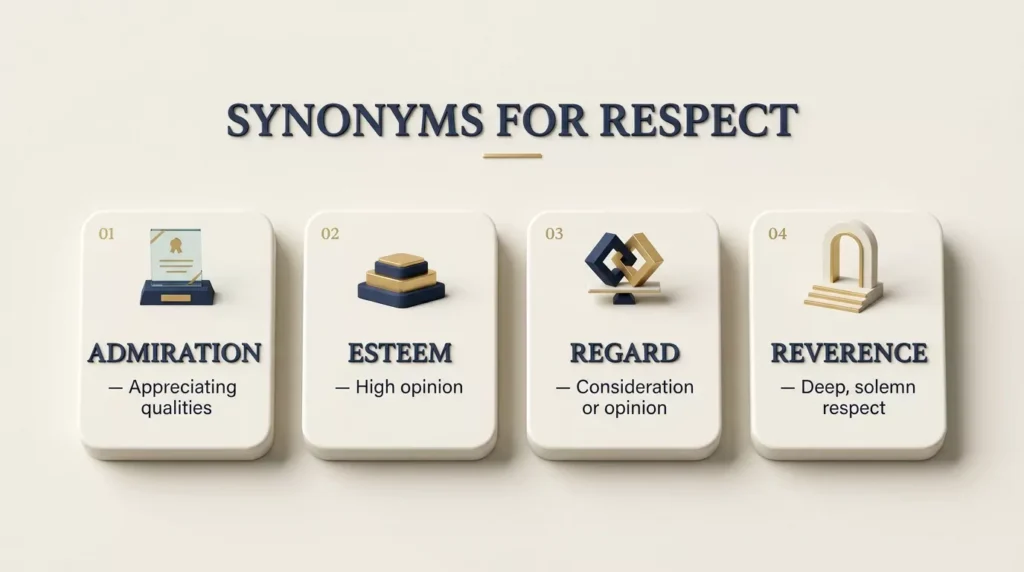
The following words are useful alternatives to respect. Some describe a feeling, while others emphasize behavior, recognition, or the relationship between people.
Respect as Admiration or High Regard
These synonyms work when you value someone’s character, abilities, accomplishments, or qualities.
- 🌟 Admiration: A feeling of approval or appreciation for someone’s qualities or achievements.
Example: Her dedication to helping others earned everyone’s admiration. - 🏆 Esteem: A high opinion of someone’s character, abilities, or worth.
Example: The experienced teacher was held in high esteem by her students. - 💎 Regard: A feeling of consideration, appreciation, or a particular opinion of someone.
Example: I have great regard for colleagues who communicate honestly. - ❤️ Appreciation: Recognition of someone’s value, effort, or contribution.
Example: The manager expressed appreciation for the team’s hard work. - 👏 Approval: Acceptance of or a favorable opinion about someone’s actions or decisions.
Example: The proposal received approval from the review committee. - 🤝 Recognition: Acknowledgment of someone’s achievements, contribution, or importance.
Example: The award gave recognition to her outstanding research. - ✨ Appreciation of worth: Recognition that someone or something has value.
Example: Living abroad gave him a deeper appreciation of different cultures.
Best choices: Use admiration for impressive qualities, esteem for a high opinion of someone, and appreciation for valued efforts or contributions.
Respect as Consideration and Courtesy
When respect refers to how people treat one another, words related to consideration and polite behavior may be more appropriate.
- 🌿 Consideration: Thoughtful attention to another person’s needs, feelings, or circumstances.
Example: She showed consideration by allowing everyone to finish speaking. - 😊 Courtesy: Polite and respectful behavior toward others.
Example: The receptionist treated every visitor with courtesy. - 🤝 Deference: Respect expressed by yielding to another person’s judgment, wishes, or authority.
Example: The junior researcher showed deference to the committee’s established procedures. - 💬 Politeness: Behavior that demonstrates good manners and consideration.
Example: He answered the difficult question with politeness and patience. - 🌍 Tolerance: Willingness to accept differences or endure something you disagree with.
Example: A diverse community benefits from tolerance and open discussion. - 🫶 Thoughtfulness: Careful attention to how your actions affect other people.
Example: Her thoughtfulness made the new employee feel welcome. - 🕊️ Acceptance: Recognition of someone or something without necessarily expressing approval.
Example: Mutual acceptance helped the team work through their differences.
Important distinction: Courtesy describes polite conduct, while consideration emphasizes thoughtfulness. Tolerance and acceptance can support respectful relationships, but neither necessarily means admiration or high regard.
Respect in Formal and Professional Writing
Formal writing often benefits from alternatives that describe professional regard, acknowledgment, or esteem.
- Esteem: Suitable for describing a high professional opinion.
Example: She is a researcher of considerable esteem in her field. - Regard: Useful in formal correspondence and professional communication.
Example: We hold the organization’s work in high regard. - Recognition: Appropriate when acknowledging achievements or contributions.
Example: The committee recognized his contribution to the project. - Acknowledgment: Recognition that someone or something exists, matters, or deserves attention.
Example: The report included an acknowledgment of the team’s contribution. - Honor: Suitable for expressing distinction, dignity, or a special mark of respect.
Example: It was an honor to present the award to the retiring professor. - Appreciation: Effective for thanking colleagues and recognizing effort.
Example: I would like to express my appreciation for your continued support. - Professional courtesy: Considerate conduct in a workplace or professional relationship.
Example: As a matter of professional courtesy, she informed her colleague before changing the schedule. - High regard: A clear phrase for expressing a favorable opinion of someone.
Example: The director has high regard for employees who take responsibility.
For workplace emails, appreciation, regard, and recognition are often natural choices. Use deference when the sentence specifically involves yielding to another person’s expertise, authority, or judgment.
Respect as Honor or Deep Reverence
Some situations call for words that convey a stronger sense of honor, dignity, or solemn appreciation.
- 🕯️ Reverence: Deep respect, often associated with something sacred, significant, or worthy of profound admiration.
Example: Visitors entered the memorial with reverence. - 🏅 Honor: Respect associated with dignity, distinction, or recognition.
Example: The community gathered to honor the volunteers. - 🙏 Veneration: Profound respect, particularly for someone regarded as exceptionally worthy or important.
Example: The historical figure was remembered with veneration. - 🛡️ Deference: Respect shown by yielding to another person’s authority or judgment.
Example: The board treated the expert’s findings with deference. - 👑 Esteem: High regard for a person’s character, achievements, or abilities.
Example: The humanitarian earned the esteem of people across the country. - 🌹 Homage: A public or formal expression of admiration or respect.
Example: The performance paid homage to the musician’s lasting influence. - 📜 Tribute: An expression of praise, appreciation, or recognition.
Example: The documentary served as a tribute to the teacher’s legacy.
Reverence and veneration convey deeper respect than the word regard in many contexts. Homage and tribute usually describe an expression of respect rather than the feeling itself.
Respect as Recognition or Deference
Respect can also involve recognizing a person’s rights, accepting legitimate authority, or acknowledging the importance of a principle.
- Acknowledgment: Recognition of a person’s contribution or position.
Example: The speech included an acknowledgment of the volunteers’ efforts. - Recognition: Awareness and appreciation of achievement or importance.
Example: Her work finally received the recognition it deserved. - Consideration: Thoughtful attention to people’s needs or circumstances.
Example: The policy was revised with consideration for employees’ concerns. - Compliance: Acting according to a rule, requirement, or instruction.
Example: The company maintained compliance with workplace regulations. - Obedience: Following instructions or commands from someone with authority.
Example: The training program emphasized obedience to emergency procedures. - Observance: Following or maintaining a rule, custom, or practice.
Example: The organization encouraged observance of its ethical standards.
Be careful with compliance and obedience. They describe following rules or instructions, not necessarily feeling respect. Someone can obey a rule without admiring the person who established it.
Synonyms for Respect as a Verb
When respect describes an action, the best alternative depends on whether you mean appreciating someone, treating them fairly, recognizing their rights, or following a rule.
| Verb | Meaning | Example |
| Admire | Appreciate someone’s qualities or achievements | I admire her commitment to education. |
| Esteem | Hold someone in high regard | We esteem colleagues who act with integrity. |
| Value | Recognize the importance of someone or something | The company values every employee’s contribution. |
| Appreciate | Recognize someone’s worth or effort | I appreciate your willingness to listen. |
| Honor | Show respect through recognition or action | They honored the founder’s achievements. |
| Acknowledge | Recognize a fact, contribution, or person’s presence | She acknowledged his contribution to the project. |
| Recognize | Identify or give credit to someone’s worth or achievements | The award recognized her years of service. |
| Consider | Take someone’s needs, feelings, or views into account | Please consider the concerns raised by the team. |
| Defer to | Yield to someone’s judgment or authority | We deferred to the engineer’s technical judgment. |
| Observe | Follow a rule, custom, or practice | Visitors must observe the site’s rules. |
| Honor the rights of | Recognize and uphold another person’s rights | The policy honors the rights of all participants. |
Example Sentences Using Respect Alternatives
Here are practical ways to replace respect without changing the intended meaning.
- Instead of “I respect her dedication,” write “I admire her dedication.”
- Instead of “We respect your contribution,” write “We appreciate your contribution.”
- Instead of “The community respects the leader,” write “The community holds the leader in high esteem.”
- Instead of “Please respect everyone’s opinions,” write “Please consider everyone’s opinions.”
- Instead of “The organization respects his achievements,” write “The organization recognizes his achievements.”
- Instead of “They respect the authority of the court,” write “They recognize the court’s authority.”
- Instead of “We respect the rules,” write “We observe the rules.”
- Instead of “I respect her decision,” write “I honor her decision.”
Not every substitution preserves the original meaning perfectly. For instance, admire suggests a positive opinion, while consider emphasizes thoughtful attention.
Synonyms for Respect by Context
The most effective synonym depends on the situation in which you use it.
| Context | Suitable alternatives | Example |
| Friendship | Consideration, appreciation, regard | Their friendship is built on mutual consideration. |
| Workplace | Esteem, appreciation, recognition | The manager expressed appreciation for the team’s effort. |
| Academic writing | Regard, esteem, acknowledgment | The study acknowledges earlier research in the field. |
| Leadership | Trust, confidence, esteem | The manager earned the team’s trust through consistent decisions. |
| Cultural differences | Tolerance, acceptance, consideration | Cultural understanding requires openness and consideration. |
| Rules and regulations | Compliance, observance, adherence | The facility requires adherence to safety procedures. |
| Religious or sacred settings | Reverence, veneration, honor | The ceremony was conducted with reverence. |
| Achievements | Admiration, recognition, tribute | The award recognized her achievements. |
| Formal correspondence | Appreciation, high regard, acknowledgment | I would like to express my appreciation for your assistance. |
| Personal boundaries | Consideration, recognition, regard | Healthy relationships require consideration of personal boundaries. |
Some alternatives in this table express related ideas rather than exact synonyms. For example, trust and confidence may accompany respect in leadership, but they refer to belief in someone’s reliability or ability.
Differences Between Respect and Similar Words
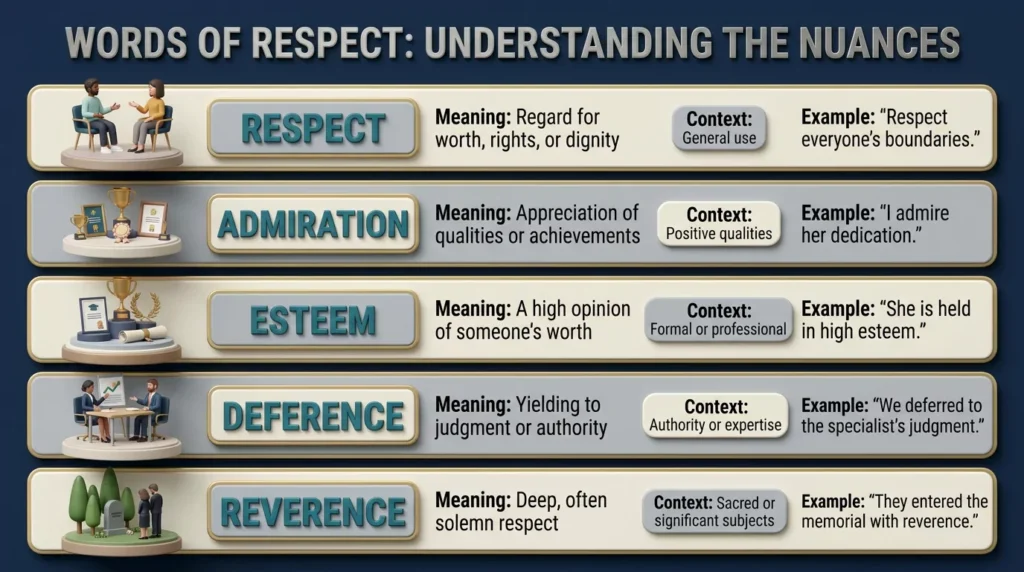
Several words overlap with respect but carry different meanings. Understanding these distinctions makes your writing more accurate.
| Word | Main meaning | How it differs from respect |
| Respect | Regard for someone’s worth, rights, or qualities | The broadest term in this comparison |
| Admiration | Appreciation for impressive qualities or achievements | Usually emphasizes positive qualities |
| Esteem | A high opinion of someone’s worth or character | Emphasizes a favorable judgment |
| Regard | Consideration or an opinion about someone | Often more neutral and flexible |
| Reverence | Deep, often solemn respect | Stronger and more formal |
| Deference | Respect shown by yielding to judgment or authority | Emphasizes accommodation or submission |
| Courtesy | Polite and considerate behavior | Describes manners rather than an inner feeling |
| Honor | Recognition of dignity, distinction, or worth | Often involves public recognition or dignified treatment |
| Tolerance | Willingness to accept differences | Does not necessarily imply admiration or approval |
| Recognition | Acknowledgment of importance or achievement | Focuses on noticing or giving credit |
Respect vs. Admiration
Respect can involve recognizing someone’s rights, dignity, or boundaries, even when you do not particularly admire them.
Admiration usually involves a positive response to a person’s qualities, talents, or achievements.
Example: You can respect a colleague’s right to disagree while admiring another colleague’s exceptional creativity.
Respect vs. Esteem
Esteem generally means holding someone in high regard. It is especially useful when describing a favorable opinion of someone’s character or professional ability.
Example: The professor earned the esteem of her peers through years of careful research.
Respect vs. Reverence
Reverence expresses a deeper, often solemn form of respect. It commonly appears in religious, ceremonial, historical, or deeply meaningful contexts.
Example: The visitors observed a moment of silence with reverence.
Respect vs. Deference
Deference involves yielding to another person’s judgment, authority, or wishes. Respect does not always require agreement or submission.
Example: The team respected the manager but challenged the decision after reviewing the evidence.
Respect vs. Tolerance
Tolerance means accepting or enduring differences, beliefs, or behavior that you may not share. Respect can go further by recognizing another person’s dignity and rights.
Example: Tolerance allows people with different beliefs to coexist; mutual respect can help them communicate constructively.
Examples of Respect Synonyms in Sentences
These examples show how alternative words work in everyday communication and formal writing.
Everyday Conversations
- Consideration: “Thank you for showing consideration when I needed extra time.”
- Appreciation: “I really appreciate everything you’ve done for me.”
- Admiration: “I admire how calmly you handled that situation.”
- Regard: “I have a lot of regard for people who keep their promises.”
- Courtesy: “She answered the question with courtesy.”
Workplace Communication
- Esteem: “Our team holds the department head in high esteem.”
- Recognition: “The company gave recognition to employees who improved customer service.”
- Acknowledgment: “I appreciate your acknowledgment of the work involved.”
- Deference: “We deferred to the specialist’s judgment on the technical issue.”
- Honor: “The organization honored her years of dedicated service.”
Academic and Formal Writing
- Regard: “The analysis treats the historical evidence with careful regard.”
- Recognition: “The paper recognizes the contributions of earlier researchers.”
- Observance: “The procedure requires observance of established research standards.”
- Esteem: “The scholar is held in high esteem within the academic community.”
- Reverence: “The ceremony reflected the community’s reverence for its traditions.”
Personal Relationships
- Consideration: “A healthy relationship requires consideration of each person’s needs.”
- Appreciation: “He showed appreciation for her patience and support.”
- Acceptance: “Their friendship grew through acceptance of their differences.”
- Thoughtfulness: “Her thoughtfulness made a difficult day easier.”
- Regard: “They continued to treat each other with regard despite their disagreement.”
Antonyms of Respect
Antonyms help clarify the meaning of respect by showing the opposite attitude or behavior.
- Disrespect: A lack of respect or consideration.
Example: Interrupting someone repeatedly can communicate disrespect. - Contempt: A strong feeling that someone or something is unworthy of consideration.
Example: He spoke about the proposal with contempt. - Disdain: A feeling that someone or something is unworthy or inferior.
Example: She expressed disdain for dishonest business practices. - Scorn: Strong contempt, sometimes expressed through words or actions.
Example: The dishonest claim was met with scorn. - Derision: Mockery or ridicule.
Example: The speaker faced derision after making an offensive remark. - Dismissiveness: Treating a person, concern, or idea as unimportant.
Example: His dismissiveness discouraged others from sharing their concerns. - Disregard: Failure to pay proper attention to someone or something.
Example: Disregard for safety instructions can create serious problems. - Rudeness: Behavior that is impolite or inconsiderate.
Example: Rudeness can damage professional relationships.
The best antonym depends on the intended meaning. Disrespect is the broadest choice, while contempt and scorn convey stronger negative attitudes.
How to Choose the Right Synonym for Respect
Selecting the right word is easier when you identify what you mean by respect.
1. Decide What You Want to Express
Ask yourself whether you mean admiration, polite treatment, recognition, honor, or obedience.
For example, use admiration for impressive qualities and consideration for someone’s needs or feelings.
2. Consider the Audience
A formal report may benefit from esteem, recognition, or regard. A personal message may sound more natural with appreciation, admiration, or consideration.
3. Check the Strength of the Word
Words differ in intensity. Regard can be relatively neutral, esteem suggests a high opinion, and reverence often expresses profound respect.
Choose a word that matches the situation instead of making the sentence sound unnecessarily dramatic.
4. Check the Grammar
Some alternatives require different sentence structures.
- “I respect her expertise.”
- “I admire her expertise.”
- “I hold her in high esteem.”
- “I have great regard for her expertise.”
- “I show consideration for her needs.”
- “I defer to her judgment.”
A word may be semantically related but still require a different grammatical pattern.
5. Read the Sentence Aloud
The best synonym should sound natural and preserve your intended meaning. If the replacement changes the tone or suggests something you do not mean, choose another word.
For example, “I obey my colleague” does not communicate the same thing as “I respect my colleague.” Obedience suggests following instructions, whereas respect may involve regard for the colleague’s judgment, dignity, or abilities.
Frequently Asked Questions About Respect Synonyms
What is the best synonym for respect?
Esteem, admiration, regard, and consideration are among the most useful alternatives. Esteem emphasizes a high opinion, admiration focuses on positive qualities, regard expresses consideration or opinion, and consideration emphasizes thoughtfulness toward others.
What is another word for respect in professional writing?
Esteem, regard, appreciation, recognition, and acknowledgment are useful in professional contexts. The best choice depends on whether you mean a favorable opinion, gratitude for effort, or recognition of an achievement.
What is a formal word for respect?
Esteem, reverence, deference, and regard can work in formal writing. Reverence is especially strong and solemn, while deference is appropriate when someone yields to another person’s judgment or authority.
What is a stronger word for respect?
Reverence and veneration often communicate deeper respect. Admiration and esteem can also express strong regard, depending on the context.
What is the difference between respect and admiration?
Respect can mean recognizing a person’s rights, dignity, or qualities. Admiration specifically emphasizes appreciation for something impressive or worthy of approval.
What is the difference between respect and regard?
Regard can mean consideration, esteem, or an opinion about someone or something. Respect more directly emphasizes worth, dignity, rights, or appropriate consideration, although the meanings overlap.
What is a synonym for mutual respect?
Useful expressions include mutual regard, reciprocal respect, shared consideration, and mutual appreciation. Mutual respect means that people recognize and consider one another’s worth, rights, or perspectives.
What is the opposite of respect?
Disrespect is the most direct antonym. Other alternatives include contempt, disdain, scorn, and disregard, depending on the intended meaning and intensity.
Can appreciation be used instead of respect?
Sometimes. Appreciation is appropriate when you recognize someone’s effort, value, or contribution. It is not always interchangeable with respect because respect can also involve dignity, rights, boundaries, and fair treatment.
How can I show respect without using the word respect?
You can communicate respect through phrases such as “I value your opinion,” “I appreciate your contribution,” “I admire your dedication,” “I recognize your expertise,” and “I understand your concerns.” Choose the expression that reflects your actual intention.
Conclusion
The best synonyms for respect depend on the meaning you want to convey. Admiration expresses appreciation for impressive qualities, esteem communicates a high opinion, consideration emphasizes thoughtful treatment, and reverence conveys profound respect. Regard, honor, appreciation, and recognition also work in appropriate contexts.
Before replacing respect, consider your audience, the tone of your writing, and the specific idea you want to express. A precise word makes your communication clearer and more natural.

Nadeem Akhtar has a keen interest in the way words shape clear communication. Through SimpleSynonyms, he shares easy-to-understand resources on vocabulary, synonyms, meanings, and everyday English to help readers express themselves with greater confidence.