


Looking for synonyms for emotional? The right alternative depends on what you want to describe. You might mean a sensitive person, a heartfelt message, or a powerful reaction.
Common synonyms include sensitive, passionate, expressive, sentimental, heartfelt, moving, poignant, intense, and touching. However, these words have different meanings and uses.
This guide explores 75 useful alternatives to emotional. You will discover their meanings, example sentences, and differences. You will also learn which words suit everyday conversations, formal writing, and emotional descriptions.
What Does Emotional Mean?
The word emotional describes feelings, strong reactions, or the expression of emotions. It can refer to happiness, sadness, anger, affection, excitement, or other feelings.
For example:
- She became emotional during the farewell speech.
- His emotional response surprised everyone.
- They shared an emotional conversation about their childhood.
The word can describe a person, a reaction, a relationship, or an experience. Its meaning changes slightly with context.
When describing a person, emotional may mean sensitive or expressive. When describing a message, it may mean heartfelt or moving. When describing a reaction, it may suggest an intense response.
Common Synonyms for Emotional
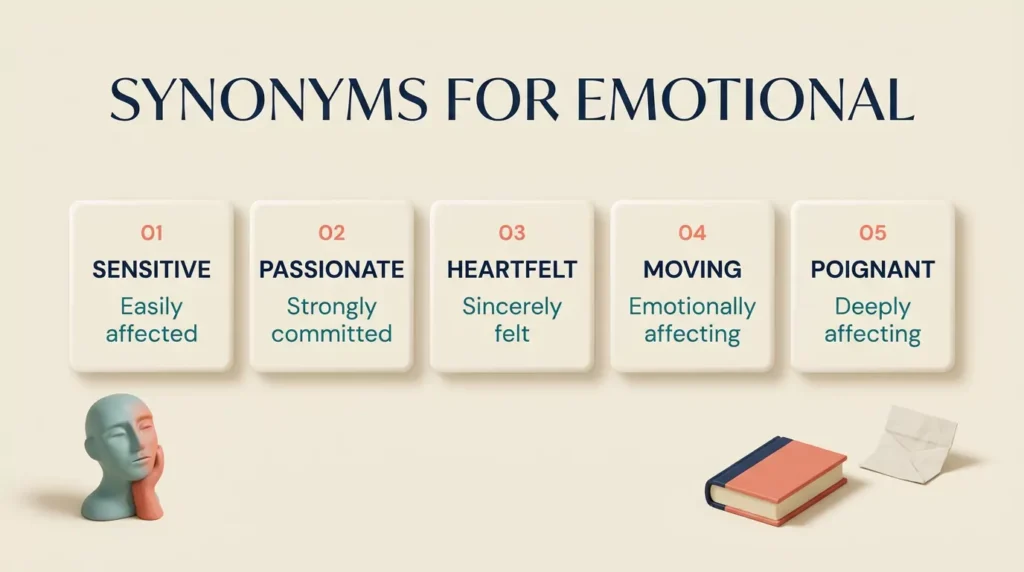
These alternatives are useful in everyday speech and general writing. Choose the word that best expresses your intended meaning.
| Synonym | Meaning | Example sentence |
| Sensitive | Easily affected by feelings or experiences | She is sensitive to criticism. |
| Passionate | Showing strong enthusiasm or feeling | He is passionate about environmental protection. |
| Expressive | Clearly showing thoughts or feelings | Her expressive face revealed her excitement. |
| Sentimental | Strongly affected by memories or affection | He kept a sentimental photograph from childhood. |
| Heartfelt | Sincere and deeply felt | She wrote a heartfelt thank-you note. |
| Moving | Causing strong feelings | The documentary was deeply moving. |
| Touching | Creating sympathy, affection, or tenderness | Their reunion was a touching moment. |
| Intense | Strong or powerful in degree | They had an intense discussion about their future. |
| Impassioned | Expressing powerful feelings or beliefs | She delivered an impassioned speech. |
| Empathetic | Able to understand another person’s feelings | Our empathetic teacher listened carefully. |
| Compassionate | Showing concern for others’ suffering | The compassionate nurse comforted the patient. |
| Sincere | Honest and genuine in expression | His sincere apology helped rebuild trust. |
| Affecting | Producing a strong emotional response | The film presented an affecting account of loss. |
| Poignant | Creating deep sadness or tenderness | The final letter was poignant. |
| Evocative | Bringing strong feelings or memories to mind | The song was evocative of her childhood. |
These words overlap, but they are not exact replacements in every sentence. For example, empathetic describes understanding others, while heartfelt describes sincere feeling.
Synonyms for Emotional When Describing People
When describing a person, consider whether you mean sensitivity, openness, affection, or emotional intensity.
| Synonym | Meaning | Example sentence |
| Emotionally expressive | Openly showing feelings | She is emotionally expressive with close friends. |
| Open | Willing to share personal feelings | He is open about his worries. |
| Demonstrative | Showing feelings openly through words or actions | They are demonstrative with their affection. |
| Impressionable | Easily influenced by experiences or people | Young children can be impressionable. |
| Vulnerable | Emotionally exposed or open to hurt | She felt vulnerable discussing her fears. |
| Tender | Showing gentleness and affection | He has a tender relationship with his daughter. |
| Affectionate | Showing fondness or love | Her affectionate greeting made everyone smile. |
| Caring | Showing concern for others | A caring friend checks in regularly. |
| Warm | Friendly and emotionally welcoming | His warm personality put guests at ease. |
| Touchy | Easily upset or offended | He becomes touchy when people criticise his work. |
| Reactive | Responding quickly or strongly to events | She can be reactive under pressure. |
| Volatile | Experiencing sudden, unpredictable changes | Their volatile relationship often involved arguments. |
| Excitable | Easily becoming enthusiastic or upset | The excitable puppy reacted to every visitor. |
| High-strung | Easily nervous, tense, or upset | He felt high-strung before the interview. |
| Impulsive | Acting quickly without enough thought | She made an impulsive decision while upset. |
Some alternatives are complimentary, while others suggest difficulties. Warm and caring are generally positive. Touchy, volatile, and high-strung can sound critical.
Use sensitive when a person feels things deeply. Choose expressive when they show their feelings clearly. Use vulnerable when emotional openness involves personal risk.
Synonyms for Emotional Feelings and Reactions
Sometimes, emotional describes a reaction rather than a person’s personality. These alternatives communicate different feelings and levels of intensity.
| Synonym | Meaning | Example sentence |
| Overwhelmed | Unable to manage the strength of a feeling | She felt overwhelmed by the unexpected support. |
| Distressed | Experiencing serious worry or unhappiness | He was distressed by the news. |
| Upset | Unhappy, worried, or disturbed | She was upset about the misunderstanding. |
| Tearful | Close to crying or showing tears | He became tearful during the farewell. |
| Weepy | Inclined to cry easily | She felt weepy after watching the film. |
| Sorrowful | Full of sadness | They exchanged sorrowful looks. |
| Mournful | Expressing grief or deep sadness | A mournful melody filled the room. |
| Melancholic | Marked by thoughtful or lasting sadness | The novel has a melancholic atmosphere. |
| Wistful | Showing gentle longing for something absent | He gave a wistful smile when remembering school. |
| Nostalgic | Feeling affection for the past | The old photographs made her nostalgic. |
| Joyful | Feeling or expressing great happiness | The family shared a joyful celebration. |
| Elated | Extremely happy or excited | She was elated by her examination results. |
| Thrilled | Extremely pleased or excited | He was thrilled to meet his favourite author. |
| Enthusiastic | Showing eager interest | The enthusiastic team welcomed the new project. |
| Exuberant | Showing lively, energetic happiness | The children gave an exuberant response. |
These words identify particular emotions rather than describing every emotional experience.
For example, distressed suggests worry or suffering. Elated describes great happiness. Wistful combines gentle sadness with longing.
Synonyms for Emotional Writing, Speeches, and Moments

Use these alternatives when describing books, films, conversations, speeches, or personal messages.
| Synonym | Meaning | Example sentence |
| Heartfelt | Expressing genuine feeling | Her heartfelt message thanked every volunteer. |
| Touching | Creating tenderness or sympathy | The touching scene reunited two old friends. |
| Moving | Strongly affecting the audience | His moving speech honoured the local community. |
| Poignant | Deeply affecting, often through sadness | The poignant ending stayed with readers. |
| Evocative | Bringing memories or feelings to mind | The evocative description recalled a summer holiday. |
| Affecting | Causing a noticeable emotional response | The affecting story explored family separation. |
| Stirring | Inspiring strong emotion or enthusiasm | The stirring performance moved the audience. |
| Powerful | Having a strong emotional effect | The film delivered a powerful message. |
| Dramatic | Full of striking events or intense feeling | The dramatic scene changed the story’s direction. |
| Impassioned | Expressing strong conviction or feeling | The impassioned address defended equal opportunities. |
| Fervent | Showing intense sincerity or enthusiasm | She offered a fervent expression of support. |
| Ardent | Showing passionate commitment or affection | He is an ardent supporter of public libraries. |
| Earnest | Serious, sincere, and deeply committed | Her earnest request received a thoughtful response. |
| Meaningful | Having personal or emotional importance | Their conversation was meaningful to both friends. |
| Resonant | Having a lasting emotional or personal effect | The novel’s resonant ending encouraged reflection. |
A moving speech affects its listeners. A heartfelt speech communicates sincere feelings. A stirring speech may inspire action or enthusiasm.
The distinction matters when writing reviews, essays, articles, and personal messages.
Positive Synonyms for Emotional
Sometimes, emotional sounds too general. A more positive word can communicate warmth, empathy, or enthusiasm.
| Synonym | Meaning | Example sentence |
| Empathetic | Understanding another person’s feelings | The empathetic manager listened without judgement. |
| Compassionate | Caring about others’ suffering | Her compassionate response reassured the family. |
| Affectionate | Showing love or fondness | He sent an affectionate message to his parents. |
| Warmhearted | Naturally kind and caring | The warmhearted neighbour helped the elderly couple. |
| Loving | Showing deep affection | They shared a loving family relationship. |
| Kindhearted | Having a kind and generous nature | The kindhearted volunteer supported new students. |
| Enthusiastic | Showing strong interest and eagerness | The enthusiastic audience welcomed the speaker. |
| Passionate | Showing strong interest or commitment | She is passionate about teaching young learners. |
| Joyful | Expressing happiness | The joyful reunion brought everyone together. |
| Uplifting | Making people feel more hopeful or positive | The uplifting story encouraged the readers. |
These alternatives emphasise different positive qualities. Compassionate highlights concern for suffering. Affectionate communicates fondness. Uplifting describes something that improves a person’s mood.
Negative Synonyms for Emotional
In critical or negative contexts, emotional may suggest distress, poor control, or an exaggerated reaction. These words have stronger connotations and require careful use.
| Synonym | Meaning | Example sentence |
| Overwrought | Extremely upset or emotionally strained | He sounded overwrought after the argument. |
| Melodramatic | Exaggerating feelings or situations | Her melodramatic response surprised her colleagues. |
| Maudlin | Excessively sentimental, often through sadness | The scene became maudlin rather than moving. |
| Hysterical | Showing extreme, uncontrolled emotion | The report described the character as hysterical. |
| Irrational | Not guided by sound reasoning | Fear led to an irrational decision. |
| Agitated | Nervous, upset, or visibly unsettled | She became agitated during the disagreement. |
| Volatile | Likely to change suddenly or unpredictably | The volatile discussion quickly became heated. |
| Excessive | Greater than is reasonable or necessary | His excessive reaction distracted from the issue. |
| Unrestrained | Not held back or controlled | She gave an unrestrained expression of grief. |
| Uncontrolled | Not kept within reasonable limits | His uncontrolled anger damaged the relationship. |
These words are not neutral replacements for emotional. They introduce a specific judgement or behaviour.
For example, irrational questions the reasoning behind a decision. It does not simply mean that someone has strong feelings. Similarly, hysterical can sound dismissive and should not be used casually to describe ordinary distress.
Formal and Academic Synonyms for Emotional
Formal writing often benefits from more precise vocabulary. The following terms suit essays, reports, literary analysis, and professional communication.
| Synonym | Meaning | Example sentence |
| Affectively charged | Strongly associated with emotional responses | The study examined affectively charged language. |
| Emotionally charged | Carrying strong feelings or tension | The meeting covered an emotionally charged issue. |
| Impassioned | Expressing intense feeling or conviction | The author presents an impassioned argument. |
| Evocative | Bringing feelings or memories to mind | The poem uses evocative imagery. |
| Poignant | Deeply affecting, often through sadness | The memoir offers a poignant account of loss. |
| Affecting | Producing a strong emotional effect | The report includes an affecting personal account. |
| Fervent | Intensely sincere or enthusiastic | The campaign received fervent public support. |
| Intense | Strong in degree or force | The interview explored intense personal experiences. |
| Sentimental | Relating to tender feelings or memories | The novel adopts a sentimental tone. |
| Resonant | Meaningful in a way that connects with people | The findings raise a resonant social question. |
For academic work, precision is more important than using complicated words. Emotionally charged suits a controversial topic. Poignant suits a deeply affecting story. Evocative suits language that recalls memories or feelings.
Emotional Synonyms by Meaning and Context
The best synonym depends on what the original sentence communicates. Use this quick reference to narrow your choices.
| If you mean… | Consider using… | Example |
| Easily affected by feelings | Sensitive | She is sensitive to negative feedback. |
| Showing feelings openly | Expressive | He is expressive when discussing art. |
| Showing strong commitment | Passionate | She is passionate about education. |
| Sincere personal feelings | Heartfelt | He wrote a heartfelt letter. |
| Strongly affecting an audience | Moving | It was a moving performance. |
| Sadness mixed with longing | Wistful | She gave a wistful glance at the house. |
| Deep concern for others | Compassionate | The compassionate teacher offered support. |
| Strong excitement | Elated or thrilled | They were thrilled by the announcement. |
| Excessive sentimentality | Maudlin | The ending felt maudlin. |
| Unpredictable reactions | Volatile | The situation became volatile. |
| Powerful imagery or memories | Evocative | The evocative passage recalled childhood. |
| A serious, sincere appeal | Earnest | He made an earnest request. |
| Strong grief | Mournful or sorrowful | The mournful song expressed loss. |
| Strong inspiration | Stirring | The stirring speech encouraged action. |
| Emotional openness and risk | Vulnerable | She felt vulnerable sharing her story. |
This table helps you replace a general adjective with a more specific description. Always check whether the replacement preserves the original meaning.
Emotional vs. Sensitive vs. Sentimental
These three words are related, but they describe different qualities.
| Word | Main meaning | Typical use | Example |
| Emotional | Involving or expressing feelings | Reactions, experiences, people, and situations | He gave an emotional response. |
| Sensitive | Easily affected by feelings or experiences | People, criticism, and delicate subjects | She is sensitive to criticism. |
| Sentimental | Strongly influenced by affection or memories | Objects, stories, relationships, and personal memories | He kept a sentimental gift. |
Use emotional as a broad term. Choose sensitive when describing someone’s response to experiences. Choose sentimental when affection, memories, or nostalgia are central.
For example, a person may become emotional during a reunion. They may be sensitive to comments about their family. A photograph may be sentimental because it recalls a loved one.
How to Choose the Right Synonym for Emotional
Choosing the right word makes your writing clearer. Follow these practical steps.
1. Identify What You Are Describing
First, determine whether you mean a person, a feeling, a reaction, or a piece of writing.
- Person: sensitive, expressive, compassionate.
- Feeling: joyful, sorrowful, wistful.
- Reaction: overwhelmed, distressed, agitated.
- Writing or speech: heartfelt, poignant, stirring.
2. Decide Whether the Meaning Is Positive or Negative
Some words suggest kindness or sincerity. Others suggest distress or exaggerated behaviour.
Use heartfelt for sincere communication. Use overwrought for excessive emotional strain. Choose compassionate when someone shows concern for others.
3. Consider Formality
Everyday language usually favours familiar words. Formal writing may require more precise alternatives.
For example, upset is common in conversation. Distressed can sound more formal. Poignant is useful when analysing literature or describing a deeply affecting moment.
4. Check the Strength of the Word
Words communicate different levels of intensity.
Touched suggests a personal emotional response. Moved often conveys a stronger effect. Overwhelmed suggests that feelings have become difficult to manage.
Choose a word that matches the situation rather than exaggerating it.
5. Read the Sentence Again
Replace emotional and check whether the sentence still means what you intended.
For example:
Original: The film was emotional.
More precise: The film was moving.
The revised sentence emphasises the effect on viewers. If the film mainly recalls memories, evocative might be more appropriate.
Common Mistakes When Using Emotional Synonyms
Treating Every Synonym as Interchangeable
Sensitive, passionate, and sentimental have different meanings. Using them without checking the context can change your message.
Using Negative Words Without Intending Criticism
Words such as melodramatic, maudlin, and volatile can suggest excessive feelings or difficult behaviour. Avoid them when you simply mean sincere or deeply felt.
Confusing Empathy With Emotional Expression
An empathetic person understands another person’s feelings. An expressive person shows their own feelings clearly. These qualities can overlap, but they are not identical.
Choosing Complex Words Just to Sound Formal
A precise everyday word is often better than an obscure alternative. Use moving if it clearly describes a scene. Choose poignant when the deeper emotional effect matters.
Ignoring the Subject of the Sentence
A person can be sensitive, a speech can be impassioned, and a memory can be nostalgic. Not every synonym fits every subject.
Antonyms of Emotional
Antonyms describe qualities that contrast with emotional expression or involvement. The most appropriate opposite depends on the context.
| Antonym | Meaning | Example sentence |
| Unemotional | Not showing much emotion | She remained unemotional during the presentation. |
| Impassive | Showing little or no outward emotion | He maintained an impassive expression. |
| Detached | Emotionally uninvolved or distant | The report took a detached approach. |
| Dispassionate | Free from strong personal feelings or bias | The reviewer offered a dispassionate assessment. |
| Stoic | Enduring difficulty without outward complaint | He remained stoic during the setback. |
| Reserved | Not openly expressing feelings | She is reserved around new colleagues. |
| Composed | Calm and in control of one’s behaviour | He stayed composed during the interview. |
| Objective | Based on facts rather than personal feelings | The analysis remained objective. |
These words are not exact opposites in every situation. Someone can be objective while still experiencing strong feelings. A reserved person may feel deeply without showing much emotion.
Frequently Asked Questions
What Is the Best Synonym for Emotional?
There is no single best synonym for every context. Sensitive describes a person’s response to feelings. Heartfelt describes sincere expression, while moving describes something that affects people.
What Is a Positive Word for Emotional?
Positive alternatives include compassionate, warmhearted, affectionate, heartfelt, and empathetic. Each describes a different quality, so choose one that matches your meaning.
What Is a Formal Word for Emotional?
Formal alternatives include impassioned, poignant, evocative, affecting, and fervent. The best choice depends on whether you describe a person, argument, story, or reaction.
What Is Another Word for an Emotional Person?
You could use sensitive, expressive, empathetic, demonstrative, or passionate. Choose sensitive for responsiveness to feelings and expressive for openly showing them.
What Is Another Word for an Emotional Reaction?
Possible alternatives include intense, distressed, overwhelmed, agitated, and tearful. Each conveys a different reaction, so consider the feeling involved.
What Is a Stronger Word for Emotional?
Intense, impassioned, and overwhelmed can communicate stronger feelings. However, overwhelmed specifically suggests difficulty managing those feelings.
What Is the Difference Between Emotional and Sentimental?
Emotional refers broadly to feelings and emotional responses. Sentimental usually involves affection, nostalgia, or strong attachment to memories and people.
What Is the Opposite of Emotional?
Common alternatives include unemotional, impassive, detached, and dispassionate. Their meanings differ, especially when describing outward behaviour versus personal feelings.
Can Emotional Be Used Positively?
Yes. Emotional experiences can involve happiness, love, gratitude, excitement, and affection. Words such as heartfelt, joyful, and moving may express these positive meanings more precisely.
How Can I Avoid Repeating the Word Emotional?
Identify the exact feeling or effect you want to communicate. Use sorrowful for sadness, passionate for strong commitment, heartfelt for sincerity, or poignant for deep emotional impact.
Conclusion
The best synonyms for emotional depend on your intended meaning. Words such as sensitive, passionate, heartfelt, moving, and poignant describe different aspects of emotion.
Choose alternatives that reflect the person, reaction, or experience you are describing. Consider tone, intensity, and context before replacing the original word.
For clearer writing, be specific rather than simply searching for a more complicated term. The right word communicates your meaning naturally and accurately.

Nadeem Akhtar has a keen interest in the way words shape clear communication. Through SimpleSynonyms, he shares easy-to-understand resources on vocabulary, synonyms, meanings, and everyday English to help readers express themselves with greater confidence.