


Looking for synonyms for defeat? The best alternative depends on what you want to express. Words such as loss, failure, beating, and setback describe different kinds of defeat.
Meanwhile, overcome, conquer, and vanquish describe defeating an opponent or obstacle from the winner’s perspective.
This guide explains useful alternatives, their meanings, and how to use them naturally. You will also learn which words work best in sports, everyday conversation, formal writing, and professional communication.
What Does Defeat Mean?
Defeat means losing a contest, failing to achieve a goal, or overcoming an opponent. It can function as both a noun and a verb.
As a noun, defeat describes an unsuccessful result. For example, “The team suffered a narrow defeat.”
As a verb, defeat means beating someone or preventing something from succeeding. For example, “The team defeated its strongest rival.”
The word can describe sports matches, elections, military conflicts, personal challenges, and unsuccessful plans. Its meaning depends on the situation and sentence structure.
Common Synonyms for Defeat
These common alternatives cover losing, unsuccessful results, and being beaten. Choose the word that best matches your intended meaning.
| Synonym | Meaning | Example sentence |
| Loss | An unsuccessful result | The team accepted its first loss of the season. |
| Failure | Lack of success | The failed launch became a costly failure. |
| Beating | A clear or heavy defeat | Our team suffered a heavy beating. |
| Setback | A problem that delays progress | The rejection was a setback, not the end. |
| Reverse | An unexpected or damaging loss | The decision was a major reverse for the campaign. |
| Downfall | A loss of power, status, or success | Poor decisions contributed to the company’s downfall. |
| Collapse | A sudden breakdown or loss | The defense suffered a late collapse. |
| Disappointment | An outcome below expectations | The final result was a disappointment for supporters. |
| Humiliation | An embarrassing defeat | The visitors suffered a humiliating loss. |
| Rout | A decisive and overwhelming defeat | The favorites won the match in a rout. |
| Drubbing | A severe defeat | The side received a painful drubbing. |
| Trouncing | A convincing, often heavy defeat | The champions handed their rivals a trouncing. |
These words are related, but they are not interchangeable. A setback may be temporary, while a downfall can involve lasting consequences. A rout or drubbing usually suggests a particularly decisive loss.
Synonyms for Defeat in Sports and Competition
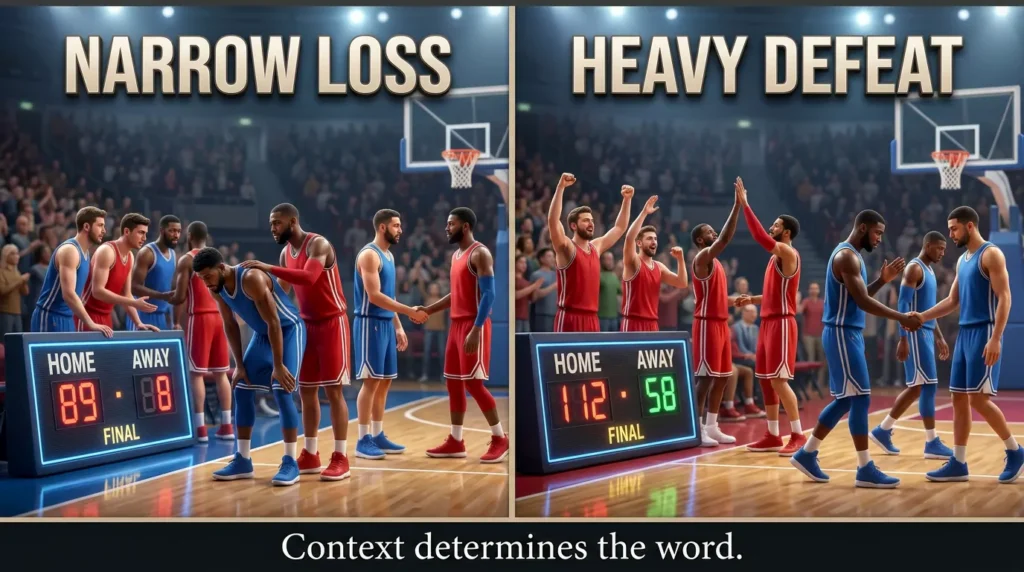
Sports writing often uses vivid terms to describe losing a match or beating an opponent. The right choice depends on the score, the margin, and the tone of the report.
| Word or phrase | Best use | Example |
| Lose | General competition results | We lost the final by one point. |
| Be beaten | A straightforward loss | The defending champions were beaten at home. |
| Be outplayed | Losing because the opponent performed better | The visitors were outplayed throughout the match. |
| Fall to | A concise sports-reporting expression | The club fell to its local rivals. |
| Succumb to | Losing after resistance | The team succumbed to pressure late in the game. |
| Go down to | Informal sports reporting | The players went down to a stronger opponent. |
| Suffer a loss | Neutral reporting | The team suffered a narrow loss. |
| Be eliminated | Leaving a tournament or competition | The club was eliminated in the semifinals. |
| Be knocked out | Being removed from a competition | The defending champions were knocked out early. |
| Be overpowered | Being unable to resist a stronger opponent | The smaller team was overpowered in the second half. |
Use eliminated or knocked out when a competitor exits a tournament. These expressions do not necessarily describe the size of the loss.
Use outplayed when you want to emphasize superior performance. Use humiliated only when the defeat was especially embarrassing.
Words for Failure and Unsuccessful Outcomes
Sometimes defeat refers to a failed goal rather than a direct contest. These alternatives help describe unsuccessful plans, missed opportunities, and disappointing results.
| Synonym | Meaning | Example sentence |
| Unsuccess | Lack of success; less common in everyday English | The project ended without success. |
| Fiasco | A complete and embarrassing failure | The poorly planned event became a fiasco. |
| Flop | Something that fails to attract interest or succeed | The expensive campaign was a commercial flop. |
| Debacle | A disastrous failure | The launch turned into a public debacle. |
| Misstep | A mistake that causes problems | One strategic misstep weakened the entire campaign. |
| Breakdown | A failure of a system or process | A communication breakdown delayed the project. |
| Frustration | An experience that blocks progress or satisfaction | The repeated delays caused widespread frustration. |
| Nonachievement | Failure to achieve a desired result | The report documented the nonachievement of its main goals. |
| Rejection | A refusal to accept something | Her proposal faced rejection from the committee. |
| Disqualification | Removal from a competition for breaking rules | The athlete’s disqualification ended the campaign. |
Not every unsuccessful result is a defeat. A fiasco or debacle usually suggests serious problems. A misstep may be one mistake within a broader effort. A rejection refers specifically to something being refused.
Formal Synonyms for Defeat
Formal vocabulary can make reports, essays, and professional writing more precise. However, some formal alternatives have narrower meanings than defeat.
| Word | Meaning and tone | Example sentence |
| Vanquish | Defeat an opponent decisively; elevated tone | The general vanquished the opposing force. |
| Overpower | Defeat through greater strength or influence | The stronger side overpowered its rival. |
| Overcome | Succeed against an opponent, difficulty, or obstacle | The team overcame a difficult challenge. |
| Subdue | Bring someone or something under control | The authorities subdued the armed resistance. |
| Conquer | Defeat or gain control over an opponent or territory | The army conquered the neighboring territory. |
| Prevail over | Prove stronger or more successful than another | The candidate prevailed over several rivals. |
| Outmaneuver | Gain an advantage through better strategy | The negotiators outmaneuvered their competitors. |
| Outclass | Perform much better than an opponent | The experienced team outclassed its rivals. |
| Best | Defeat someone, often through skill | The challenger bested the reigning champion. |
| Overthrow | Remove a ruler or government from power | The rebels overthrew the ruling regime. |
| Repulse | Drive back an attack or advancing force | The defenders repulsed the attack. |
| Repel | Prevent an attack or advance | The defenders repelled the invading force. |
For academic and professional writing, prevail over, overcome, and outmaneuver can be useful when the situation supports them. Vanquish and conquer are stronger and more dramatic.
Avoid replacing every instance of defeat with a formal word. Precise, familiar language is often easier to understand.
Words for Overcoming an Opponent or Obstacle
Some synonyms describe defeat from the perspective of the person or side that wins. These verbs focus on the successful action rather than the losing result.
- Beat: Defeat someone in a contest. Example: “The challenger beat the defending champion.”
- Defeat: Win against an opponent. Example: “The candidate defeated the incumbent.”
- Conquer: Gain control over an opponent, territory, or difficult challenge. Example: “She conquered her fear of public speaking.”
- Overcome: Successfully deal with a problem or obstacle. Example: “The team overcame several setbacks.”
- Surmount: Successfully deal with a difficulty. Example: “The researchers surmounted major technical barriers.”
- Vanquish: Defeat an opponent decisively. Example: “The hero vanquished the enemy.”
- Outwit: Defeat someone through clever thinking. Example: “The detective outwitted the suspect.”
- Outsmart: Gain an advantage through intelligence. Example: “The young player outsmarted the experienced defender.”
- Prevail: Succeed despite competition or difficulty. Example: “The underdog prevailed against the odds.”
- Overpower: Defeat through superior strength or force. Example: “The larger force overpowered the resistance.”
- Neutralize: Make a threat or opposing force ineffective. Example: “The strategy neutralized the rival’s main advantage.”
- Disarm: Remove someone’s weapons or ability to attack. Example: “The officers disarmed the suspect.”
These alternatives require careful selection. Outwit and outsmart imply cleverness. Overpower emphasizes strength. Neutralize means making a threat ineffective, not necessarily winning an entire contest.
Synonyms for Defeat in Formal and Professional Writing
In business, education, politics, and official reports, a neutral expression is often preferable to dramatic language.
| Original expression | More precise alternative | Example |
| The proposal was defeated. | The proposal was rejected. | The committee rejected the proposal. |
| The campaign suffered defeat. | The campaign was unsuccessful. | The campaign was unsuccessful in reaching its target. |
| The company was defeated by competition. | The company lost market share to competitors. | The company lost market share to newer competitors. |
| The plan was defeated by delays. | The plan was derailed by delays. | Unexpected delays derailed the plan. |
| The candidate faced defeat. | The candidate lost the election. | The candidate lost the election by a narrow margin. |
| The team was defeated. | The team was outperformed. | The team was outperformed by its opponents. |
Choose the alternative that identifies what actually happened. Rejected means someone refused a proposal. Derailed means something disrupted progress. Lost market share describes a business outcome more accurately than a general defeat.
Defeat vs. Failure vs. Setback
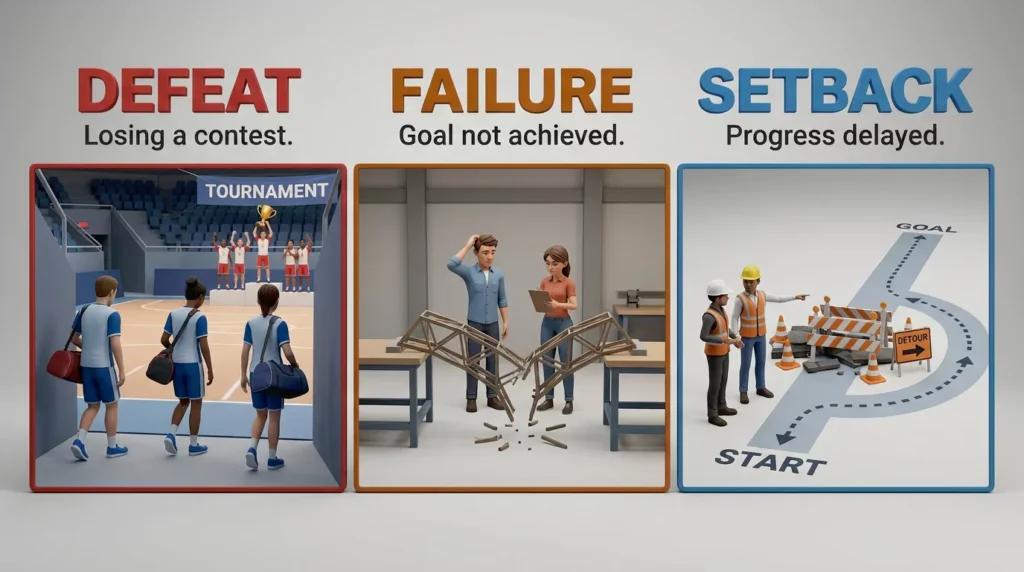
These three words overlap, but their meanings differ.
| Word | Main meaning | Typical context | Example |
| Defeat | Losing to an opponent or failing in a contest | Sports, elections, battles, competition | The team suffered defeat in the final. |
| Failure | Not achieving a goal or expected result | Projects, plans, experiments, personal goals | The experiment was a failure. |
| Setback | A difficulty that delays progress | Work, recovery, plans, personal goals | The delay was a temporary setback. |
| Loss | An unsuccessful result or something no longer possessed | Games, business, personal experiences | The company reported a financial loss. |
| Downfall | A serious decline in status, power, or success | Careers, organizations, governments | The scandal led to his downfall. |
| Debacle | A disastrous and often embarrassing failure | Events, launches, negotiations | The poorly managed launch became a debacle. |
Use defeat for a contest or an opponent. Use failure when an objective is not achieved. Choose setback when progress suffers but recovery remains possible.
A defeat can also be a setback or a failure, depending on the circumstances. The terms describe different aspects of the same event.
Examples of Synonyms for Defeat in Sentences
Here are additional examples showing how different alternatives work in natural writing.
- Loss: The unexpected loss changed the team’s strategy.
- Failure: The plan failed because the budget was insufficient.
- Setback: Losing the contract was a setback for the business.
- Beating: The visitors gave the home team a severe beating.
- Rout: The final score reflected a complete rout.
- Humiliation: The defeat was a humiliation for the defending champions.
- Overcome: She overcame the obstacles that threatened her progress.
- Conquer: The team conquered its nerves and played confidently.
- Vanquish: The protagonist vanquished the villain in the final scene.
- Outwit: The smaller team outwitted its stronger opponents.
- Prevail: The candidate prevailed after a close election.
- Debacle: Poor communication turned the presentation into a debacle.
- Rejection: The rejection encouraged him to improve his proposal.
- Collapse: The defense collapsed during the final minutes.
- Outplay: The visitors outplayed their opponents in midfield.
Notice the grammar. A team can suffer a defeat, experience a loss, or be defeated. It can also defeat, beat, or outplay an opponent.
Common Mistakes When Choosing Synonyms for Defeat
Treating every synonym as identical
Defeat, failure, and setback have overlapping meanings. However, each emphasizes a different aspect of an unsuccessful outcome. Choose the word that matches the event.
Using dramatic words for ordinary losses
Words such as humiliation, rout, and debacle suggest a severe or embarrassing result. They may exaggerate a narrow loss. Use neutral language unless the situation justifies stronger wording.
Confusing the winner’s action with the loser’s result
Defeat can describe either side, depending on its grammatical use. A team defeats its opponent, while the opponent suffers defeat. Overcome usually focuses on the successful side.
Ignoring grammar and sentence structure
Some alternatives work as nouns, while others are verbs or adjectives. You can experience a loss, suffer a defeat, or lose a match. You can overcome an obstacle, but you generally cannot “a loss” an obstacle.
Antonyms of Defeat
Antonyms express the opposite of defeat. The most suitable choice depends on whether defeat refers to a contest, a goal, or a difficult situation.
| Antonym | Meaning | Example sentence |
| Victory | Winning a contest | The victory secured the championship. |
| Triumph | A significant or celebrated success | Her triumph inspired the entire team. |
| Win | A successful result in a contest | The team earned a narrow win. |
| Success | Achieving a desired outcome | The project became a major success. |
| Achievement | Something accomplished successfully | Completing the challenge was a personal achievement. |
| Conquest | The act of conquering an opponent or territory | The conquest expanded the kingdom. |
| Breakthrough | A significant advance after difficulty | The discovery marked a scientific breakthrough. |
| Prevailing | Being successful or dominant in a situation | The prevailing side controlled the match. |
Victory and win are direct opposites of defeat in competition. Success is broader and can describe achieving any desired goal.
Frequently Asked Questions
What is the closest synonym for defeat?
Loss is a close noun synonym when defeat means an unsuccessful result. Beat is a common verb alternative when someone wins against an opponent. The best choice depends on the sentence.
What is another word for defeat in sports?
Common alternatives include loss, beating, rout, drubbing, and trouncing. Use rout or drubbing for a particularly decisive loss. Use loss for a neutral description.
What is a formal word for defeat?
Formal alternatives include vanquish, overcome, subdue, conquer, and prevail over. Their meanings differ, so select one that accurately describes the action or outcome.
Is defeat the same as failure?
No. Defeat often involves losing to an opponent or losing a contest. Failure means not achieving a desired outcome. A person can experience failure without competing against anyone.
What is the difference between defeat and setback?
Defeat usually describes a loss or unsuccessful result. A setback is a problem that delays progress. A setback does not necessarily mean the overall effort has failed.
What is the opposite of defeat?
Common antonyms include victory, win, triumph, and success. Victory and win are especially suitable for contests. Success also applies to goals and projects.
What is a synonym for defeat in formal writing?
Depending on context, use loss, unsuccessful outcome, rejection, or failure. In a contest, defeat or loss may be the clearest option. Avoid dramatic terms unless they are justified.
Can defeat be used as both a noun and a verb?
Yes. As a noun, defeat means an unsuccessful result: “The defeat disappointed the supporters.” As a verb, it means winning against an opponent: “The team defeated its rival.”
Conclusion
The best synonyms for defeat depend on the situation, tone, and intended meaning. Use loss for an unsuccessful result, failure for an unmet goal, and setback for delayed progress.
In sports, beating, rout, and drubbing can describe decisive losses. In formal writing, overcome, prevail over, and outmaneuver may offer greater precision.
Remember that these words have different meanings and grammatical uses. Choosing the right alternative makes your writing clearer, more natural, and more accurate.

Nadeem Akhtar has a keen interest in the way words shape clear communication. Through SimpleSynonyms, he shares easy-to-understand resources on vocabulary, synonyms, meanings, and everyday English to help readers express themselves with greater confidence.