
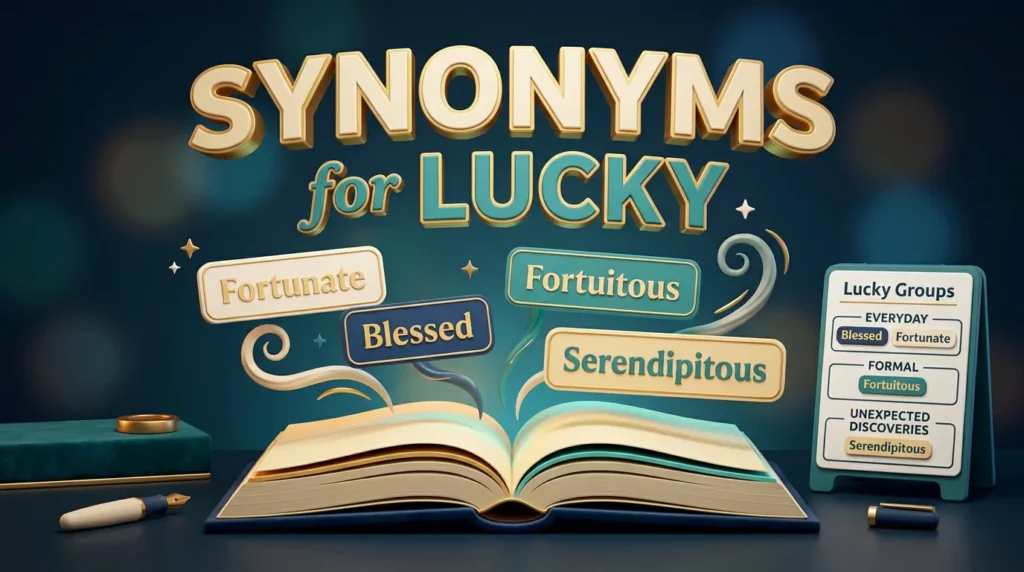

The best synonyms for lucky include fortunate, blessed, favored, charmed, and serendipitous. Each word describes good fortune in a slightly different way. Some emphasize favorable circumstances, while others suggest unexpected discoveries or positive outcomes.
Choosing the right synonym for lucky can make your writing more precise. This guide explores useful alternatives, their meanings, and examples. You will also learn which words suit everyday conversations, formal writing, and descriptions of fortunate events.
What Does Lucky Mean?
The word lucky describes someone or something that benefits from good fortune or favorable circumstances. It often refers to positive events that happen partly through chance rather than deliberate effort.
For example, someone might feel lucky after finding a lost wallet. A student might consider herself lucky after receiving an unexpected scholarship. A business owner might experience a lucky break when a major customer places an order.
The word can describe people, events, opportunities, discoveries, and outcomes. Its best replacement depends on what makes the situation fortunate.
Common Synonyms for Lucky
These alternatives are useful in everyday writing and conversation. However, some emphasize good fortune, while others focus on favorable results or unexpected opportunities.
- Fortunate: Experiencing good circumstances or positive outcomes. Example: We were fortunate to find a hotel near the station.
- Blessed: Enjoying something valuable or deeply appreciated. Example: She feels blessed to have supportive friends.
- Favored: Receiving an advantage or favorable treatment. Example: The favored team won the championship.
- Charmed: Seemingly protected from bad luck. Example: He seemed charmed because his plans always worked out.
- Serendipitous: Involving a pleasant discovery made by chance. Example: Our meeting was serendipitous and led to a lasting friendship.
- Fortuitous: Happening by chance in a beneficial way. Example: A fortuitous delay helped us avoid the storm.
- Auspicious: Suggesting that something will begin or develop favorably. Example: The project began under auspicious circumstances.
- Propitious: Creating favorable conditions for success. Example: The calm weather was propitious for sailing.
- Favorable: Producing or suggesting a positive result. Example: We received a favorable response to our proposal.
- Advantageous: Providing a useful benefit or position. Example: The early arrival gave us an advantageous position.
- Felicitous: Particularly suitable, successful, or well chosen. Example: Her felicitous timing made the announcement especially effective.
- Providential: Seeming to result from helpful timing or divine guidance. Example: Finding that shelter felt providential.
- Promising: Showing signs of future success. Example: The promising opportunity arrived at the right time.
- Opportune: Occurring at a particularly suitable moment. Example: His visit was opportune because we needed advice.
- Well-timed: Happening at exactly the right moment. Example: Her well-timed suggestion saved the meeting.
- Timely: Occurring when needed. Example: The timely warning helped everyone leave safely.
- Welcome: Pleasant or helpful in a particular situation. Example: The unexpected discount was a welcome surprise.
- Beneficial: Producing a useful or positive effect. Example: The unexpected change proved beneficial.
- Positive: Having a favorable or encouraging quality. Example: We received positive news about the application.
- Rewarding: Providing satisfaction or a worthwhile result. Example: It was rewarding to discover such a useful opportunity.
Synonyms for Lucky in Everyday Conversation
Casual conversations often benefit from simple, familiar expressions. These alternatives sound natural when describing unexpected advantages, fortunate moments, or things that work out well.
- In luck: Experiencing good fortune at a particular moment. Example: You are in luck because we have one ticket left.
- On a winning streak: Enjoying repeated successes. Example: Our team is on a winning streak this season.
- Having a lucky break: Receiving an unexpected opportunity or advantage. Example: She had a lucky break when the employer reopened the position.
- Struck lucky: Experiencing an unexpected success or fortunate discovery. Example: We struck lucky and found affordable seats.
- Hit the jackpot: Achieving an exceptionally valuable or fortunate result. Example: He hit the jackpot with that apartment.
- Born under a lucky star: Seeming to enjoy unusually consistent good fortune. Example: She seems born under a lucky star.
- Had a stroke of luck: Experienced a sudden, fortunate event. Example: We had a stroke of luck when the rain stopped.
- Fortune smiled on: Experienced a favorable turn of events. Example: Fortune smiled on them during the final round.
- Caught a break: Received helpful relief or an unexpected advantage. Example: The driver caught a break when traffic cleared.
- Things went their way: Events developed favorably for someone. Example: Things went her way during the interview.
Formal and Professional Alternatives to Lucky

In professional writing, the word lucky can sometimes sound informal. More precise alternatives explain whether circumstances were favorable, an opportunity arrived at the right time, or a result occurred by chance.
- Fortunate: Suitable for describing favorable circumstances. Example: We were fortunate to secure the contract.
- Fortuitous: Useful when an event occurs by chance. Example: A fortuitous introduction connected the two companies.
- Favorable: Appropriate for positive conditions or results. Example: The business received favorable market conditions.
- Propitious: Suitable for describing conditions that support success. Example: The company launched during a propitious period.
- Auspicious: Useful for promising beginnings or signs. Example: The partnership had an auspicious start.
- Advantageous: Best when a situation creates a clear benefit. Example: The revised schedule proved advantageous.
- Opportune: Describes something happening at a useful moment. Example: The announcement came at an opportune time.
- Beneficial: Emphasizes a helpful effect rather than chance. Example: The unexpected partnership was beneficial.
- Promising: Describes potential rather than guaranteed good fortune. Example: The early results looked promising.
- Serendipitous: Suitable for unexpected discoveries or connections. Example: A serendipitous encounter inspired the research.
These words are not interchangeable in every sentence. Choose the one that describes the actual circumstances, rather than simply making the sentence sound formal.
Words for Someone Who Is Lucky
Some words describe people who seem to experience good fortune. Others describe people who enjoy advantages, achieve success, or receive favorable opportunities. The distinction matters when writing about personality or life circumstances.
- Fortunate: A person who benefits from favorable circumstances. Example: He was fortunate to receive a second chance.
- Blessed: Someone who enjoys valued relationships, opportunities, or resources. Example: She feels blessed to have a loving family.
- Favored: Someone who receives an advantage or favorable treatment. Example: The favored candidate received strong support.
- Charmed: Someone who seems unusually free from misfortune. Example: He appeared charmed throughout the journey.
- Prosperous: Someone who enjoys financial success or material well-being. Example: They became prosperous after years of careful planning.
- Successful: Someone who achieves desired goals. Example: She became successful through skill and persistence.
- Thriving: Someone who is developing or doing very well. Example: The thriving business attracted new customers.
- Flourishing: Someone or something growing successfully. Example: Their flourishing garden produced fresh vegetables.
- Winning: Someone who repeatedly succeeds in competitions or contests. Example: The winning player celebrated another victory.
- Well-favored: Someone or something viewed favorably or given an advantage. Example: The well-favored proposal received early support.
Note that successful, prosperous, thriving, and flourishing do not directly mean lucky. They describe positive conditions or results that may occur with or without good fortune.
Words for Lucky Events and Unexpected Discoveries
When describing a fortunate event, select a word that explains how the positive outcome happened. Some alternatives highlight chance, while others emphasize timing or the benefit received.
- Serendipitous: A beneficial discovery made unexpectedly. Example: A serendipitous search revealed the perfect reference book.
- Fortuitous: A favorable event that happens by chance. Example: A fortuitous opening allowed us to enter.
- Providential: An event that seems remarkably helpful or perfectly timed. Example: Their providential arrival brought the supplies we needed.
- Coincidental: Happening at the same time or by coincidence, without necessarily being fortunate. Example: Our coincidental meeting surprised both of us.
- Unexpected: Happening without being anticipated. Example: The unexpected refund covered our travel costs.
- Accidental: Happening unintentionally, sometimes with a useful result. Example: An accidental discovery improved the design.
- Opportune: Occurring at a moment that offers an advantage. Example: The opportune opening helped her secure the position.
- Well-timed: Occurring at exactly the right moment. Example: His well-timed call prevented a misunderstanding.
- Heaven-sent: Extremely helpful or welcome, often expressing strong appreciation. Example: The extra help was heaven-sent.
- A blessing in disguise: Something that initially seems bad but later brings benefits. Example: Missing that flight was a blessing in disguise because the replacement route was faster.
Synonyms for Very Lucky
When a sentence needs stronger emphasis, choose an expression that matches the degree of good fortune. Some phrases suggest ordinary relief, while others describe extraordinary success.
- Extremely fortunate: Experiencing unusually favorable circumstances. Example: We were extremely fortunate to escape unharmed.
- Incredibly lucky: Experiencing remarkable good fortune. Example: She was incredibly lucky to find her passport.
- Exceptionally fortunate: Benefiting from unusually favorable conditions. Example: The company was exceptionally fortunate with its timing.
- Immensely blessed: Enjoying something deeply valued. Example: He felt immensely blessed by his family.
- Remarkably fortunate: Experiencing an outcome that stands out as unusually favorable. Example: They were remarkably fortunate to find help.
- Lucky beyond belief: Experiencing seemingly extraordinary good fortune. Example: We were lucky beyond belief to catch the last train.
- On a roll: Experiencing a series of successes. Example: The young author is on a roll after three successful releases.
- Fortune favored them: Their circumstances or outcomes developed in their favor. Example: Fortune favored them during the final match.
For formal writing, prefer “exceptionally fortunate” or “remarkably fortunate.” For casual conversation, “incredibly lucky” and “on a roll” sound more natural.
Expressions That Mean Good Luck
Some expressions offer good wishes rather than describe a fortunate person. Others describe an event that brings an advantage. Understanding the difference helps prevent awkward word choices.
- Best of luck: A common expression of goodwill. Example: Best of luck with your examination.
- Good fortune: A favorable outcome or set of circumstances. Example: Good fortune helped them find a new home.
- Lady Luck: A figurative expression for luck, especially in games or chance-based situations. Example: Lady Luck was on our side.
- Lucky charm: An object believed to bring good luck. Example: He carries a lucky charm during competitions.
- Stroke of good fortune: A sudden favorable event. Example: The refund was a stroke of good fortune.
- A run of good luck: A period with several fortunate outcomes. Example: We enjoyed a run of good luck during the trip.
- Fortune is on your side: An expression suggesting favorable circumstances. Example: Fortune is on your side today.
- May luck be with you: A wish for success or good fortune. Example: May luck be with you in the final round.
These expressions have different grammatical uses. “Best of luck” offers a wish, while “fortunate” describes circumstances.
Lucky vs. Fortunate vs. Blessed
These three words share a positive meaning, but their emphasis differs. “Lucky” often suggests chance. “Fortunate” sounds more neutral and can suit formal writing. “Blessed” expresses gratitude or a sense of receiving something valuable.
| Word | Main emphasis | Best use | Example |
| Lucky | Good fortune or chance | Casual conversation | I was lucky to find my keys. |
| Fortunate | Favorable circumstances | Formal and everyday writing | We were fortunate to receive help. |
| Blessed | Something deeply valued | Personal or emotional writing | I feel blessed to have good friends. |
| Serendipitous | Unexpected beneficial discovery | Discoveries and encounters | It was a serendipitous meeting. |
| Fortuitous | Favorable chance event | Formal descriptions | A fortuitous delay helped us. |
| Auspicious | A promising beginning or sign | Events and occasions | It was an auspicious start. |
| Propitious | Conditions favorable to success | Formal analysis | The timing was propitious. |
When Should You Use Lucky?
Use lucky when describing good fortune in ordinary conversation. It is clear, familiar, and suitable for many situations.
Example: “I was lucky to get a seat on the crowded train.”
When Should You Use Fortunate?
Use fortunate when you want a slightly more formal or measured tone. It works well in professional writing and serious discussions.
Example: “We were fortunate to receive assistance during the emergency.”
When Should You Use Blessed?
Use blessed when expressing gratitude for something meaningful. It often carries emotional, personal, or spiritual associations.
Example: “She feels blessed to have such supportive colleagues.”
How to Choose the Right Synonym for Lucky

The best alternative depends on your sentence, intended meaning, and tone. Before replacing lucky, identify whether you mean chance, timing, success, gratitude, or a favorable result.
- For everyday conversation: Choose lucky, fortunate, in luck, or caught a break.
- For formal writing: Choose fortunate, favorable, fortuitous, or propitious.
- For unexpected discoveries: Choose serendipitous or fortuitous.
- For promising beginnings: Choose auspicious or promising.
- For expressing gratitude: Choose blessed or fortunate.
- For repeated successes: Choose on a roll or on a winning streak.
- For successful outcomes: Choose successful, rewarding, or beneficial when those meanings fit.
Always check whether the replacement preserves the original meaning. A person can be successful because of hard work without being lucky. Similarly, an event can be unexpected without being fortunate.
Common Mistakes When Using Synonyms for Lucky
Several related words describe positive situations without directly replacing lucky. Understanding their differences makes your writing clearer and more accurate.
- Successful: Describes achievement, not necessarily chance. A successful person may have worked hard for every result.
- Optimistic: Describes a positive outlook about the future. It does not mean someone has good fortune.
- Coincidental: Describes events that happen together by chance. The events may be positive, negative, or neutral.
- Promising: Suggests potential for future success. It does not guarantee a favorable outcome.
- Blessed: Often communicates gratitude or spiritual meaning. It may not fit neutral business writing.
- Auspicious: Suggests a promising sign or beginning. It is less suitable for describing every fortunate event.
Use the most precise word rather than selecting a synonym solely for variety.
Antonyms of Lucky
Antonyms help explain the opposite of good fortune. Choose one according to whether you mean an unfortunate event, a person experiencing bad luck, or a situation with poor prospects.
| Antonym | Meaning | Example |
| Unlucky | Experiencing bad luck | I was unlucky to miss the train. |
| Unfortunate | Involving an undesirable circumstance | It was an unfortunate misunderstanding. |
| Ill-fated | Destined or seemingly destined for failure | The ill-fated expedition ended early. |
| Hapless | Unlucky, often in a helpless situation | The hapless traveler lost his luggage. |
| Inauspicious | Suggesting a poor beginning or outcome | The event began under inauspicious conditions. |
| Adverse | Unfavorable or harmful | Adverse weather delayed the journey. |
| Unfavorable | Not supporting a desired result | The team faced unfavorable conditions. |
| Jinxed | Seemingly affected by repeated bad luck | He joked that his old car was jinxed. |
Frequently Asked Questions
What is the best synonym for lucky?
“Fortunate” is one of the closest general synonyms for lucky. It describes someone who benefits from favorable circumstances. “Fortuitous” is more specific to chance events, while “blessed” often expresses gratitude.
What is another word for lucky in formal writing?
Use “fortunate,” “favorable,” “fortuitous,” or “propitious,” depending on context. “Fortunate” suits many formal sentences. “Propitious” describes conditions that support success, while “fortuitous” emphasizes chance.
What is a stronger word for lucky?
“Exceptionally fortunate,” “incredibly lucky,” and “remarkably fortunate” express stronger degrees of good fortune. “Lucky beyond belief” is more informal and emphasizes extraordinary circumstances.
What is a synonym for a lucky person?
“Fortunate,” “blessed,” “favored,” and “charmed” can describe a lucky person. “Charmed” often suggests someone who seems unusually protected from misfortune.
What is a synonym for a lucky coincidence?
“Serendipitous” is often the best choice when a coincidence produces a pleasant discovery. “Fortuitous” also works when a chance event brings an advantage.
Are lucky and fortunate interchangeable?
They often have similar meanings, but their tone differs slightly. “Lucky” is common in everyday speech, while “fortunate” can sound more formal. Neither word always implies the same degree of chance.
Does successful mean lucky?
No. Successful describes achieving a goal or producing a desired result. Lucky describes good fortune. A person may be successful through effort, skill, favorable timing, or a combination of factors.
What is the opposite of lucky?
Common antonyms include unlucky, unfortunate, ill-fated, hapless, and inauspicious. Use “unlucky” for everyday situations and “inauspicious” for unfavorable beginnings or signs.
What word means lucky and successful?
“Fortunate” may fit when good circumstances contribute to success. “Prosperous” describes financial or general well-being, while “thriving” suggests continued growth. None of these words always means lucky.
Conclusion
The best synonyms for lucky depend on what you want to express. “Fortunate” works in many everyday and professional situations. “Fortuitous” emphasizes a favorable event that happens by chance. “Serendipitous” suits unexpected discoveries, while “auspicious” describes promising beginnings. “Blessed” often conveys gratitude for something valuable.
Choose words according to their meanings, tone, and context. Avoid treating every positive word as a direct synonym. Success, optimism, and prosperity can relate to good fortune, but each describes something different. By selecting precise alternatives, you can make your writing clearer, more natural, and more engaging.

Nadeem Akhtar has a keen interest in the way words shape clear communication. Through SimpleSynonyms, he shares easy-to-understand resources on vocabulary, synonyms, meanings, and everyday English to help readers express themselves with greater confidence.