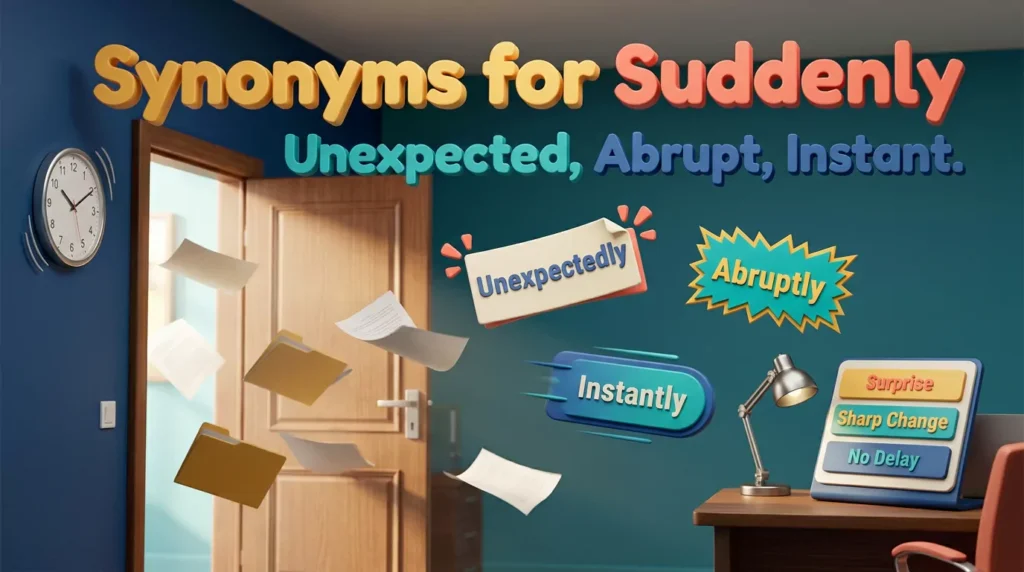

Looking for synonyms for suddenly? The best alternatives include unexpectedly, abruptly, instantly, all at once, without warning, and out of the blue. Each expresses a slightly different idea. Some emphasize surprise, while others describe speed, interruption, or an immediate change.
Choosing the right word can make your writing more precise and natural. Whether you’re writing a school assignment, professional email, article, or short story, understanding these differences helps you communicate clearly.
This guide explores useful words similar to suddenly, explains their meanings, and provides examples for everyday conversation, formal writing, and storytelling.
What Does Suddenly Mean?
Suddenly is an adverb that describes something happening unexpectedly or with little warning. It can also emphasize that an action or change happens quickly.
For example:
- Suddenly, the lights went out.
- She suddenly remembered the appointment.
- The weather suddenly changed.
- He suddenly stopped speaking.
In each sentence, suddenly draws attention to an event or change that occurs without much anticipation.
However, the word does not always mean exactly the same thing in every context. Sometimes it emphasizes surprise. In other situations, it highlights an abrupt action or rapid change.
Understanding the intended meaning is the first step toward choosing an effective alternative.
Best Synonyms for Suddenly
The following words and expressions are useful alternatives, but they are not interchangeable in every sentence.
1. Words That Emphasize Unexpectedness
Use these alternatives when an event surprises someone or happens without being anticipated.
Unexpectedly: In a way that was not anticipated.
Example: The meeting unexpectedly ended early.
Unanticipatedly: In a way that was not expected beforehand. This word is relatively formal and less common in everyday conversation.
Example: The project unexpectedly, or unanticipatedly, encountered a major obstacle.
For smoother writing, use “unexpectedly encountered” rather than forcing the less common alternative.
Surprisingly: In a way that causes surprise.
Example: The quiet student surprisingly won the competition.
Unforeseenly: In an unforeseen manner. This is uncommon and often sounds awkward; “unexpectedly” or “in an unforeseen way” is usually clearer.
Example: The schedule changed unexpectedly.
Inadvertently: Unintentionally or without intending to do something. This is not a general synonym for suddenly, but it can replace it when the intended meaning is accidental action.
Example: She inadvertently deleted the original document.
Unbeknownst to everyone: Without the knowledge of the people concerned. This expression describes a lack of awareness rather than sudden timing.
Example: Unbeknownst to the team, the deadline had already changed.
Out of the blue: In a completely unexpected way.
Example: An old friend called me out of the blue.
Without warning: With no advance notice.
Example: The storm arrived without warning.
All of a sudden: An expression meaning suddenly or unexpectedly.
Example: All of a sudden, the room became silent.
Unexpectedly enough: In a way that is surprising. This phrase can sound conversational or emphatic.
Example: Unexpectedly enough, both teams agreed on the proposal.
To everyone’s surprise: In a way that surprises everyone involved.
Example: To everyone’s surprise, the smallest team finished first.
2. Words That Emphasize Abruptness
These alternatives are useful when an action, sound, movement, or situation changes sharply.
Abruptly: In a sudden, unexpected, or noticeably unceremonious manner.
Example: The speaker abruptly ended the discussion.
Instantaneously: At once, with no perceptible delay.
Example: The display changed instantaneously when the update finished.
All at once: Suddenly, or with several things happening at the same time.
Example: All at once, several people began asking questions.
Without hesitation: Immediately and without pausing to consider. This describes a person’s response, not every kind of sudden event.
Example: She accepted the offer without hesitation.
Without delay: Immediately, without postponement.
Example: The team began the repairs without delay.
At a stroke: Through one decisive action or in one decisive step. This is more suitable for certain formal or literary contexts.
Example: The new policy changed the process at a stroke.
At once: Immediately, or sometimes simultaneously, depending on context.
Example: The manager requested an update at once.
In a flash: Very quickly.
Example: The solution came to him in a flash.
In an instant: Within an extremely short time.
Example: In an instant, the entire situation changed.
In the blink of an eye: Extremely quickly.
Example: The opportunity disappeared in the blink of an eye.
In one swift movement: Through a single quick action.
Example: She opened the envelope in one swift movement.
With a sudden jolt: With a sharp, unexpected movement or sensation.
Example: The vehicle stopped with a sudden jolt.
3. Words That Emphasize Speed or Immediate Timing
These words are especially useful when the main idea is how quickly an action happens.
Instantly: Immediately, with no meaningful delay.
Example: The screen instantly displayed the results.
Immediately: Without delay.
Example: Please contact the support team immediately.
Promptly: Without unnecessary delay. It can suggest a timely or responsible response rather than a surprising event.
Example: The technician promptly addressed the problem.
Swiftly: Quickly and efficiently.
Example: The emergency team swiftly secured the area.
Rapidly: At a fast rate.
Example: Temperatures rapidly increased during the afternoon.
Quickly: At a fast speed or within a short time.
Example: She quickly closed the window.
Speedily: At a fast pace. This word is less common in everyday writing than “quickly.”
Example: The application was processed speedily.
In no time: Very quickly or after only a short period.
Example: They completed the setup in no time.
Straightaway: Immediately, particularly in British English.
Example: The technician straightaway identified the issue.
Forthwith: Immediately, often in formal, legal, or official language.
Example: The notice required payment forthwith.
Right away: Immediately; a natural choice for conversational English.
Example: I’ll send you the updated file right away.
In a split second: In an extremely short amount of time.
Example: He made the decision in a split second.
In no time at all: Very quickly.
Example: The children finished the puzzle in no time at all.
4. Expressions for Unexpected Events and Sudden Changes
These phrases help describe events, changes, and developments more naturally.
From nowhere: Appearing or occurring with no obvious source or prior indication.
Example: A strong gust of wind seemed to come from nowhere.
Without prior notice: Without being informed in advance.
Example: The inspection took place without prior notice.
With little notice: With only a short period of advance information.
Example: The team had to reorganize with little notice.
All of a sudden: A natural expression for an unexpected change.
Example: All of a sudden, the power returned.
Before anyone knew it: So quickly that people barely noticed the time passing.
Example: Before anyone knew it, the afternoon had ended.
At an unexpected moment: At a time that was not anticipated.
Example: She received the news at an unexpected moment.
In one moment: Within a single moment, often highlighting a dramatic change. Depending on the sentence, “in an instant” may sound more natural.
Example: In one moment, their plans seemed completely different.
In a matter of seconds: Within only a few seconds.
Example: The traffic cleared in a matter of seconds.
Without any apparent cause: Without an obvious reason. This describes the apparent cause of an event rather than its timing.
Example: The alarm sounded without any apparent cause.
All at once: Useful when several events begin together or one situation changes rapidly.
Example: The questions came all at once.
Formal Synonyms for Suddenly
Formal writing benefits from precise vocabulary. The best alternative depends on whether you are describing timing, an unexpected development, or an abrupt change.
| Alternative | Meaning or emphasis | Example |
| Unexpectedly | An event was not anticipated | The results unexpectedly differed from the forecast. |
| Abruptly | A sharp change or interruption | The negotiations abruptly ended. |
| Immediately | No delay | The department immediately issued a response. |
| Instantaneously | No perceptible delay | The system instantaneously registered the change. |
| Rapidly | A high rate of change | Demand rapidly increased during the quarter. |
| Promptly | Timely action | The organization promptly addressed the complaint. |
| Forthwith | Immediate action in formal language | The document instructed the recipient to respond forthwith. |
| Without prior notice | No advance notification | The inspection occurred without prior notice. |
| Without delay | No postponement | The corrective measures were implemented without delay. |
| Precipitously | A steep or sudden change, often in amount or level | Sales precipitously declined during the period. |
How to Choose a Formal Alternative
Consider the meaning of your sentence before replacing suddenly.
- Use unexpectedly when the result was not anticipated.
- Use abruptly when an action or process ended sharply.
- Use immediately when timing or urgency matters.
- Use rapidly when describing a fast rate of change.
- Use promptly when emphasizing a timely response.
- Use precipitously when describing a steep decline or similarly sharp change.
For example:
Original: The company’s revenue suddenly decreased.
More precise: The company’s revenue decreased precipitously.
The revised sentence emphasizes the steepness of the decline. It does not merely state that the decline was unexpected.
Synonyms for Suddenly in Storytelling

In creative writing, suddenly can create urgency, but repeated use may weaken its effect. Choose words that communicate the specific action, emotion, or change.
Alternatives for Suspenseful Moments
Without warning
Example: Without warning, a loud crash echoed through the hallway.
Out of nowhere
Example: Out of nowhere, a figure appeared at the end of the street.
In an instant
Example: In an instant, the room fell silent.
All at once
Example: All at once, the distant voices stopped.
In the blink of an eye
Example: In the blink of an eye, the door slammed shut.
Alternatives for Fast Actions
Swiftly
Example: The guard swiftly moved toward the entrance.
Instantly
Example: She instantly recognized the familiar voice.
In a flash
Example: In a flash, he understood what the warning meant.
Without hesitation
Example: She stepped forward without hesitation.
Alternatives for Dramatic Changes
Abruptly
Example: The music abruptly stopped.
Unexpectedly
Example: The stranger unexpectedly revealed the truth.
In a split second
Example: In a split second, he decided to change direction.
With a sudden jolt
Example: The elevator stopped with a sudden jolt.
A Better Way to Edit Suddenly in Stories
Instead of replacing suddenly with another adverb every time, consider describing the event itself.
Original: Suddenly, the door opened.
Revised: The door swung open, startling everyone in the room.
Original: Suddenly, she became angry.
Revised: Her expression hardened, and her voice grew sharp.
Original: Suddenly, the lights went out.
Revised: The lights flickered once before the room plunged into darkness.
These revisions communicate action and atmosphere directly. They also help readers experience the event rather than simply being told it happened suddenly.
How to Choose the Right Synonym for Suddenly
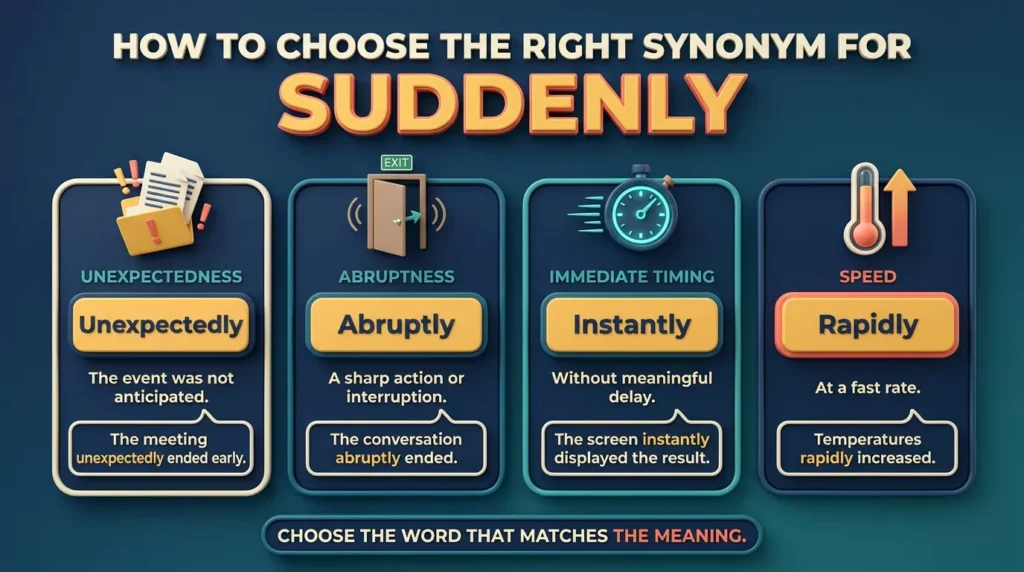
Before choosing an alternative, ask what you want the sentence to emphasize.
| If you mean… | Choose… | Example |
| Something was not expected | Unexpectedly | The visitor unexpectedly arrived early. |
| Something ended sharply | Abruptly | The conversation abruptly ended. |
| Something happened without delay | Immediately | The team immediately responded. |
| A process changed at a fast rate | Rapidly | The river level rapidly rose. |
| An action was quick and efficient | Swiftly | The staff swiftly evacuated the building. |
| Something happened without advance notice | Without warning | The announcement came without warning. |
| Something was surprising | Out of the blue | The invitation arrived out of the blue. |
| A change happened almost instantly | In an instant | In an instant, the mood changed. |
| A response involved no hesitation | Without hesitation | He agreed without hesitation. |
| Several things happened together | All at once | All at once, the alarms began ringing. |
Suddenly vs. Unexpectedly
Both words can describe events that happen without anticipation.
However, suddenly emphasizes the manner or timing of an event, while unexpectedly emphasizes that it was not anticipated.
- Suddenly: The lights suddenly went out.
- Unexpectedly: The lights unexpectedly went out during the presentation.
The first focuses on the abrupt event. The second highlights the surprise.
Suddenly vs. Abruptly
Suddenly is a broad term for an unexpected or quick event. Abruptly often emphasizes a sharp interruption or change.
- Suddenly: She suddenly remembered his name.
- Abruptly: She abruptly ended the conversation.
“Remembered” describes a change in awareness. “Ended” describes a sharp termination, making abruptly especially suitable.
Suddenly vs. Instantly
Suddenly emphasizes an abrupt or unexpected occurrence. Instantly emphasizes that something happens immediately, with no meaningful delay.
- Suddenly: The sky suddenly darkened.
- Instantly: The application instantly displayed the result.
The sky’s darkening may be unexpected. The application’s response is described in terms of speed.
Suddenly vs. Immediately
Immediately is mainly about timing. It does not necessarily imply surprise.
- Suddenly: He suddenly stood up.
- Immediately: He stood up immediately after hearing his name.
The first emphasizes the abrupt movement. The second identifies when he stood up.
Suddenly vs. All at Once
All at once can mean suddenly or simultaneously. Its meaning depends on the sentence.
- Suddenly: All at once, the room went dark.
- Simultaneously: All at once, three phones began ringing.
When several events occur together, all at once is particularly useful.
Example Sentences Using Alternatives to Suddenly
Here are additional examples showing how different alternatives work in everyday, professional, and creative writing.
| Alternative | Example sentence |
| Unexpectedly | Our guest unexpectedly arrived an hour early. |
| Abruptly | The instructor abruptly stopped the demonstration. |
| Instantly | The new page instantly appeared on the screen. |
| Immediately | The nurse immediately contacted the doctor. |
| Swiftly | The cyclist swiftly avoided the obstacle. |
| Rapidly | The situation rapidly became more complicated. |
| Promptly | The supplier promptly replaced the damaged item. |
| Surprisingly | Surprisingly, the old computer still worked. |
| Without warning | The fire alarm sounded without warning. |
| Out of the blue | I received an invitation out of the blue. |
| All at once | All at once, the audience began applauding. |
| In an instant | In an instant, the clouds covered the sun. |
| In a flash | In a flash, she understood the instructions. |
| In the blink of an eye | The ball disappeared in the blink of an eye. |
| Without hesitation | He answered without hesitation. |
| Without delay | The crew began the rescue without delay. |
| Forthwith | The official requested that the records be submitted forthwith. |
| Straightaway | She straightaway recognized the mistake. |
| In a split second | He changed direction in a split second. |
| In no time | They assembled the furniture in no time. |
Common Mistakes to Avoid When Replacing Suddenly
1. Treating Every Alternative as Identical
Words can share a general meaning without having identical uses.
For example, inadvertently means unintentionally. It does not simply mean suddenly.
Incorrect: The building inadvertently collapsed.
Better, if the collapse was unexpected: The building unexpectedly collapsed.
2. Using Instantly When You Mean Unexpectedly
Instantly emphasizes timing, not surprise.
Less precise: The manager instantly resigned.
Clearer, if the resignation was surprising: The manager unexpectedly resigned.
3. Using Abruptly for Every Quick Action
Abruptly often suggests a sharp, interrupted, or sudden manner.
Less natural: She abruptly completed the worksheet.
More natural: She quickly completed the worksheet.
Use abruptly when the manner of an action or transition is noticeably sharp.
4. Overusing Adverbs in Creative Writing
A story can become repetitive if every major event begins with suddenly.
Instead, vary your sentence structure, use stronger verbs, and describe visible changes or reactions.
For example:
Original: Suddenly, he heard a noise. Suddenly, the door opened. Suddenly, someone called his name.
Revised: A noise came from the hallway. The door swung open, and someone called his name.
The revised version creates a more connected sequence without repeating the same adverb.
5. Choosing an Unnecessarily Complicated Word
Longer words do not automatically make writing more professional.
For example, immediately is usually clearer than forthwith in everyday business communication. Similarly, unexpectedly is often more natural than unanticipatedly.
Prefer the clearest word that expresses your intended meaning.
Antonyms of Suddenly
Antonyms help explain the difference between abrupt events and gradual changes.
| Antonym or contrasting expression | Meaning | Example |
| Gradually | Developing over time | The temperature gradually increased. |
| Slowly | At a low speed or over a longer period | The door slowly opened. |
| Progressively | Developing in stages | The workload progressively increased. |
| Steadily | Continuing at a consistent rate | The company’s revenue steadily grew. |
| Little by little | In small stages | Little by little, the room became brighter. |
| Eventually | At some point after time has passed | Eventually, the problem disappeared. |
| Predictably | In a way that can be anticipated | Predictably, the familiar issue returned. |
| In due course | At the appropriate or expected time | The final report arrived in due course. |
These words do not all function as exact grammatical opposites. They contrast with different aspects of suddenness, such as speed, gradual development, and predictability.
Frequently Asked Questions
What is the best synonym for suddenly?
Unexpectedly is one of the closest alternatives when an event occurs without being anticipated. Abruptly is better for sharp changes or interruptions, while instantly emphasizes immediate timing.
What is another word for suddenly in writing?
Useful alternatives include unexpectedly, abruptly, instantly, rapidly, and all at once. Choose the word that matches the meaning of the sentence.
What is a formal synonym for suddenly?
Unexpectedly, abruptly, immediately, instantaneously, and precipitously can work in formal writing. Their suitability depends on the context.
What is a stronger word for suddenly?
Abruptly can create a stronger sense of a sharp interruption. In a suitable context, precipitously emphasizes a steep or sudden change. For dramatic storytelling, “without warning” can emphasize surprise.
Is suddenly the same as unexpectedly?
Not exactly. Suddenly emphasizes an event’s abruptness or timing, while unexpectedly emphasizes that it was not anticipated. The meanings overlap in many sentences.
What is the difference between suddenly and abruptly?
Suddenly is a broad term for quick or unexpected events. Abruptly more strongly suggests a sharp action, interruption, or ending.
Can I use instantly instead of suddenly?
Sometimes. Instantly is appropriate when an action or result occurs with no meaningful delay. It is less suitable when the main idea is that an event was surprising rather than immediate.
How can I avoid using suddenly too often?
Replace it with a more precise word when appropriate, or describe the event directly. Strong verbs, physical details, and varied sentence structures can make writing more engaging.
What is the opposite of suddenly?
Gradually and slowly are useful contrasts when describing changes that develop over time. Predictably contrasts with the element of surprise, rather than with speed.
Which synonym for suddenly is best for storytelling?
Without warning, out of nowhere, in an instant, and abruptly can work well. The best choice depends on whether the scene emphasizes surprise, speed, or a sharp change.
Conclusion
The best synonyms for suddenly depend on the meaning you want to communicate. Use unexpectedly for surprise, abruptly for sharp changes, instantly for immediate results, and rapidly for fast-moving developments.
Expressions such as without warning, out of the blue, and in the blink of an eye can also add variety to your writing.
Rather than replacing suddenly with the first alternative you find, consider the context, tone, and intended meaning. A precise word makes your writing clearer, more natural, and more effective.

Nadeem Akhtar has a keen interest in the way words shape clear communication. Through SimpleSynonyms, he shares easy-to-understand resources on vocabulary, synonyms, meanings, and everyday English to help readers express themselves with greater confidence.