

The best synonyms for business depend on what you want to describe. Words such as company, firm, enterprise, commerce, and trade have different meanings. Some describe an organisation, while others refer to commercial activity or professional work.
Choosing the right alternative makes your writing clearer and more precise. This guide explains useful business synonyms, their meanings, and natural examples. You will also learn which words suit formal writing, everyday conversations, and professional documents.
What Does Business Mean?
The word business has several meanings in English. It can describe a company, commercial activity, professional work, or a matter requiring attention.
For example, a person might own a business, conduct business, or discuss personal business. Each expression uses the word differently. Therefore, the best synonym depends on the sentence and intended meaning.
Understanding these distinctions helps you avoid awkward wording. It also makes your emails, reports, essays, and conversations more effective.
Best Synonyms for Business
The following words are useful alternatives in different contexts. Each has a specific meaning, so choose according to your sentence.
| Synonym | Meaning | Example sentence |
| Company | An organisation that provides goods or services | Her company develops accounting software. |
| Firm | A commercial or professional organisation | The law firm hired two new associates. |
| Enterprise | An organisation or commercial undertaking | They built a successful enterprise together. |
| Corporation | A company established as a legal entity | The corporation opened another office. |
| Venture | A business project or undertaking | Their new venture focuses on renewable energy. |
| Commerce | The activity of buying and selling goods or services | Digital commerce has changed retail shopping. |
| Trade | Buying, selling, or exchanging goods and services | International trade supports many local industries. |
| Industry | A sector of economic activity | The tourism industry creates many jobs. |
| Company operations | The activities involved in running a company | Better software improved company operations. |
| Commercial activity | Activities involving trade or profit | The site supports commercial activity in the region. |
| Occupation | A person’s job or profession | Teaching is her chosen occupation. |
| Work | Tasks or activities performed for a purpose | He manages the family’s business work. |
| Profession | Work requiring specialised knowledge or training | Accounting is a demanding profession. |
| Undertaking | A task, project, or serious commitment | The expansion was a costly undertaking. |
| Concern | A matter requiring attention or consideration | The agreement became a private concern. |
Not every word above replaces business in every sentence. A company is an organisation, while commerce describes buying and selling. Select the alternative that preserves your intended meaning.
Synonyms for a Company or Organisation
Use these words when business means an organisation that sells products or provides services.
Company
A company is an organisation that conducts commercial activities. It is one of the most common alternatives to business.
Example: She started a company that produces eco-friendly packaging.
Use company in everyday conversation, professional writing, and general business communication. It is usually the safest choice when referring to an organisation.
Firm
A firm is a business organisation, often associated with professional services. Law firms, accounting firms, and consulting firms are common examples.
Example: The consulting firm advised several international clients.
Firm works well in professional and formal contexts. However, it may sound less natural for some retail shops or informal businesses.
Enterprise
An enterprise can describe a business organisation or a commercial undertaking. It often suggests initiative, ambition, or organised activity.
Example: Their family enterprise has operated for three generations.
Enterprise is useful in formal writing, entrepreneurship discussions, and economic contexts. It can also describe a major project rather than an established company.
Corporation
A corporation is a specific kind of legally recognised organisation. Its exact legal meaning depends on the relevant jurisdiction.
Example: The corporation published its annual financial report.
Use corporation when the legal structure matters or when it accurately describes the organisation. Do not use it as a universal replacement for every small business.
Organisation
An organisation is a structured group working towards particular goals. It may operate commercially, publicly, or for charitable purposes.
Example: The organisation employs more than one hundred people.
Organisation is broader than company. Use it when the commercial nature of the group is unimportant or already clear.
Establishment
An establishment can refer to a business, institution, or place of operation. Its meaning depends on the surrounding sentence.
Example: The family owns a popular dining establishment.
This word can suit restaurants, shops, and other operating premises. It may sound formal or slightly impersonal in everyday writing.
Synonyms for Commercial Activity

Use these alternatives when business describes buying, selling, trade, or economic activity.
Commerce
Commerce refers to activities involving the exchange of goods and services. It includes many transactions between individuals and organisations.
Example: Online commerce has expanded access to international markets.
Commerce suits discussions about markets, economic systems, and trade. It is not normally a direct replacement for company.
Trade
Trade involves buying, selling, or exchanging goods and services. The word can also describe a skilled occupation in other contexts.
Example: The country depends heavily on agricultural trade.
Use trade when discussing transactions, imports, exports, or exchanges. Check the context because trade can also refer to skilled work.
Commercial activity
Commercial activity describes actions connected with commerce or business purposes. It is a clear alternative when you need a precise, formal phrase.
Example: The new rules affect commercial activity across the region.
This expression works well in reports, policies, and formal explanations. It may sound unnecessarily technical in casual conversations.
Economic activity
Economic activity includes producing, distributing, and consuming goods or services. It is broader than activity intended solely to generate profit.
Example: Tourism remains an important source of economic activity.
Use this term when discussing economies, employment, production, or regional development. Avoid treating it as identical to every commercial activity.
Market activity
Market activity refers to activity within a market. Depending on context, it may concern buying, selling, competition, or financial transactions.
Example: Increased market activity attracted several new suppliers.
This term suits market reports and economic discussions. It is not a general substitute for a company or an entire business.
Transactions
Transactions are exchanges or dealings between parties. They may involve money, goods, services, or other forms of value.
Example: The platform processes thousands of transactions each day.
Use transactions when discussing individual exchanges or financial dealings. The word describes specific activities rather than a complete business operation.
Synonyms for Work and Professional Activities
Sometimes business means work, duties, or professional responsibilities. These alternatives are especially useful in everyday expressions.
Work
Work describes tasks, effort, or activities performed for a purpose. It can refer to employment or a particular assignment.
Example: I have some important work to finish this afternoon.
Work is suitable for many informal and professional situations. However, it does not always mean commercial activity.
Profession
A profession is an occupation that often requires specialised knowledge or training. Common examples include medicine, law, and accounting.
Example: She built a successful career in the legal profession.
Use profession when discussing someone’s occupation or professional field. It does not usually replace business when describing a company.
Occupation
An occupation is the work someone does regularly. It can describe paid employment, a trade, or another recognised form of work.
Example: His occupation involves managing customer accounts.
Occupation is useful for forms, biographies, and general descriptions. It usually refers to a person’s work rather than commercial activity.
Operations
Operations are the activities involved in running an organisation or system. In business contexts, they often include production, staffing, and daily processes.
Example: The company improved its operations by updating its software.
Operations is particularly useful in reports and management discussions. It describes how an organisation functions rather than the organisation itself.
Duties
Duties are tasks or responsibilities assigned to a person. They can be professional, personal, or legal.
Example: Her duties include preparing reports and managing invoices.
Use duties when describing responsibilities. It is unsuitable when you mean a company, market, or commercial sector.
Affairs
Affairs can refer to matters, activities, or responsibilities. In business writing, the word appears in expressions such as business affairs.
Example: She manages the company’s financial affairs.
Use affairs when referring to a collection of matters or responsibilities. The phrase business affairs may be more accurate than replacing business with affairs alone.
Synonyms for a Business Project or Venture
When business describes a project or undertaking, choose a word that reflects its purpose and scale.
Venture
A venture is an undertaking that may involve uncertainty or risk. It often describes a new business project.
Example: Their latest venture aims to make transport more affordable.
Venture is suitable for entrepreneurship and new commercial projects. It can emphasise the challenge or opportunity involved.
Undertaking
An undertaking is a task, project, or commitment. It may be commercial, professional, or personal.
Example: Opening a second factory was a major undertaking.
Use undertaking when describing the scale or effort involved in a project. It does not necessarily imply that the activity is commercial.
Project
A project is a planned piece of work with a particular objective. Businesses often use projects to organise improvements, launches, or expansion.
Example: The company completed its website redesign project.
Project is appropriate when the focus is on a defined task. It is not a direct substitute for an entire company.
Operation
An operation can describe an organised activity or a functioning business unit. Its meaning depends on the context.
Example: They launched a delivery operation in three cities.
Operation works well when discussing organised activities or services. Use company or enterprise when referring to the organisation as a whole.
Startup
A startup is a newly established business, often developing a product or service. The term commonly appears in technology and entrepreneurship.
Example: The startup attracted investors during its first year.
Use startup when the organisation’s early stage matters. Established businesses are not necessarily startups.
Synonyms for a Matter or Concern
Business can also mean a matter, responsibility, or issue. In these situations, commercial terms may not fit.
Matter
A matter is a subject, issue, or situation requiring attention. It is a useful alternative in formal and everyday communication.
Example: We need to discuss an important personal matter.
Use matter when referring to a topic or issue. It works in expressions involving personal or official business.
Concern
A concern is an issue, interest, or matter requiring attention. It can also describe worry about something.
Example: Staff safety is a major concern for management.
Concern suits discussions about priorities and responsibilities. It does not usually mean a company or commercial activity.
Affair
An affair can mean a matter or situation involving particular people or interests. It often appears in formal expressions.
Example: The contract remains a private affair between the parties.
Use affair when the context involves a matter or relationship. Check the surrounding words because affair has several meanings.
Responsibility
A responsibility is a duty or obligation. It may involve managing work, making decisions, or completing assigned tasks.
Example: Handling customer complaints is part of her responsibility.
Use responsibility when emphasising accountability. It is not interchangeable with business in general commercial contexts.
Formal Synonyms for Business
Formal alternatives are useful in reports, proposals, contracts, and professional emails. The best choice depends on what you want to communicate.
| Formal alternative | Best use | Example |
| Enterprise | An organisation or commercial undertaking | The enterprise expanded into new markets. |
| Commercial activity | Trade-related actions | The policy regulates commercial activity. |
| Commercial operations | Activities involved in running a business | Commercial operations resumed on Monday. |
| Corporate affairs | Organisational or corporate matters | She oversees corporate affairs. |
| Business operations | Day-to-day organisational activities | Business operations require careful planning. |
| Trade | Exchange of goods and services | Trade between the regions increased. |
| Undertaking | A major project or commitment | The undertaking required additional funding. |
| Commercial interests | Financial or business-related interests | The agreement protects commercial interests. |
| Economic activity | Production, distribution, or consumption | Economic activity declined during the quarter. |
| Organisation | A structured group or institution | The organisation serves customers nationwide. |
Some phrases are more precise than single-word synonyms. For example, commercial operations is often clearer than enterprise when describing daily activities.
Business Synonyms for Different Situations
The following examples show how word choice changes with context.
In Professional Emails
Choose clear terms that explain the subject without sounding unnecessarily formal.
- Business meeting: company meeting, client meeting, or commercial meeting.
- Business proposal: commercial proposal or project proposal.
- Business partner: commercial partner or business associate.
- Business agreement: commercial agreement or contract.
- Business operations: company operations or operational activities.
The best alternative depends on the exact relationship or activity. A client meeting is not always a commercial meeting, and a contract may be more precise than an agreement.
In Resumes and Cover Letters
Resume language should describe actual responsibilities and achievements. Avoid replacing business with impressive-sounding words that change the meaning.
- Business development: sales development or market development, when accurate.
- Business management: company management or operational management.
- Business experience: commercial experience or professional experience.
- Business skills: commercial skills or management skills, depending on the skills involved.
- Business operations: operational management or business administration, when appropriate.
Use the phrase that matches your experience. For example, sales development is narrower than business development in many organisations.
In Academic Writing
Academic writing often requires precise terms for organisations, markets, and economic activity.
- Business sector: commercial sector or private sector, depending on meaning.
- Business activity: commercial activity or economic activity.
- Business growth: company growth or enterprise growth.
- Business environment: commercial environment or market environment.
- Business ownership: company ownership or enterprise ownership.
These expressions are related but not identical. The private sector, for example, does not include every organisation involved in economic activity.
In Everyday Conversation
Simple alternatives usually sound more natural in casual speech.
- I run a business: I run a company.
- She is in business: She works in business.
- We discussed business: We discussed work.
- He started a business: He started a company.
- Mind your own business: Do not interfere in my affairs.
The final example shows why context matters. “Mind your own company” would not preserve the original meaning.
Business vs Company vs Firm vs Enterprise
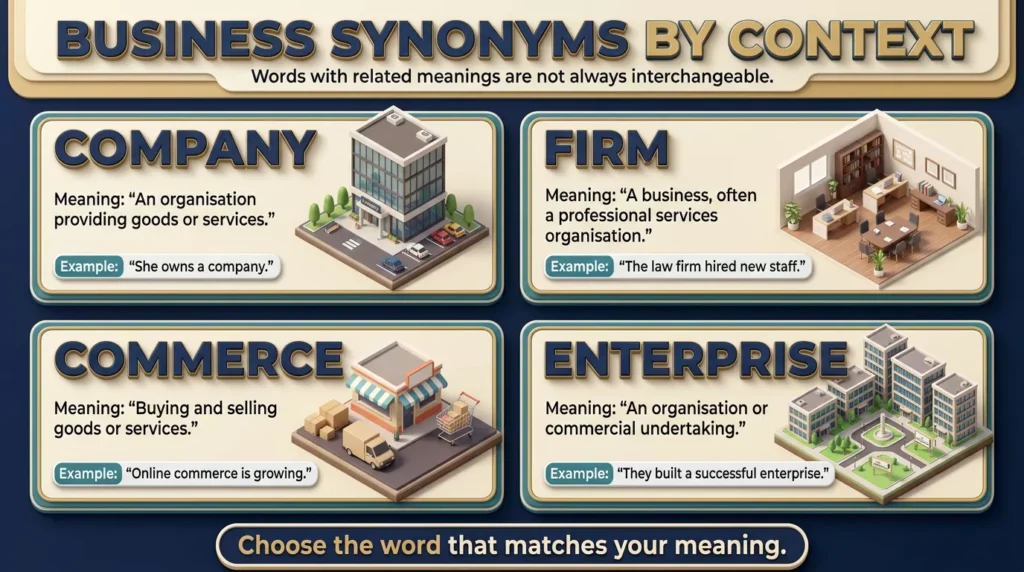
These words overlap, but they are not interchangeable in every situation.
| Word | Main meaning | Best context |
| Business | Commercial activity, an organisation, or a matter | General conversations and broad descriptions |
| Company | An organisation providing goods or services | Referring to a specific commercial organisation |
| Firm | A business organisation, often professional | Law, accounting, consulting, and similar services |
| Enterprise | An organisation or commercial undertaking | Formal writing, entrepreneurship, and economic discussions |
| Corporation | A particular legal form of organisation | Legal, financial, or corporate contexts |
| Commerce | Buying and selling goods or services | Trade, markets, and economic activity |
| Industry | A particular economic sector | Manufacturing, technology, tourism, and other sectors |
| Venture | A project or undertaking involving uncertainty | Startups, new projects, and entrepreneurship |
Consider this sentence: “She owns a successful business.”
You could write “She owns a successful company” if you mean the organisation. You might write “She runs a successful enterprise” in a more formal context. However, “She owns successful commerce” would be unnatural.
Always consider the complete sentence before choosing a replacement.
How to Choose the Right Business Synonym
Follow these practical steps when editing your writing.
1. Identify the Intended Meaning
Decide whether business refers to an organisation, commercial activity, work, or a matter.
For example, company is suitable for an organisation. Commerce is more suitable for buying and selling.
2. Consider Your Audience
Choose familiar language for general readers. Use specialist terms only when they improve accuracy.
A customer email may need the word company. An economic report may need commercial activity or industry.
3. Match the Level of Formality
Company and work are common in everyday communication. Enterprise and commercial operations may suit formal documents.
However, formal wording is not automatically better. Choose the clearest expression for your reader.
4. Check the Meaning of the Whole Sentence
Replace the original word and read the sentence again. Make sure the alternative preserves the intended meaning.
For example, “business growth” may become “company growth.” It should not automatically become “trade growth,” because the meanings differ.
5. Avoid Repetition Naturally
Synonyms can make writing less repetitive, but excessive variation can confuse readers.
Repeat a key term when it provides clarity. Change it only when another expression communicates the same idea accurately.
Common Mistakes When Using Business Synonyms
Some related words appear interchangeable but describe different concepts.
Treating Industry and Company as Identical
An industry is a sector containing many organisations. A company is a particular organisation.
For example, the automotive industry includes multiple vehicle manufacturers. One manufacturer is a company within that industry.
Using Commerce for an Individual Organisation
Commerce describes buying, selling, and related exchanges. It does not usually identify a single organisation.
Use company, firm, or enterprise when discussing an organisation itself.
Using Corporation Without Checking Legal Meaning
Corporation can refer to a particular legal form. The definition and requirements vary by jurisdiction.
Use company when the legal structure is unknown or irrelevant. Choose corporation when that description is accurate.
Replacing Every Use of Business With Work
Work may describe tasks, employment, or effort. Business may describe a company or commercial activity.
For example, “I own a business” does not mean “I own work.” Choose an alternative based on the original meaning.
Choosing Formal Words That Sound Unnatural
Longer words do not automatically improve professional writing. Unnecessary jargon can make a simple message harder to understand.
Prefer company over enterprise when the simpler word communicates the same meaning. Use more specialised terms only when their distinctions matter.
Frequently Asked Questions
What Is the Best Synonym for Business?
Company is often the best synonym when business refers to an organisation. Enterprise and firm also work in suitable contexts. If business means buying and selling, commerce or trade may be more accurate. Always consider the sentence before choosing a replacement.
What Is a More Professional Word for Business?
Enterprise, commercial activity, and commercial operations can sound more formal. However, company is also professional and often clearer. Choose the term that accurately describes the organisation or activity.
What Is Another Word for a Business Company?
Company, firm, enterprise, and corporation are common alternatives. Firm often suits professional services. Enterprise can describe a commercial undertaking, while corporation may have a specific legal meaning.
What Is a Synonym for Business in a Resume?
Commercial experience, business operations, company management, and business development may fit different resume contexts. Choose wording that accurately reflects your responsibilities. Do not use a broader or more impressive term than your experience supports.
What Is a Synonym for Business Activities?
Commercial activity, business operations, commercial operations, and economic activity may work. The best option depends on the activities involved. Economic activity is broader than commercial activity.
Is Enterprise the Same as Business?
Not always. Enterprise can refer to an organisation or a particular undertaking. Business can also refer to commercial activity, work, or a matter. The words overlap, but their meanings differ by context.
What Is the Difference Between Business and Commerce?
Business can describe an organisation or the activities it conducts. Commerce focuses on buying, selling, and exchanging goods or services. Commerce is therefore one aspect of many business activities.
What Is a Synonym for Small Business?
Small company, small enterprise, and small firm may work. The best choice depends on the organisation’s structure and context. A startup is appropriate only when the business is in its early stage.
Can Business Mean Work?
Yes. In certain expressions, business refers to work, duties, or professional responsibilities. However, work is not a suitable replacement in every sentence. The meaning depends on how business is used.
What Is the Opposite of Business?
There is no single antonym that fits every meaning of business. If business means commercial activity, leisure may contrast with work in some contexts. If it means a company, closure or inactivity may describe a different situation, but neither is a direct antonym. Choose a contrast that matches the intended meaning.
Conclusion
The best synonyms for business depend on the meaning and context. Company, firm, enterprise, and corporation can describe organisations. Commerce, trade, and commercial activity refer to economic exchanges. Work, operations, and duties describe different aspects of professional activity. Matter, concern, and affair suit situations unrelated to commerce.
Before replacing business, identify what the word means in your sentence. Consider your audience, writing style, and intended message. Then choose the most accurate alternative. Clear wording is more useful than unnecessary variation. By understanding these differences, you can write more naturally and communicate your ideas with confidence.

Nadeem Akhtar has a keen interest in the way words shape clear communication. Through SimpleSynonyms, he shares easy-to-understand resources on vocabulary, synonyms, meanings, and everyday English to help readers express themselves with greater confidence.