


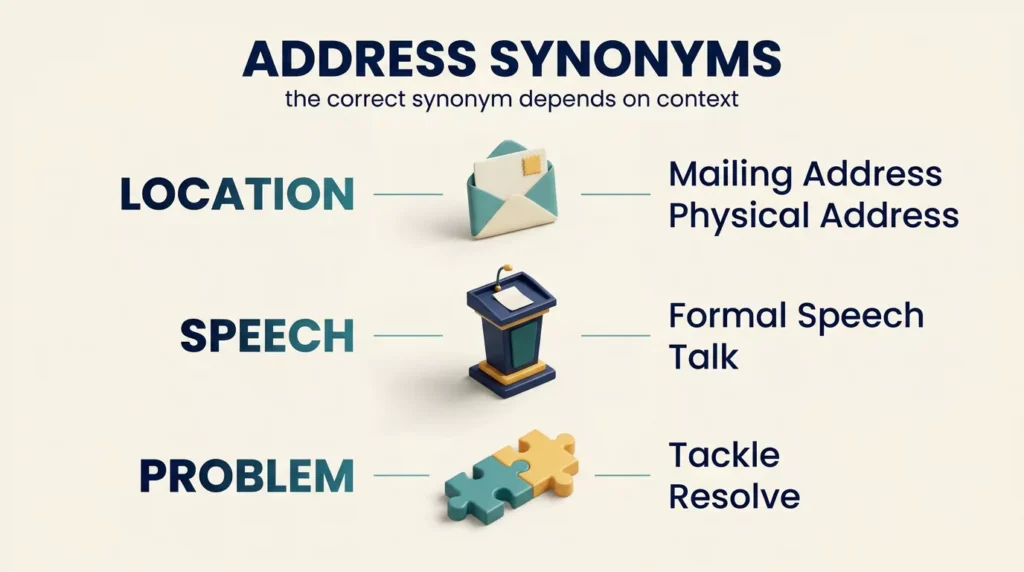
The best synonyms for address depend on how you use the word. For a location, try location, residence, or postal address.
For a speech, consider talk, speech, or formal remarks. When discussing a problem, use tackle, handle, or resolve. Choosing the right alternative makes your writing clearer and more natural.
What Does Address Mean?
The word address has several meanings in English. It can describe a place, a speech, or an action.
As a noun, it often identifies where someone lives or receives mail. It can also describe a formal speech given to an audience.
As a verb, address can mean speaking to someone or dealing with an issue. It may also refer to writing someone’s details on a letter.
Understanding these meanings helps you choose the right synonym.
Synonyms for Address by Meaning
1. Address as a Location
When address refers to a place, suitable alternatives include location, residence, and postal address. However, these words have slightly different meanings.
Location: The place where someone or something is situated.
Example: Please confirm the delivery location before placing your order.
Residence: A place where someone lives.
Example: The application requires proof of residence.
Postal address: The details used to receive letters and parcels.
Example: Please enter your postal address on the registration form.
Mailing address: The address where someone receives mail.
Example: My mailing address has changed since I moved.
Physical address: The actual street location of a person or organisation.
Example: The company provided its physical address on the website.
Street address: The building number and street name of a location.
Example: Enter your street address to calculate delivery charges.
Contact details: Information used to reach someone, such as an address or telephone number.
Example: Please update your contact details before submitting the form.
Whereabouts: The place where someone or something can be found.
Example: The team confirmed the equipment’s whereabouts.
Use location for a general place. Choose postal address or mailing address for correspondence. Use residence when discussing someone’s home.
2. Address as a Speech
When address means a formal speech, several alternatives may work. The best choice depends on the occasion and audience.
Speech: A spoken presentation delivered to an audience.
Example: The principal delivered a speech at the graduation ceremony.
Talk: An informal or formal spoken presentation about a subject.
Example: She gave a talk about improving workplace communication.
Presentation: An organised explanation of information to an audience.
Example: He prepared a presentation about the company’s annual results.
Lecture: A structured talk that explains a subject, often in education.
Example: The professor gave a lecture on modern British literature.
Oration: A formal, carefully prepared public speech.
Example: The mayor delivered an oration during the memorial service.
Remarks: Spoken comments made during an event or gathering.
Example: The director offered brief remarks before the meeting began.
Statement: A spoken or written expression of a position or opinion.
Example: The spokesperson issued a statement about the announcement.
Public address: A speech delivered to a group or the public.
Example: The president made a public address during the ceremony.
Use speech for general public speaking. Choose lecture for teaching and oration for an especially formal occasion.
3. Address as a Verb Meaning to Deal With

When address means dealing with a problem, concern, or task, these alternatives can improve your writing.
Tackle: To make a serious effort to deal with something difficult.
Example: The council plans to tackle traffic congestion.
Handle: To manage a situation, responsibility, or problem.
Example: Our support team will handle your complaint.
Resolve: To find a solution to a problem or disagreement.
Example: The manager helped resolve the dispute.
Deal with: To take action concerning a situation or issue.
Example: The organisation must deal with the safety concerns.
Manage: To control or organise a situation effectively.
Example: The team learned to manage its workload more efficiently.
Confront: To face a difficult situation directly.
Example: The company must confront the reasons behind its declining sales.
Examine: To inspect or study something carefully.
Example: The report examines the causes of rising costs.
Investigate: To discover facts about a problem or event.
Example: The authorities will investigate the reported incident.
Discuss: To talk about a subject and consider different views.
Example: The committee will discuss the proposed changes.
Consider: To think carefully about an issue or possible action.
Example: The board will consider the recommendations.
These alternatives are not identical. Tackle suggests taking action, while resolve suggests reaching a solution. Examine focuses on understanding an issue rather than fixing it.
4. Address as a Verb Meaning to Speak To
When address means speaking to a person or audience, choose an alternative that reflects your intention.
Speak to: To communicate verbally with someone.
Example: I need to speak to the department manager.
Talk to: To have a conversation with someone.
Example: Please talk to your supervisor about the schedule.
Contact: To communicate with someone through an available method.
Example: Contact the admissions office for further information.
Approach: To begin speaking to someone or seek their help.
Example: She decided to approach the director with her proposal.
Appeal to: To make a request or argument to someone.
Example: The campaign appealed to local residents for support.
Convey: To communicate information, meaning, or feelings.
Example: The letter conveys our concerns about the delay.
Brief: To give someone essential information about a situation.
Example: The manager will brief the team before the inspection.
Announce: To make information known publicly or formally.
Example: The chairperson will announce the decision tomorrow.
Choose speak to for direct communication. Use contact for communication by telephone, email, or another method. Choose brief when giving someone essential information.
5. Address in Letters and Formal Communication
In correspondence, address can refer to the details written on a letter or the way someone is approached.
Recipient details: Information identifying the person receiving a message or item.
Example: Check the recipient details before sending the parcel.
Delivery address: The location where an item should be delivered.
Example: Please confirm the delivery address before checkout.
Correspondence address: An address used for receiving letters and official communication.
Example: The organisation requested my correspondence address.
Salutation: The greeting used at the beginning of a letter or email.
Example: Dear Ms Patel is a suitable salutation for this email.
Form of address: The title or expression used when speaking to or writing to someone.
Example: Professor is the appropriate form of address in this situation.
These terms serve different purposes. A salutation is a greeting, while a form of address identifies how someone should be referred to.
Address Synonyms in Example Sentences
The table below shows how to choose alternatives according to context.
| Original sentence | Alternative | Revised sentence |
| Please confirm your address. | Mailing address | Please confirm your mailing address. |
| She delivered an address. | Speech | She delivered a speech. |
| We must address the problem. | Tackle | We must tackle the problem. |
| He addressed the audience. | Spoke to | He spoke to the audience. |
| Please address the letter. | Write the recipient’s details | Please write the recipient’s details on the letter. |
| The team addressed the concerns. | Responded to | The team responded to the concerns. |
| The manager addressed the complaint. | Handled | The manager handled the complaint. |
| The report addresses the issue. | Examines | The report examines the issue. |
Remember that changing the word can also change the meaning. Always check the complete sentence before choosing an alternative.
Differences Between Common Address Synonyms
Some words appear interchangeable but express different ideas.
Address vs. Tackle
Address can mean considering, discussing, or taking action on an issue. Tackle suggests making an active effort to deal with it.
Example: The report addresses staff concerns.
Example: The management team will tackle staff shortages.
Use address when describing a broad response. Choose tackle when emphasising action.
Address vs. Resolve
Address does not always mean solving something. Resolve means finding a solution or settling a problem.
Example: The committee addressed the complaints.
Example: The committee resolved the complaints.
The first sentence describes a response. The second suggests the complaints were settled.
Address vs. Handle
Handle focuses on managing a situation or responsibility. Address can also mean discussing an issue.
Example: The supervisor handled the customer complaint.
Example: The supervisor addressed the customer’s concerns during the meeting.
Choose the word that reflects the action performed.
Address vs. Speech
An address is often a formal speech. However, a speech can be formal or informal.
Example: The president delivered an address to the nation.
Example: The student gave a speech at the school event.
Use address when the occasion is formal. Use speech for a broader range of situations.
Address vs. Location
A location identifies a place in general. An address usually provides details for identifying or reaching a specific place.
Example: The location is near the railway station.
Example: The venue’s address is listed on the invitation.
Use location when describing where something is. Use address when giving identifying or delivery details.
How to Choose the Right Address Synonym
Choosing the right synonym starts with understanding your sentence.
1. Identify the Intended Meaning
First, determine what address means in your sentence.
- For a place, consider location, residence, or postal address.
- For a formal speech, consider speech, talk, or formal remarks.
- For a problem, consider tackle, handle, or resolve.
- For communication, consider speak to, contact, or brief.
2. Consider the Context
The same alternative may not suit every situation.
For example, resolve works well when a problem is settled. It is less suitable when someone merely discusses the problem.
Similarly, lecture suggests teaching, while oration suggests formal public speaking.
3. Match the Tone
Choose words that suit your audience and purpose.
Formal writing may benefit from examine, investigate, or resolve. Everyday conversation often sounds more natural with talk to or deal with.
However, the simplest word is not always the best. Prioritise accuracy and natural phrasing.
4. Check the Grammar
Some alternatives require different sentence structures.
For example:
- Address the issue.
- Tackle the issue.
- Deal with the issue.
- Respond to the issue.
Notice that deal with and respond to use a preposition. Replacing words without adjusting grammar can create errors.
5. Read the Sentence Again
Finally, read your revised sentence aloud. Check whether it sounds natural and preserves the original meaning.
A good synonym improves clarity without changing your intended message.
Common Mistakes When Using Address Synonyms
Treating Every Synonym as Interchangeable
Words with similar meanings can express different ideas.
For example, examine a problem means studying it. Resolve a problem means finding a solution.
Confusing an Address With a Location
A location can be a general place. An address usually identifies a specific place or provides contact details.
Use the term that matches the information required.
Using Formal Words in Casual Situations
Words such as oration and salutation suit particular contexts. They may sound unnatural in everyday conversation.
Choose vocabulary that matches your audience.
Ignoring Prepositions
Some verbs require prepositions to form correct expressions.
Write deal with a problem, not deal a problem, when you mean handling it.
Similarly, write respond to a concern when using that expression.
Replacing a Word Without Checking Its Meaning
Before changing address, ask whether the sentence concerns a place, speech, person, or issue.
This simple check prevents many vocabulary mistakes.
Frequently Asked Questions
What Is the Best Synonym for Address?
The best synonym depends on the context. Use location for a place, speech for formal remarks, and tackle for taking action on a problem.
What Is Another Word for Addressing a Problem?
Useful alternatives include tackling, handling, resolving, examining, and dealing with. Choose according to whether you mean investigating, managing, or solving the problem.
What Is a Formal Synonym for Address?
For a speech, consider formal remarks, speech, or oration. For dealing with an issue, consider examine, investigate, or resolve.
What Is a Synonym for Address in an Email?
The best alternative depends on the intended meaning. For contacting someone, use write to or contact. For the greeting, use salutation. For recipient details, use recipient address.
What Is Another Word for a Postal Address?
Depending on the context, alternatives include mailing address and delivery address. These terms are related, but they do not always mean exactly the same thing.
What Is the Difference Between Address and Discuss?
Discuss means talking about a subject or considering different views. Address can mean discussing a concern, responding to it, or taking action.
What Is the Difference Between Address and Resolve?
Address means dealing with or responding to an issue. Resolve means finding a solution or settling it.
What Is the Opposite of Address?
There is no single antonym for every meaning of address. Depending on the context, possible contrasts include ignore or neglect when referring to an issue. These are contextual opposites rather than universal antonyms.
Conclusion
The best address synonyms depend on the meaning and context of your sentence. Use location or mailing address for places and correspondence. Choose speech or talk for spoken presentations. For problems, consider tackle, handle, or resolve.
Always check the meaning, tone, and grammar before replacing a word. This approach makes your writing clearer, more accurate, and more natural.

Nadeem Akhtar has a keen interest in the way words shape clear communication. Through SimpleSynonyms, he shares easy-to-understand resources on vocabulary, synonyms, meanings, and everyday English to help readers express themselves with greater confidence.