

Fear is an emotion that arises when something seems threatening or dangerous. However, the word fear does not always express the exact feeling you want to describe.
Words such as worry, apprehension, dread, and terror convey different levels of concern. Choosing the right alternative makes your writing more accurate and engaging.
This guide explores 60 fear synonyms and related expressions. You will learn their meanings, understand their differences, and discover how to use them naturally.
What Does Fear Mean?
Fear is an unpleasant emotion caused by a perceived threat, danger, or possible harm. It can arise from an immediate threat or something that might happen later.
For example:
- She felt fear when the dog approached aggressively.
- He feared losing his job.
- The children were frightened by the sudden noise.
Fear can be mild, intense, temporary, or persistent. Its meaning depends on the situation and the person’s response.
Common Synonyms for Fear
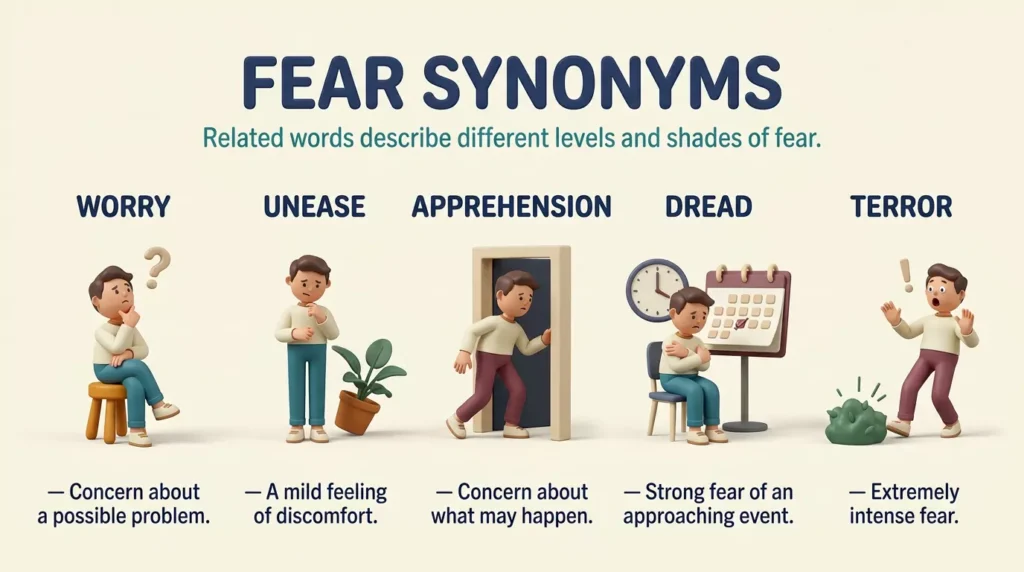
The following words provide useful alternatives for different writing situations.
| Synonym | Meaning | Example |
| 1. Fright | Sudden fear caused by something unexpected | The loud bang gave her a fright. |
| 2. Terror | Extremely intense fear | The passengers felt terror during the emergency. |
| 3. Dread | Strong fear about something approaching | He felt dread before the difficult conversation. |
| 4. Alarm | Sudden worry about possible danger | Her expression showed alarm. |
| 5. Panic | Sudden, overwhelming fear | Panic spread through the crowd. |
| 6. Anxiety | Unease about possible problems or threats | She experienced anxiety before the interview. |
| 7. Apprehension | Concern about what might happen | He approached the meeting with apprehension. |
| 8. Worry | Concern about a possible problem | Her worry grew as the hours passed. |
| 9. Unease | A mild feeling that something is wrong | An unexplained unease filled the room. |
| 10. Trepidation | Nervousness about an uncertain situation | She opened the letter with trepidation. |
| 11. Nervousness | Uneasiness caused by pressure or uncertainty | His nervousness showed during the speech. |
| 12. Horror | Intense fear mixed with shock or revulsion | She watched the scene in horror. |
| 13. Consternation | Sudden distress or confusion caused by something troubling | The unexpected announcement caused consternation. |
| 14. Dismay | Distress or disappointment after troubling news | He stared at the damaged car in dismay. |
| 15. Misgiving | A doubt or concern about something | She had misgivings about the agreement. |
| 16. Foreboding | A sense that something bad may happen | A feeling of foreboding followed him home. |
| 17. Qualm | A feeling of doubt or uneasiness | He had no qualms about asking for help. |
| 18. Disquiet | A feeling of worry or disturbance | The strange silence caused disquiet. |
| 19. Disquietude | A state of uneasiness or mental disturbance | The report created disquietude among residents. |
| 20. Angst | Deep anxiety or emotional unease | The novel explores the angst of adolescence. |
These words are not interchangeable in every sentence. For example, terror suggests greater intensity than unease. Meanwhile, misgiving usually describes doubt about a decision.
Fear Synonyms by Intensity
The strength of fear can change the word that best describes it. Consider the following categories when selecting an alternative.
Mild Fear and Unease
Mild fear often involves uncertainty, nervousness, or concern rather than immediate danger.
| Word | Meaning | Example |
| 21. Concern | Worry about a situation or outcome | Her concern increased after the delay. |
| 22. Jitters | Informal nervousness before an event | He had the jitters before his first performance. |
| 23. Apprehensiveness | A state of expecting something unpleasant | Her apprehensiveness disappeared after the meeting. |
| 24. Insecurity | Uncertainty about oneself or one’s circumstances | His insecurity made him doubt his abilities. |
| 25. Diffidence | Lack of confidence or self-assurance | Her diffidence prevented her from speaking freely. |
| 26. Hesitancy | Reluctance or uncertainty before acting | His hesitancy revealed his doubts. |
| 27. Nervous anticipation | Uneasy expectation of an upcoming event | She waited in nervous anticipation. |
| 28. Butterflies | Informal nervous excitement felt physically | I had butterflies before the interview. |
| 29. Misgiving | Doubt about whether something is right | He expressed misgivings about the plan. |
| 30. Qualm | A brief feeling of doubt or discomfort | She felt a qualm before accepting the offer. |
Strong Fear and Terror
Strong fear may involve intense distress, sudden alarm, or an overwhelming sense of danger.
| Word | Meaning | Example |
| 31. Panic | Overwhelming fear that can disrupt clear thinking | Panic gripped the audience when the lights failed. |
| 32. Horror | Extreme fear, often mixed with shock | He reacted with horror to the discovery. |
| 33. Fright | A sudden experience of fear | The unexpected movement caused a fright. |
| 34. Shock | Sudden emotional disturbance after an unexpected event | She stood in shock after hearing the news. |
| 35. Distress | Severe emotional discomfort or suffering | The trapped animal showed signs of distress. |
| 36. Perturbation | Mental disturbance or uneasiness | The unexplained message caused perturbation. |
| 37. Agitation | A state of nervous excitement or disturbance | His agitation increased as the storm approached. |
| 38. Alarm | Strong concern about possible danger | The smoke raised the alarm among staff. |
| 39. Terror | Extreme and overwhelming fear | Terror spread when the building began shaking. |
| 40. Trepidation | Fearful uncertainty about what lies ahead | She entered the unfamiliar building with trepidation. |
Some words describe the emotional response rather than fear itself. For example, shock emphasises surprise, while distress describes broader emotional suffering.
Fear Synonyms for Different Contexts
The best synonym also depends on your audience and purpose. Everyday conversation, formal writing, and storytelling often require different vocabulary.
Fear Synonyms for Everyday Conversation
These alternatives work well in casual conversations and accessible writing.
| Word or expression | Meaning | Example |
| 41. Scare | A sudden experience of fear | That noise gave me a scare. |
| 42. Worry | Concern about something that might go wrong | I worry about travelling alone at night. |
| 43. Nervousness | Uneasiness about a situation | Her nervousness faded after introductions. |
| 44. Jitters | Informal nervousness or anxiety | I always get the jitters before exams. |
| 45. Uneasiness | A feeling of discomfort or uncertainty | He felt uneasiness about the strange request. |
Fear Synonyms for Formal and Professional Writing
Formal writing often benefits from precise words that explain the nature of a concern.
| Word | Meaning | Example |
| 46. Apprehension | Concern about a possible future event | The team expressed apprehension about the changes. |
| 47. Trepidation | Fearful hesitation about an uncertain situation | She accepted the responsibility with trepidation. |
| 48. Anxiety | Uneasiness about potential difficulties | The announcement caused anxiety among employees. |
| 49. Concern | A reason for worry or attention | Safety concerns prompted further investigation. |
| 50. Foreboding | An expectation that something unpleasant may occur | The findings created a sense of foreboding. |
Fear Synonyms for Creative Writing
Creative writing often benefits from words that convey atmosphere, character, and emotional depth.
| Word or expression | Meaning | Example |
| 51. Dread | Heavy fear about an approaching event | Dread settled over the village before sunset. |
| 52. Terror | Overwhelming fear | Terror froze him as footsteps approached. |
| 53. Horror | Intense fear mixed with shock | Horror filled her eyes when the door opened. |
| 54. Foreboding | A sense of approaching trouble | The empty corridor carried an air of foreboding. |
| 55. Angst | Deep emotional anxiety | His angst shaped every decision he made. |
Related Words and Expressions
Some words describe reactions, behaviours, or specific forms of fear. They can enrich your writing, but they are not always direct synonyms.
| Word or expression | Meaning | Example |
| 56. Timidity | A tendency to avoid bold or unfamiliar actions | Her timidity made introductions difficult. |
| 57. Cowardice | A lack of courage when facing danger | He was criticised for his cowardice. |
| 58. Phobia | An excessive or persistent fear of a specific object or situation | Her phobia made flying difficult. |
| 59. Fearfulness | The state of being easily frightened | His fearfulness increased in unfamiliar places. |
| 60. In fear of | An expression describing a perceived threat | They lived in fear of losing their home. |
A phobia is more specific than ordinary fear. Cowardice describes a judgement about behaviour, while timidity concerns a person’s manner or confidence.
Fear Synonyms Compared
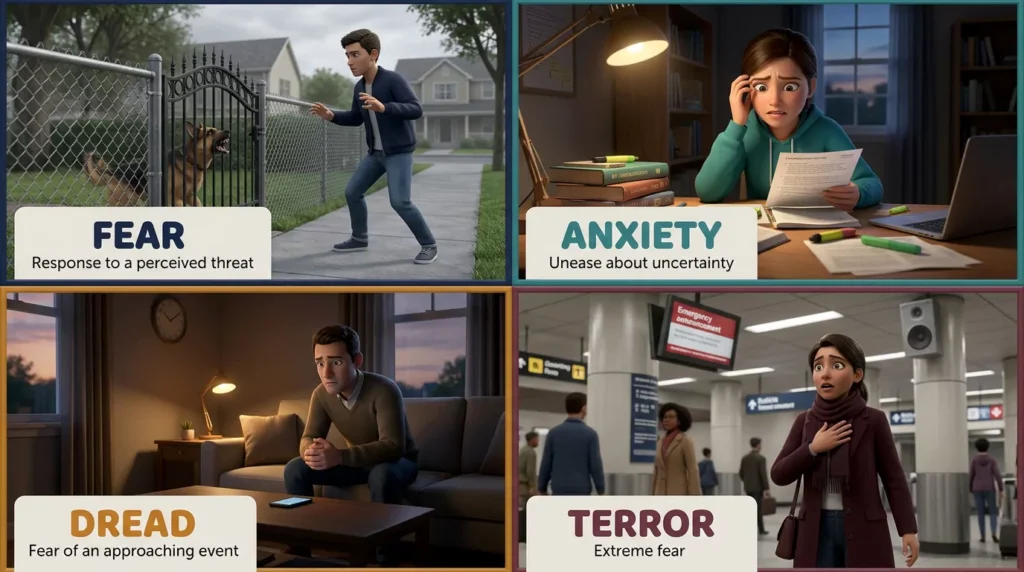
Several fear-related words have similar meanings but different emotional shades. Understanding these differences helps you choose the right term.
| Word | Main distinction | Best use |
| Fear | General response to a perceived threat | Broad descriptions |
| Worry | Concern about possible problems | Everyday concerns |
| Anxiety | Uneasiness about uncertain outcomes | Emotional or psychological contexts |
| Apprehension | Concern about something expected | Formal writing |
| Dread | Strong fear of an approaching event | Anticipation and storytelling |
| Panic | Sudden, overwhelming fear | Urgent or frightening situations |
| Terror | Extreme fear | Severe danger or intense emotion |
| Horror | Fear combined with shock or revulsion | Disturbing discoveries or events |
| Unease | Mild discomfort or uncertainty | Subtle tension |
| Phobia | Persistent, excessive fear of a specific trigger | Specific fear-related conditions |
Fear vs. Anxiety
Fear commonly responds to a perceived threat. Anxiety often involves concern about possible future events or uncertain outcomes.
For example:
- Fear: She felt fear when the aggressive dog approached.
- Anxiety: She felt anxiety before travelling alone.
The two experiences can overlap. Their meanings depend on the situation.
Fear vs. Dread
Fear can describe a present threat or a general emotional response. Dread usually involves strong apprehension about something unpleasant that may happen.
For example:
- Fear: He felt fear during the dangerous crossing.
- Dread: He dreaded the difficult conversation ahead.
Fear vs. Terror
Terror expresses a much greater degree of fear. It is appropriate when the emotional response is intense or overwhelming.
For example:
- Fear: She felt fear when she heard the noise.
- Terror: She felt terror when she realised she was trapped.
Fear vs. Panic
Fear is a broad emotional response. Panic describes a sudden, intense reaction that may interfere with clear thinking.
For example:
- Fear: He felt fear during the emergency.
- Panic: He panicked when he could not find the exit.
Fear vs. Apprehension
Apprehension generally focuses on uncertainty about what may happen. It often suits formal or professional writing.
For example:
- Fear: She feared the consequences of the decision.
- Apprehension: She approached the decision with apprehension.
Antonyms of Fear
Antonyms describe the opposite or a contrasting emotional state. The most suitable choice depends on the context.
| Antonym | Meaning | Example |
| Courage | The ability to face difficulty or danger | She showed courage during the crisis. |
| Bravery | Willingness to face danger | His bravery inspired the team. |
| Confidence | Belief in one’s abilities or judgement | She spoke with confidence. |
| Fearlessness | The absence of fear or apparent fear | His fearlessness impressed the audience. |
| Calmness | A peaceful, controlled emotional state | She maintained calmness during the emergency. |
| Composure | The ability to remain controlled under pressure | He regained his composure before speaking. |
| Security | A feeling of safety or protection | The children felt security in their home. |
| Assurance | Confidence or certainty | Her assurance helped settle the group. |
Fearlessness does not always mean a person feels no fear. Courage often means acting despite fear.
How to Choose the Right Fear Synonym
Use these practical guidelines to make your writing more precise.
1. Consider the Intensity
Choose a word that matches the strength of the emotion.
- Use unease for mild discomfort.
- Use apprehension for nervous expectation.
- Use dread for strong anticipatory fear.
- Use terror for extreme fear.
2. Identify the Cause
Ask yourself what creates the emotion.
- Use worry for possible problems.
- Use alarm for perceived danger.
- Use horror for frightening or disturbing events.
- Use misgiving for doubts about a decision.
3. Match the Writing Style
Everyday language often favours simple words. Formal writing may need more precise alternatives.
For example, “She felt nervous” suits everyday conversation. “She approached the negotiations with apprehension” sounds more formal.
4. Check the Grammar
Not every alternative works in the same grammatical position.
- Noun: Fear stopped him.
- Verb: He feared the consequences.
- Adjective: She felt fearful.
- Adjective: The situation was frightening.
Choose a word that fits the sentence’s grammatical structure.
5. Avoid Unnecessary Repetition
Repeatedly using fear can make writing less varied. However, replacing every occurrence with a different word can sound unnatural.
Use synonyms when they add meaning or improve clarity. Keep the original word when it remains the most accurate choice.
Frequently Asked Questions
What Is the Best Synonym for Fear?
The best synonym depends on the context. Worry suits everyday concerns, while dread expresses strong anticipatory fear. Terror describes extreme fear, and apprehension suits uncertain future situations.
What Are Five Common Synonyms for Fear?
Five common synonyms are fright, terror, dread, anxiety, and apprehension. Each conveys a slightly different emotional experience.
What Is a Stronger Word for Fear?
Terror is a strong alternative for intense fear. Horror can express fear mixed with shock, while panic describes a sudden, overwhelming reaction.
What Is a Formal Word for Fear?
Apprehension, trepidation, and anxiety can suit formal writing. Choose according to the meaning and tone of your sentence.
What Is the Difference Between Fear and Worry?
Fear often involves a perceived threat or danger. Worry usually concerns a possible problem or unwanted outcome.
What Is a Word for Fear of the Future?
Apprehension, dread, and foreboding can describe fear about the future. Foreboding specifically suggests that something unpleasant may happen.
What Is the Opposite of Fear?
Possible antonyms include courage, bravery, fearlessness, confidence, and calmness. The correct choice depends on whether you mean an emotion, an action, or a personal quality.
Can Anxiety and Fear Mean the Same Thing?
They can overlap, but they are not identical. Fear often responds to a perceived threat, whereas anxiety frequently involves uncertainty or anticipated problems.
What Is the Difference Between Fear and a Phobia?
Fear is a normal response to perceived danger. A phobia involves persistent, excessive fear related to a particular object or situation. Not every fear qualifies as a phobia.
How Can I Avoid Repeating the Word Fear?
Use precise alternatives such as worry, unease, apprehension, or dread. Consider the intensity, cause, and context before choosing a replacement.
Conclusion
Fear synonyms help you describe emotions with greater accuracy and variety. Words such as worry, unease, apprehension, and dread convey different shades of concern.
For intense situations, terror, horror, and panic may communicate a stronger reaction. In formal writing, apprehension and trepidation can offer a more precise tone.
The most effective synonym is the one that fits your meaning, audience, and sentence. Choose words for their accuracy rather than variety alone.

Nadeem Akhtar has a keen interest in the way words shape clear communication. Through SimpleSynonyms, he shares easy-to-understand resources on vocabulary, synonyms, meanings, and everyday English to help readers express themselves with greater confidence.