


The best sun synonyms depend on what you want to describe. Words like star, daystar, and orb can refer to the sun itself. Other words, such as sunshine and sunlight, describe its light or effects. Understanding these differences helps you choose the right word for essays, creative writing, and everyday communication.
This guide explores common sun synonyms, their meanings, and natural example sentences. You will also discover poetic alternatives and related words for different writing situations.
What Does Sun Mean?
The sun is the star at the center of our solar system. It provides Earth with light and heat, making life possible. People also use the word symbolically to describe happiness, hope, warmth, and energy.
In everyday language, the sun usually refers to the bright celestial object visible during the day. In poetry, it can represent new beginnings, strength, or positive feelings.
The context determines which alternative works best. A scientific explanation may require precise terminology, while a poem might benefit from a more imaginative expression.
Common Synonyms for Sun
Here are some useful alternatives and related expressions. Some refer directly to the sun, while others describe its appearance, light, or symbolic meaning.
| Word or expression | Meaning | Example sentence |
| Star | A celestial object that produces energy and light | Our sun is the nearest star to Earth. |
| Daystar | A poetic name for the sun | The daystar appeared above the distant hills. |
| Sol | The Latin name for the sun, also used in astronomy | The spacecraft studied conditions around Sol. |
| Orb | A rounded object, often used poetically for a celestial body | The golden orb descended behind the mountains. |
| Luminary | A source of light or a person who inspires others | The bright luminary illuminated the morning sky. |
| Helios | The Greek god associated with the sun | The poet described the sunrise through the myth of Helios. |
| Sunshine | Sunlight or the presence of bright sunlight | Sunshine filled the quiet garden. |
| Sunlight | Light emitted by the sun | Sunlight streamed through the open window. |
| Sunbeam | A narrow beam of sunlight | A sunbeam crossed the wooden floor. |
| Daylight | Natural light present during the day | The room looked brighter in daylight. |
| Solar body | A celestial object associated with the sun or solar system, depending on context | The report examined the solar environment near the star. |
| Golden disc | A descriptive expression for the sun’s round appearance | The golden disc rose above the horizon. |
Not all these expressions are interchangeable. Star and daystar can refer directly to the sun. Sunshine, sunlight, and sunbeam refer to light or its effects. Sol and Helios have specific linguistic or mythological associations.
Sun Synonyms by Context
The best word depends on your sentence, intended meaning, and writing style. Some alternatives suit everyday conversation, while others work better in poetry or technical writing.
Everyday Alternatives for Sun
Everyday writing usually benefits from simple, familiar words. Star can describe the sun when the astronomical context is clear. Sunshine and sunlight work when you mean its light rather than the object itself.
Consider these options:
- Star: Our sun is an ordinary star compared with many others.
- Sunshine: We enjoyed the sunshine during our afternoon walk.
- Sunlight: The plants need enough sunlight to grow.
- Daylight: We finished the repairs before daylight faded.
- Sunbeam: A sunbeam fell across the kitchen table.
Choose sunshine when discussing bright, sunny conditions. Use sunlight when the light itself matters. Choose star when discussing the sun as an astronomical object.
Poetic and Literary Alternatives for Sun
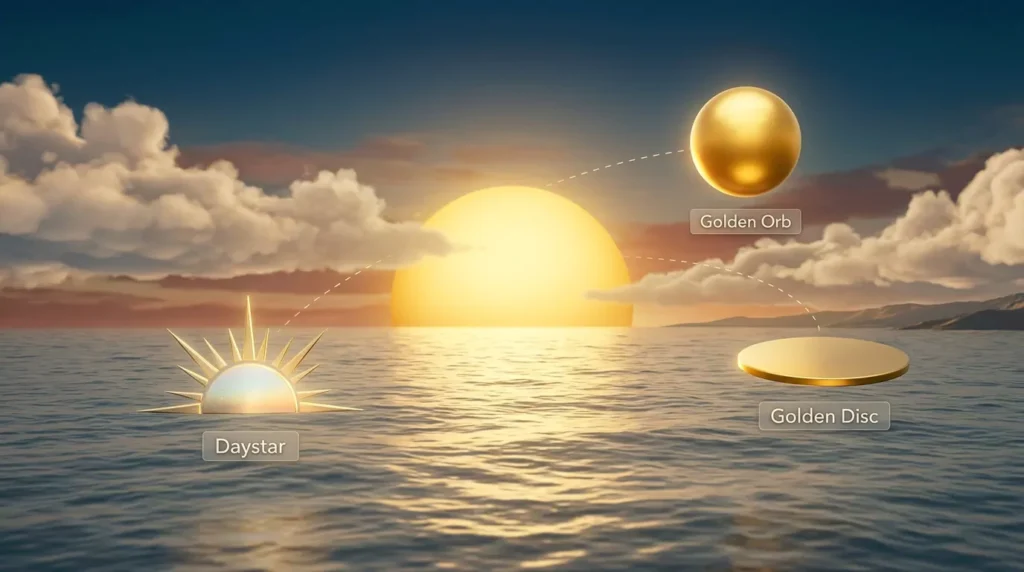
Poets often describe the sun through imagery, color, shape, and movement. These expressions create atmosphere without changing the scene’s central meaning.
| Alternative | Meaning or effect | Example |
| Daystar | A poetic name for the sun | The daystar awakened the sleeping valley. |
| Golden orb | Emphasizes the sun’s round, golden appearance | The golden orb hovered above the sea. |
| Celestial orb | Creates a formal or poetic image of a heavenly object | The celestial orb brightened the winter landscape. |
| Golden disc | Highlights the sun’s circular shape and color | A golden disc appeared through the mist. |
| Luminary | Suggests a source of illumination | The luminary cast long shadows across the fields. |
| Helios | Introduces a classical mythological association | Helios rode through the poet’s imagined sky. |
These expressions suit poems, novels, descriptive essays, and imaginative storytelling. However, some are creative descriptions rather than established synonyms.
Daystar can sound elevated or old-fashioned in modern writing. Golden orb and golden disc are descriptive phrases. Helios refers primarily to a mythological figure, so it suits allusions rather than ordinary factual descriptions.
Scientific and Technical Alternatives for Sun
Scientific writing requires accuracy more than stylistic variety. In astronomy, the sun is a star, specifically the star at the center of our solar system.
Useful terms include:
- Star: The correct classification of the sun.
- The Sun: The standard name for our solar system’s central star.
- Solar: An adjective describing something related to the sun.
- Solar radiation: Energy emitted by the sun across different wavelengths.
- Solar energy: Energy obtained from sunlight and converted into usable forms.
For example, write, “The star produces energy through nuclear fusion.” This describes the sun’s physical nature.
Write, “The solar panels convert sunlight into electricity.” Here, solar describes the panels’ relationship to the sun.
Do not use solar as a direct noun replacement for sun. It normally functions as an adjective. Likewise, solar radiation refers to emitted energy, not the celestial object itself.
Words Related to Sunlight and Warmth
Some words associated with the sun describe its effects rather than the object. These alternatives help you explain weather, lighting, temperature, and atmosphere more precisely.
| Word | Meaning | Example |
| Sunshine | Sunlight or sunny conditions | The sunshine made the park inviting. |
| Sunlight | Light coming from the sun | Sunlight entered through the curtains. |
| Sunbeam | A visible beam of sunlight | One sunbeam illuminated the dusty room. |
| Daylight | Natural daytime light | The photograph looked clearer in daylight. |
| Sun warmth | Heat felt from the sun | We enjoyed the sun warmth on the balcony. |
| Solar radiation | Energy emitted by the sun | Solar radiation affects Earth’s climate. |
Sun warmth is a descriptive phrase rather than a fixed technical synonym. It can work in informal or descriptive writing.
These distinctions matter because replacing the sun with its light or warmth can change your sentence’s meaning.
Sun Synonyms With Example Sentences
Examples show how each alternative works in a complete sentence. Use the following list to find a suitable word for your writing.
- Star: The sun is the closest star to our planet.
- Daystar: The daystar appeared above the eastern mountains.
- Sol: Sol is the name associated with our solar system’s central star.
- Orb: The glowing orb sank below the horizon.
- Luminary: The luminary brightened the otherwise dark landscape.
- Helios: The story portrayed Helios as a powerful figure in the sky.
- Sunshine: We spent the afternoon enjoying the sunshine.
- Sunlight: Sunlight reached the plants beside the window.
- Sunbeam: A sunbeam illuminated the child’s reading corner.
- Daylight: The workers completed the task in daylight.
- Golden orb: The golden orb shone above the calm ocean.
- Golden disc: The golden disc disappeared behind the clouds.
- Celestial orb: The celestial orb dominated the poet’s description of dawn.
- Solar body: The researcher studied the star and its surrounding solar environment.
- Solar radiation: Solar radiation provides energy that reaches Earth’s atmosphere.
Remember that these words have different meanings and levels of formality. Choose a replacement that preserves the original sentence’s meaning.
Sun, Sunshine, Sunlight, and Daylight: Key Differences
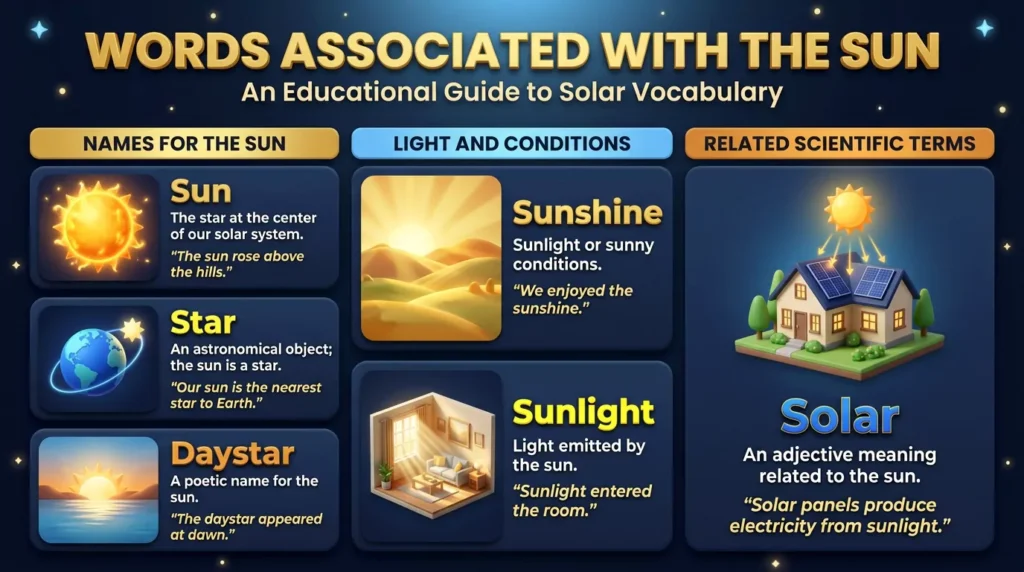
These four terms are closely related, but they describe different things. Choosing the correct term makes your writing clearer and more accurate.
| Word | What it describes | Example |
| Sun | The star at the center of our solar system | The sun rose above the hills. |
| Sunshine | Sunlight or sunny conditions | The sunshine brightened our morning. |
| Sunlight | Light emitted by the sun | Sunlight entered the room. |
| Daylight | Natural light during the daytime | We could see clearly in daylight. |
Use sun when discussing the celestial object. Choose sunshine when describing sunny weather or the pleasant feeling of sunlight. Use sunlight when discussing illumination or energy reaching an object.
Daylight is broader because it describes natural light during the day. It can include indirect light scattered through the atmosphere, not just direct sunshine.
For example, “The sun disappeared behind the clouds” describes the object becoming obscured. “The daylight faded” describes the changing brightness around you.
How to Choose the Right Sun Synonym
Choosing a synonym involves more than finding a similar word. You should consider meaning, tone, audience, and context.
Match the Meaning
First, decide whether you mean the celestial object, its light, or its warmth. This distinction prevents inaccurate substitutions.
Use star when describing the sun astronomically. Choose sunlight when discussing light reaching a surface. Use sunshine when referring to sunny conditions.
For example, “The sun warmed the garden” can become “Sunlight warmed the garden.” The second sentence emphasizes the sun’s light rather than the object itself.
Consider Your Writing Style
Different contexts require different levels of formality. Scientific writing needs precise terminology. Creative writing can use descriptive expressions for atmosphere and imagery.
Use star in straightforward explanations. Choose daystar for a poetic tone. Consider golden orb when describing the sun’s appearance.
Avoid overly elaborate language when a simple word communicates your meaning better. Clear writing usually serves readers more effectively than unnecessary variety.
Check the Sentence Structure
Some alternatives change how a sentence works grammatically. Solar usually functions as an adjective, while sun, star, and orb can function as nouns.
For example, “The solar energy increased” is grammatically correct. However, “The solar appeared” is generally incorrect when you mean the sun.
A useful synonym must fit both the meaning and the grammar of your sentence. Always read the complete sentence after making a substitution.
Common Questions About Sun Synonyms
What Is the Closest Synonym for Sun?
Star is the closest straightforward alternative when referring to the sun as an astronomical object. Daystar is another direct alternative, particularly in poetic writing.
What Is a Poetic Word for Sun?
Daystar is a traditional poetic name for the sun. Golden orb and golden disc are descriptive alternatives that emphasize its appearance.
Is Sunshine a Synonym for Sun?
Not exactly. Sunshine usually refers to sunlight or sunny conditions. The sun itself is the celestial object producing that light.
Is Sunlight the Same as Sun?
No. Sunlight is the light emitted by the sun. The sun is the star that produces this light and other forms of energy.
What Is Another Word for the Sun in Literature?
Writers may use daystar, golden orb, celestial orb, or golden disc. The best choice depends on the image and tone they want to create.
Is Sol Another Name for the Sun?
Yes. Sol is the Latin name for the sun and is also used in astronomical contexts. It is not the usual everyday English replacement.
Can I Use Solar Instead of Sun?
Usually, no. Solar is an adjective that means related to the sun. You can write “solar energy” or “solar system,” but not usually “the solar” to mean the sun.
What Is the Difference Between Daystar and Star?
Star is the general astronomical term for a celestial object like the sun. Daystar is a poetic name specifically used for the sun.
Conclusion
The best sun synonyms depend on what you want to express. Star is a clear choice for the sun as an astronomical object. Daystar, golden orb, and golden disc can add variety to creative writing. Sunshine and sunlight describe its light or sunny conditions, while solar works as an adjective. Understanding these differences helps you avoid awkward or inaccurate substitutions. Choose words that match your sentence’s meaning, tone, and purpose. When precision matters, use the simplest accurate term. When writing creatively, descriptive alternatives can make your language more vivid and engaging.

Nadeem Akhtar has a keen interest in the way words shape clear communication. Through SimpleSynonyms, he shares easy-to-understand resources on vocabulary, synonyms, meanings, and everyday English to help readers express themselves with greater confidence.