


Looking for the best synonyms for encourage? The right word can make your writing clearer and more natural. You might want to motivate someone, offer support, inspire confidence, or influence a decision.
Popular synonyms for encourage include motivate, inspire, support, reassure, empower, uplift, stimulate, and bolster. However, these words have different meanings and uses.
This guide explores useful encourage synonyms, their meanings, and realistic examples. You will also learn which alternatives work best in everyday conversations and professional writing.
What Does Encourage Mean?
To encourage someone means giving them support, confidence, or a reason to act. Encouragement can help people overcome difficulties and continue their efforts.
For example:
- The teacher encouraged her students to ask questions.
- His friends encouraged him during a difficult time.
- The manager encouraged employees to share their ideas.
The word can describe emotional support, positive influence, or an effort to promote an action. Its exact meaning depends on the situation.
Common Synonyms for Encourage
These alternatives cover several common meanings of encourage. Choose a word that matches your intended message.
| Synonym | Meaning | Example sentence |
| Motivate | Give someone a reason to act | Her progress motivated the entire team. |
| Inspire | Fill someone with ideas or enthusiasm | His story inspired young athletes. |
| Support | Help someone emotionally or practically | We support students who want to improve. |
| Reassure | Reduce someone’s doubts or worries | The doctor reassured the nervous patient. |
| Empower | Give someone confidence or ability | The training empowered employees to lead. |
| Uplift | Improve someone’s mood or confidence | Her kind words uplifted her friend. |
| Stimulate | Encourage activity, interest, or thought | The discussion stimulated fresh ideas. |
| Bolster | Strengthen confidence or support | Positive feedback bolstered his confidence. |
| Cheer | Help someone feel happier or more hopeful | Her friends cheered her after the match. |
| Prompt | Cause or encourage a response | The question prompted further discussion. |
| Urge | Strongly encourage someone to act | Doctors urge people to exercise regularly. |
| Persuade | Convince someone to do something | She persuaded him to attend the workshop. |
| Incite | Encourage a strong reaction or action | The speech incited public debate. |
| Spur | Encourage action or progress | The setback spurred him to work harder. |
| Foster | Help something develop | The school fosters creativity and curiosity. |
| Cultivate | Develop a quality or habit | Parents can cultivate independence in children. |
| Nurture | Help someone or something grow | Good mentors nurture young talent. |
| Strengthen | Make something stronger | Their feedback strengthened her determination. |
| Reinvigorate | Restore energy or enthusiasm | The new plan reinvigorated the team. |
| Animate | Give energy or enthusiasm | The lively discussion animated the audience. |
Some alternatives suit specific situations better than others. For example, “reassure” addresses worry, while “motivate” focuses on action.
Encourage Synonyms by Context
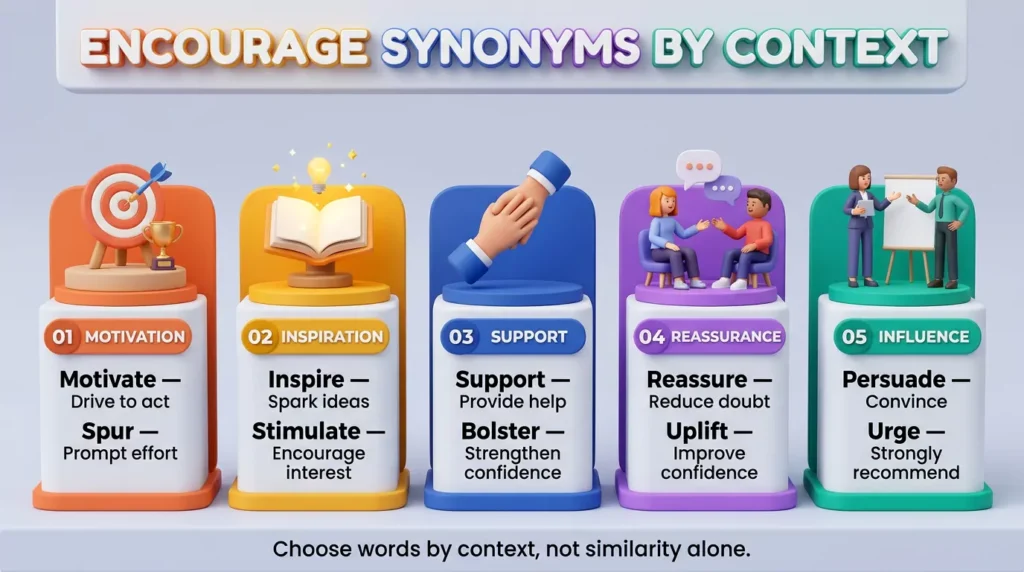
Words That Mean Motivate or Inspire
Use these words when you want someone to take action, pursue a goal, or develop enthusiasm.
- Motivate: Give someone a reason to act. Example: The coach motivated the players before the final.
- Inspire: Encourage enthusiasm, ideas, or ambition. Example: Her achievements inspired other women to start businesses.
- Stimulate: Encourage activity, interest, or thought. Example: The lesson stimulated students’ curiosity.
- Spur: Prompt someone to make an effort. Example: The competition spurred him to improve his skills.
- Galvanize: Inspire people to take immediate action. Example: The announcement galvanized volunteers into action.
- Energize: Give someone renewed energy or enthusiasm. Example: The new challenge energized the entire department.
- Fire up: Make someone enthusiastic or determined. Example: The speech fired up the team before the game.
- Rouse: Awaken interest, emotion, or action. Example: The campaign roused public interest in recycling.
- Activate: Make something or someone active. Example: The programme activated community participation.
- Drive: Provide a strong reason or force for action. Example: Her ambition drove her to practise daily.
- Encourage: Give confidence or support for an action. Example: His parents encouraged him to pursue music.
- Kindle: Begin to create a feeling or interest. Example: The book kindled her interest in science.
These alternatives are useful in education, sports, leadership, and personal development. However, “galvanize” often suggests stronger and more immediate action than “encourage.”
Words That Mean Support or Reassure

Choose these words when someone needs confidence, comfort, or assistance.
- Support: Provide emotional or practical help. Example: Her colleagues supported her during the transition.
- Reassure: Reduce fear, uncertainty, or doubt. Example: The teacher reassured the student before the examination.
- Comfort: Help someone feel less upset. Example: He comforted his friend after the disappointment.
- Console: Offer comfort during sadness or distress. Example: She consoled her sister after the loss.
- Bolster: Strengthen confidence or resolve. Example: The positive results bolstered their confidence.
- Uphold: Maintain or defend a principle or position. Example: The organisation upholds equal opportunities.
- Stand by: Remain supportive during difficulty. Example: Her family stood by her throughout the recovery.
- Back: Support a person, plan, or decision. Example: The director backed her proposal.
- Reinforce: Strengthen an existing belief or behaviour. Example: Regular praise reinforced his good habits.
- Validate: Acknowledge that someone’s feelings or concerns matter. Example: The counsellor validated her concerns.
- Encourage: Help someone feel confident enough to continue. Example: His friends encouraged him after the setback.
- Heartening: Make someone feel more hopeful. Example: The heartening response encouraged the volunteers.
“Support” often involves practical help, while “reassure” specifically addresses uncertainty. “Validate” acknowledges feelings but does not necessarily mean agreeing with every belief.
Words That Mean Persuade or Prompt
Use these alternatives when you want someone to consider an idea or take a particular action.
- Persuade: Convince someone through reasons or influence. Example: She persuaded her colleague to reconsider the proposal.
- Convince: Lead someone to accept an idea or belief. Example: The evidence convinced him to change his opinion.
- Urge: Strongly recommend an action. Example: The manager urged staff to complete the training.
- Prompt: Cause a response or action. Example: The reminder prompted him to submit the form.
- Nudge: Gently guide someone towards an action. Example: The email nudged customers to update their details.
- Prod: Push someone to act, sometimes impatiently. Example: His supervisor prodded him to finish the report.
- Press: Strongly encourage or insist on something. Example: The committee pressed leaders to explain the decision.
- Advocate: Publicly recommend or support an idea. Example: She advocates better access to education.
- Recommend: Suggest something as a suitable choice. Example: The adviser recommended further training.
- Encourage: Recommend or support an action without necessarily forcing it. Example: The teacher encouraged students to read more.
- Lobby: Seek to influence a decision-maker. Example: The group lobbied officials for safer roads.
- Entreat: Ask someone earnestly to do something. Example: She entreated him to reconsider his decision.
These words differ in intensity. “Nudge” suggests gentle influence, while “press” can imply strong pressure. “Persuade” usually suggests that someone changes their mind or agrees to act.
Words for Professional and Formal Writing
Professional writing often benefits from precise verbs. The best replacement depends on whether you mean support, development, action, or approval.
- Promote: Actively support or advance something. Example: The policy promotes equal access to training.
- Facilitate: Make an action or process easier. Example: The workshop facilitates collaboration.
- Enable: Make an action possible. Example: The new system enables faster communication.
- Advance: Help an idea, goal, or cause progress. Example: The initiative advances digital literacy.
- Foster: Encourage the development of something. Example: The company fosters a culture of innovation.
- Cultivate: Develop a quality, relationship, or habit. Example: Managers cultivate trust through honest communication.
- Champion: Actively support a cause or proposal. Example: The director champions employee development.
- Endorse: Publicly express approval or support. Example: The board endorsed the revised strategy.
- Recommend: Advise someone to consider an action. Example: The report recommends further investigation.
- Facilitate: Help people complete an activity more easily. Example: The coordinator facilitated discussions between departments.
- Strengthen: Improve the power or effectiveness of something. Example: The programme strengthens community partnerships.
- Promote: Help an activity, practice, or idea gain acceptance. Example: The campaign promotes responsible business practices.
Some professional alternatives are not direct synonyms in every sentence. For example, “enable” means making something possible, not necessarily giving emotional encouragement. Choose it only when that meaning fits.
Words That Mean Praise or Build Confidence
Use these alternatives when encouragement involves recognition, appreciation, or confidence-building.
- Praise: Express approval of someone’s work or behaviour. Example: The teacher praised her careful research.
- Commend: Formally express approval or admiration. Example: The manager commended the team for its dedication.
- Applaud: Show approval or appreciation. Example: The audience applauded his efforts.
- Recognise: Acknowledge someone’s effort or achievement. Example: The company recognised employees who helped customers.
- Appreciate: Show that you value someone’s contribution. Example: We appreciate your commitment to the project.
- Celebrate: Publicly recognise a success or achievement. Example: The school celebrated its students’ progress.
- Affirm: Express support for someone’s value, identity, or decision. Example: Her mentor affirmed her ability to lead.
- Validate: Acknowledge the importance of someone’s experience or feelings. Example: The supervisor validated his concerns.
- Compliment: Say something positive about a person or their work. Example: She complimented him on his clear presentation.
- Uplift: Help someone feel more positive or confident. Example: His message uplifted the entire group.
Praise can encourage future effort, but the words are not interchangeable. “Commend” sounds more formal, while “compliment” often refers to a specific positive remark.
Encourage Synonyms for Different Situations
The most suitable synonym depends on what you want to communicate.
| Situation | Suitable word | Example |
| Helping a student improve | Motivate | The teacher motivated students to practise regularly. |
| Giving someone hope | Reassure | Her words reassured the worried parent. |
| Supporting a new idea | Champion | The manager championed the proposal. |
| Building workplace confidence | Empower | The programme empowered new employees. |
| Encouraging immediate action | Urge | Officials urged residents to follow the guidance. |
| Developing a positive habit | Foster | Parents foster independence through everyday choices. |
| Helping someone feel better | Cheer | Her friends cheered her after the defeat. |
| Recognising strong performance | Commend | The director commended the team for its work. |
| Making a process easier | Facilitate | The new tool facilitated collaboration. |
| Influencing a decision | Persuade | He persuaded the group to reconsider. |
| Creating interest | Stimulate | The exhibition stimulated interest in local history. |
| Strengthening existing confidence | Bolster | The successful trial bolstered their confidence. |
Encourage vs. Motivate vs. Inspire vs. Support
These four words are common alternatives, but their meanings differ.
| Word | Main focus | Best use | Example |
| Encourage | Confidence and willingness | Helping someone continue or try | She encouraged him to apply. |
| Motivate | Reasons and drive | Increasing effort towards a goal | The reward motivated the team. |
| Inspire | Ideas and enthusiasm | Creating ambition or new possibilities | Her journey inspired young artists. |
| Support | Help and backing | Providing emotional or practical assistance | His colleagues supported his decision. |
When Should You Use Encourage?
Use “encourage” when you want to express positive guidance or support. It works in most everyday and professional situations.
Example: The teacher encouraged pupils to explore different solutions.
When Should You Use Motivate?
Use “motivate” when the main idea involves effort, determination, or achieving a goal.
Example: The clear target motivated the employees to improve performance.
When Should You Use Inspire?
Use “inspire” when someone or something creates enthusiasm, ambition, or new ideas.
Example: The scientist’s discoveries inspired a new generation of researchers.
When Should You Use Support?
Use “support” when you mean helping, backing, or standing by someone.
Example: Her family supported her decision to return to university.
Phrases You Can Use Instead of Encourage
Sometimes, a complete phrase sounds more natural than a single replacement word.
| Alternative phrase | Meaning | Example |
| Give someone confidence | Help someone believe in their abilities | Her feedback gave him confidence to present. |
| Offer support | Provide practical or emotional help | We offered support throughout the project. |
| Build someone’s confidence | Help someone become more self-assured | Practice can build a learner’s confidence. |
| Inspire someone to act | Create enthusiasm for an action | The campaign inspired people to volunteer. |
| Give someone a boost | Improve someone’s mood or confidence | A kind message gave her a boost. |
| Help someone move forward | Support progress | The advice helped him move forward. |
| Give someone the courage | Help someone feel brave enough | Her friends gave her the courage to speak. |
| Bring out the best in someone | Help someone perform well | A good coach brings out the best in players. |
| Cheer someone on | Express active support | The crowd cheered the runners on. |
| Encourage further progress | Support continued development | The results encourage further progress. |
These phrases are useful in emails, speeches, essays, and everyday conversations. They also help avoid repeating “encourage” too frequently.
Antonyms of Encourage
Antonyms express the opposite or a contrasting meaning. Choose one that fits the situation.
| Antonym | Meaning | Example |
| Discourage | Reduce someone’s confidence or willingness | The harsh criticism discouraged the learner. |
| Deter | Make someone less likely to act | High costs deterred potential buyers. |
| Dishearten | Cause someone to lose hope | The delay disheartened the volunteers. |
| Demotivate | Reduce someone’s desire to act | Unclear goals demotivated the team. |
| Undermine | Weaken confidence or support | Repeated doubts undermined his confidence. |
| Dissuade | Convince someone not to act | Her adviser dissuaded her from rushing. |
| Hinder | Make progress more difficult | Poor planning hindered the project. |
| Suppress | Prevent an activity or feeling from developing or being expressed | The rules suppressed open discussion. |
“Discourage” is the most direct general antonym. “Deter” focuses on preventing action, while “dissuade” means convincing someone against a particular choice.
Common Mistakes When Choosing Encourage Synonyms
Using Motivate and Inspire Interchangeably
These words overlap, but their emphasis differs. Motivation often relates to effort and goals. Inspiration often involves ideas, enthusiasm, or ambition.
Incorrect choice: The inspiring deadline made the team work faster.
Better choice: The approaching deadline motivated the team to work faster.
Using Persuade When You Mean Support
“Persuade” suggests influencing someone’s decision. “Support” means providing help or backing.
Example: Her friends supported her decision to change careers.
Use “persuaded” only if her friends helped change or shape that decision.
Using Urge for Gentle Encouragement
“Urge” can sound forceful or urgent. It may be unsuitable for a sensitive conversation.
Gentler alternative: I encouraged him to take his time.
Stronger alternative: I urged him to seek immediate assistance.
Using Formal Words in Casual Conversations
Words such as “galvanize,” “entreat,” and “advocate” suit specific contexts. They may sound unnatural in simple everyday speech.
Instead of saying, “I galvanised my friend to join us,” say, “I encouraged my friend to join us.”
Replacing Words Without Checking Grammar
Not every synonym fits the same sentence structure.
- Encourage someone to do something: She encouraged him to apply.
- Persuade someone to do something: She persuaded him to apply.
- Motivate someone to do something: She motivated him to apply.
- Support someone in doing something: She supported him in applying.
Always check the word’s usual grammatical pattern before replacing it.
Frequently Asked Questions
What Is the Best Synonym for Encourage?
“Motivate” is a useful alternative when you mean prompting effort or action. “Support” works for help, while “inspire” suits enthusiasm and ambition. The best choice depends on context.
What Is a More Professional Word for Encourage?
Consider “promote,” “foster,” “facilitate,” “empower,” or “champion.” Use “promote” for advancing an idea, “foster” for development, and “facilitate” for making an activity easier.
What Is Another Word for Encourage Someone?
You can use “motivate,” “inspire,” “reassure,” “support,” “empower,” or “cheer on.” Choose according to the help you want to describe.
What Is a Positive Word for Encourage?
“Inspire,” “uplift,” “empower,” and “bolster” often communicate positive support. However, each word emphasises a different effect.
What Is the Difference Between Encourage and Persuade?
To encourage someone is to give support or confidence. To persuade someone is to influence their decision or convince them to act. Encouragement does not always involve changing someone’s mind.
What Is the Opposite of Encourage?
“Discourage” is the most direct opposite in many contexts. Other alternatives include “deter,” “dishearten,” “demotivate,” and “dissuade.”
How Can I Avoid Repeating Encourage in an Essay?
Identify your intended meaning first. Use “motivate” for effort, “inspire” for enthusiasm, “support” for assistance, and “promote” for advancing an idea. Vary your vocabulary naturally without changing your meaning.
Can Encourage Mean to Promote Something?
Yes. “Encourage” can describe actions that help an activity or behaviour become more common. For example, the school encourages reading among its pupils. “Promote” may be more suitable when describing organised efforts to advance a policy or practice.
Is Encourage a Formal or Informal Word?
“Encourage” works in both formal and informal writing. It is suitable for conversations, academic essays, workplace emails, and professional reports.
What Is the Difference Between Encourage and Reassure?
“Encourage” can support action, confidence, or continued effort. “Reassure” specifically helps reduce fear, doubt, or worry.
Conclusion
The best encourage synonym depends on your purpose and audience. Use “motivate” for effort, “inspire” for ambition, and “support” for assistance. Choose “reassure” when someone needs comfort or confidence.
For professional writing, consider “foster,” “promote,” “empower,” or “facilitate” where appropriate. Always check the meaning and tone before replacing a word.
Precise vocabulary makes your writing clearer and more natural. Select the alternative that expresses your intended message most accurately.

Nadeem Akhtar has a keen interest in the way words shape clear communication. Through SimpleSynonyms, he shares easy-to-understand resources on vocabulary, synonyms, meanings, and everyday English to help readers express themselves with greater confidence.