

Looking for synonyms for therefore? The best alternatives include consequently, thus, hence, accordingly, as a result, and for this reason. Each expression communicates a conclusion or result, but some work better in academic writing, professional communication, or everyday conversation.
Choosing the right alternative can make your writing clearer and more natural. This guide explains the meaning of each word, provides practical example sentences, and shows you when to use different expressions.
What Does Therefore Mean?
“Therefore” is a transition word that introduces a logical conclusion, consequence, or result. It connects an earlier statement with something that follows from it.
For example:
- The roads were icy; therefore, the school closed early.
- She completed every assignment; therefore, she earned a high grade.
- The evidence was insufficient. Therefore, the committee postponed its decision.
In each example, “therefore” connects information with a logical outcome.
You can replace it with another expression when that alternative preserves the intended meaning and fits the sentence structure.
Best Synonyms for Therefore
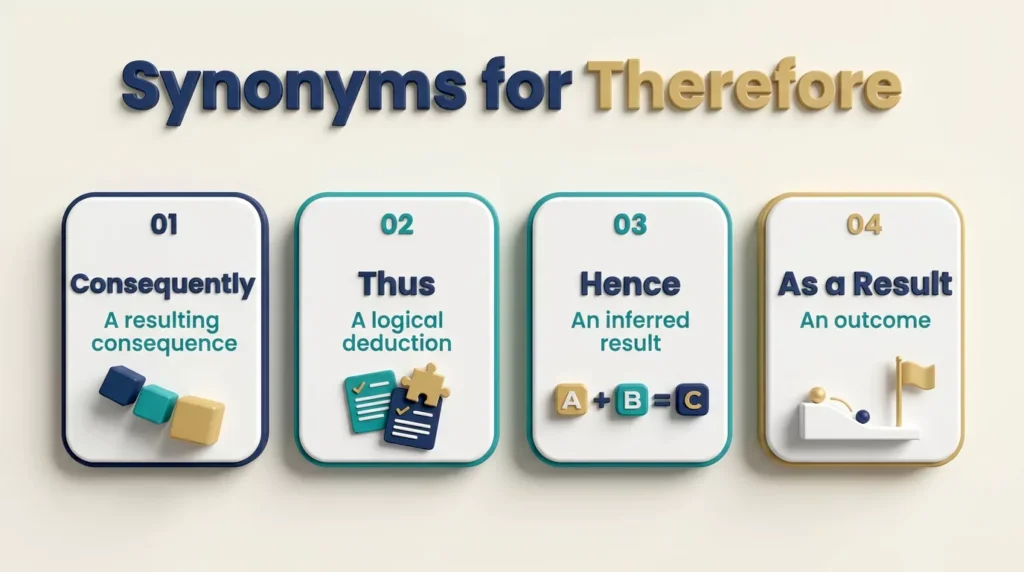
Several words and phrases can replace “therefore.” However, their meanings and tones vary slightly.
Common Alternatives to Therefore
These alternatives work well in general writing, explanations, and everyday communication.
- 🔗 As a result: Introduces an outcome caused by an earlier event.
Example: The team missed several deadlines. As a result, the project was delayed. - ➡️ Consequently: Emphasizes the consequence of an action or situation.
Example: The company reduced its expenses; consequently, its profits improved. - 💡 So: Provides a simple, conversational way to introduce a result.
Example: The train was running late, so we waited at the station. - 🧩 For this reason: Explicitly connects a conclusion with the explanation behind it.
Example: The instructions were unclear. For this reason, the manager provided additional guidance. - 📌 Because of this: Highlights a result caused by a previously mentioned circumstance.
Example: The roof had several leaks. Because of this, the homeowner arranged an inspection. - 🔄 As such: Can connect a description or established status with its implications. Its meaning depends on the sentence.
Example: The document contains confidential information and, as such, should be stored securely.
Formal and Academic Synonyms for Therefore
Formal alternatives can improve essays, research papers, reports, and professional documents.
- 🎓 Thus: Introduces a conclusion, deduction, or result, often in concise academic writing.
Example: The two measurements were consistent; thus, the hypothesis received additional support. - 📚 Hence: Expresses an inference or result, especially in formal, technical, or mathematical contexts.
Example: The sample size was too small; hence, the findings require further investigation. - 🏛️ Accordingly: Shows that an action, decision, or response follows from particular facts or circumstances.
Example: The requirements had changed. Accordingly, the team revised its proposal. - 📝 It follows that: Introduces a conclusion derived from the preceding reasoning.
Example: All registered participants must complete the assessment. It follows that unregistered visitors cannot take part. - 🔍 For this reason: Works in academic writing when you want to make the connection between evidence and a conclusion explicit.
Example: The results varied significantly between groups. For this reason, the researchers analyzed each group separately. - 📖 In consequence: A formal expression meaning as a consequence. It is less common in contemporary American English than “as a result.”
Example: The original deadline was missed. In consequence, the delivery date was revised.
Alternatives That Emphasize Results and Consequences
Use these expressions when you want readers to focus on the outcome of an event, decision, or action.
- ⚙️ Thereby: Indicates that an action produces a particular result or effect. It usually fits within the same sentence.
Example: The company automated routine tasks, thereby reducing processing time. - 📈 As a consequence: Emphasizes the outcome of an earlier event, often when discussing significant effects.
Example: The region received unusually little rainfall. As a consequence, water restrictions were introduced. - 🔗 In turn: Describes a result that becomes part of a chain of effects.
Example: Better insulation reduced heat loss, which in turn lowered heating costs. - 🧭 This means that: Explains the practical implication of information just presented.
Example: The warranty excludes accidental damage. This means that repairs following an accident may not be covered. - 🛠️ Which is why: Connects a preceding explanation to a decision or action. It often sounds natural in conversational writing.
Example: The basement frequently becomes damp, which is why the owner installed a dehumidifier. - 📍 For that reason: Emphasizes a specific justification for a decision or conclusion.
Example: The road becomes dangerous during heavy rain. For that reason, drivers should reduce their speed.
Alternatives for Introducing Conclusions
Not every conclusion is a direct consequence. Some expressions summarize an argument, draw an inference, or introduce a final recommendation.
- ✅ In conclusion: Signals the closing section of an argument or discussion.
Example: In conclusion, the available evidence supports improving the current process. - 💭 On that basis: Introduces a judgment or decision based on previously stated information.
Example: The supplier met every quality requirement. On that basis, the company approved the contract. - 🔎 Given this: Introduces a conclusion that follows from the circumstances already described.
Example: Given this, the organization should review its existing procedures. - 🧠 It can therefore be concluded that: Introduces an explicit conclusion, especially in formal analysis. Use it sparingly to avoid wordiness.
Example: It can therefore be concluded that the revised procedure improved consistency. - 📋 Taking this into account: Shows that a conclusion or decision considers the information previously discussed.
Example: Taking this into account, the manager recommended a more flexible schedule. - 🎯 Ultimately: Emphasizes the final outcome or main point after considering multiple factors. It does not always mean “therefore.”
Example: Ultimately, the committee selected the proposal that best met its requirements.
How to Choose the Right Synonym for Therefore
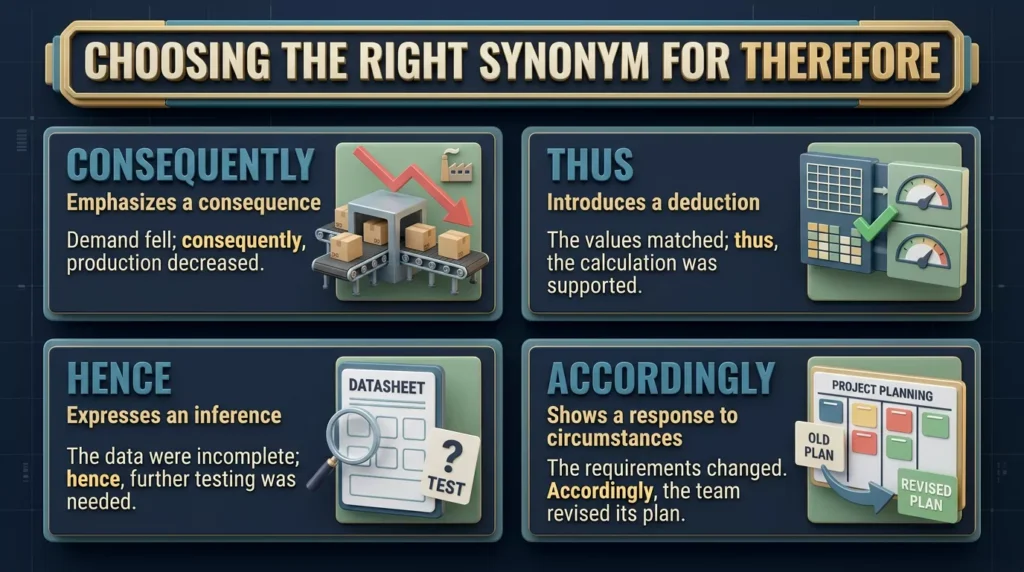
The best alternative depends on what you want to communicate.
| Your writing goal | Recommended alternative | Example |
| Show a direct result | As a result | The pipe burst. As a result, the basement flooded. |
| Emphasize a consequence | Consequently | Demand increased; consequently, prices rose. |
| Present a logical deduction | Thus | Both conditions were met; thus, the application qualified. |
| Make a formal inference | Hence | The data were incomplete; hence, further testing was necessary. |
| Explain a decision | Accordingly | The policy changed. Accordingly, the team updated its procedures. |
| Sound conversational | So | It was getting late, so we headed home. |
| Explain a specific reason | For this reason | The surface was slippery. For this reason, visitors used another entrance. |
| Introduce a final summary | In conclusion | In conclusion, the evidence supports the recommendation. |
| Show a chain of effects | In turn | Lower energy use reduced costs, which in turn improved profitability. |
| Explain a practical implication | This means that | The permit has expired. This means that renewal is necessary. |
A useful rule is to choose the expression that describes the relationship between your ideas most accurately. Formality alone is not a good reason to replace one word with another.
Therefore vs. Consequently vs. Thus vs. Hence
These four alternatives are similar, but they do not always communicate exactly the same emphasis.
| Word | Main emphasis | Best use | Example |
| Therefore | Logical conclusion or result | General explanations and arguments | The requirements were met; therefore, the application was approved. |
| Consequently | Consequence or outcome | Describing effects | Demand fell; consequently, production decreased. |
| Thus | Logical deduction or resulting state | Concise formal writing | The values matched; thus, the calculation was confirmed. |
| Hence | Inference or resulting explanation | Formal, technical, or mathematical writing | The equation has no valid solution; hence, the proposed value is incorrect. |
When Should You Use Therefore?
Use “therefore” when the second statement follows logically from the first.
Example: The equipment failed the safety inspection; therefore, it could not be put into service.
The word clearly signals the conclusion drawn from the inspection result.
When Should You Use Consequently?
Use “consequently” when you want to emphasize an outcome or effect.
Example: The supplier delivered the materials late; consequently, construction fell behind schedule.
This expression draws attention to the practical consequence of the delay.
When Should You Use Thus?
Use “thus” when you want a concise transition into a deduction or result.
Example: Both sides accepted the revised terms; thus, the agreement was finalized.
It is particularly useful when writing formal explanations, technical reports, and analytical arguments.
When Should You Use Hence?
Use “hence” when a conclusion follows from reasoning, evidence, or a stated condition.
Example: The measurements were inconsistent; hence, the experiment required additional testing.
“Hence” may sound more formal than “therefore” in ordinary conversation, so choose it according to your audience.
How to Use Therefore in a Sentence
“Therefore” can appear in different positions, depending on the sentence structure.
1. Use Therefore After a Semicolon
When “therefore” connects two independent clauses, you can place it after a semicolon and follow it with a comma.
Example:
The forecast predicted severe weather; therefore, the organizers postponed the event.
Both clauses can stand as complete sentences.
2. Use Therefore at the Beginning of a Sentence
You can begin a new sentence with “therefore” when the preceding sentence provides the reasoning.
Example:
The original measurements were inaccurate. Therefore, the technician repeated the test.
Place a comma after “therefore” when it introduces the sentence in this way.
3. Use Therefore Within a Sentence
“Therefore” can also appear in the middle of an independent clause.
Example:
The revised plan is therefore more practical for the available budget.
Its position depends on the sentence’s emphasis and structure.
4. Avoid Joining Independent Clauses With Only a Comma
A common mistake is using a comma alone to join two complete sentences.
Incorrect: The road was flooded, therefore, the driver took another route.
Correct: The road was flooded; therefore, the driver took another route.
Also correct: The road was flooded. Therefore, the driver took another route.
Punctuation helps readers understand the relationship between the two ideas.
Common Mistakes When Replacing Therefore
Choosing a synonym involves more than finding a word with a similar dictionary definition.
Using a Conclusion Marker to Show a Cause
“In conclusion” usually introduces a summary, not a direct consequence.
Less suitable: The power failed. In conclusion, the office closed.
More suitable: The power failed. As a result, the office closed.
Use “in conclusion” when wrapping up an argument or discussion.
Using Formal Words in Casual Conversations
“Hence” and “accordingly” may sound unnatural in relaxed conversation.
Unnatural: I missed the bus; hence, I arrived late.
More natural: I missed the bus, so I arrived late.
Match the tone of your transition to the situation.
Treating Every Synonym as Interchangeable
“Therefore,” “thereby,” and “in turn” perform different grammatical and semantic functions.
Compare these examples:
- Therefore: The team changed its strategy; therefore, the campaign improved.
- Thereby: The team changed its strategy, thereby improving the campaign.
- In turn: The campaign improved, which in turn increased customer engagement.
Each sentence expresses a relationship between actions and outcomes, but the grammatical structure differs.
Adding Unnecessary Transition Words
Too many transitions can make writing repetitive.
Wordy: The results were positive. Therefore, as a result, the team continued the project.
Clearer: The results were positive. Therefore, the team continued the project.
Choose one transition that communicates the relationship clearly.
Frequently Asked Questions About Synonyms for Therefore
What is the best synonym for therefore?
“Consequently,” “thus,” “hence,” and “as a result” are useful alternatives. The best choice depends on whether you want to emphasize a logical conclusion, a consequence, or a practical outcome.
What is a simple word for therefore?
“So” is a simple, conversational alternative. “As a result” is another clear option when you want to emphasize an outcome.
What is a formal word for therefore?
“Consequently,” “thus,” “hence,” and “accordingly” are formal alternatives. Choose the one that best expresses the relationship between your statements.
What can I use instead of therefore in an essay?
You can use “consequently,” “thus,” “hence,” “as a result,” or “for this reason.” For a conclusion paragraph, “in conclusion” may be appropriate when you are summarizing your argument rather than showing a direct result.
Is thus the same as therefore?
“Thus” and “therefore” often introduce logical conclusions or results. However, “thus” can also emphasize the manner in which something happens or the resulting state. The most suitable word depends on context.
Is hence more formal than therefore?
“Hence” often sounds more formal or technical in everyday American English. Both words can appear in academic and professional writing, and neither is automatically better in every context.
Can I use so instead of therefore?
Yes. “So” often works as a natural alternative in everyday conversation and informal writing.
For example:
- Formal: The data were incomplete; therefore, the analysis was postponed.
- Conversational: The data were incomplete, so we postponed the analysis.
The sentence structure must remain grammatically correct.
What is another way to say therefore in a business email?
“Accordingly,” “as a result,” “consequently,” and “for this reason” can work well in business emails.
Example: The delivery date has changed. Accordingly, we have updated the project schedule.
For a more conversational email, you can simply use “so.”
What punctuation should follow therefore?
When “therefore” begins a sentence, it is usually followed by a comma: “Therefore, we revised the plan.”
When it connects two independent clauses, a semicolon commonly precedes it, and a comma follows it: “The deadline changed; therefore, we revised the plan.”
Punctuation can vary with sentence structure and editorial style.
Conclusion
The best synonyms for therefore include “consequently,” “thus,” “hence,” “accordingly,” and “as a result.” For everyday communication, “so” and “because of this” can sound more natural.
Choose your alternative according to the meaning you want to express. Use “consequently” to emphasize an outcome, “thus” or “hence” for a logical deduction, and “accordingly” when a decision follows from particular circumstances.
When in doubt, read the sentence with the replacement word. If it preserves the intended relationship and sounds natural to your audience, it is likely a suitable choice.

Nadeem Akhtar has a keen interest in the way words shape clear communication. Through SimpleSynonyms, he shares easy-to-understand resources on vocabulary, synonyms, meanings, and everyday English to help readers express themselves with greater confidence.