
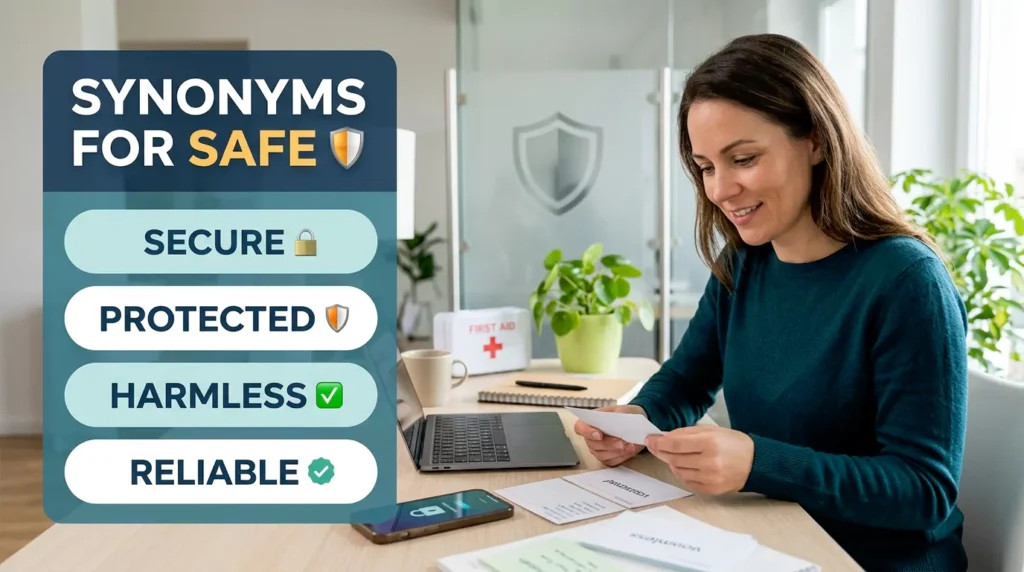

Looking for the best synonyms for safe? The right alternative depends on what you mean. Words such as secure, protected, harmless, reliable, cautious, and risk-free can communicate different aspects of safety.
For example, a secure building protects against unauthorized access, while a harmless substance is unlikely to cause injury under the relevant conditions. A reliable system performs consistently, and a cautious person takes steps to avoid danger.
This guide explores useful synonyms for safe, explains their differences, and provides practical example sentences for everyday conversation, professional writing, health, technology, and other situations.
What Does Safe Mean?
The word safe generally describes a person, place, object, action, or situation that is protected from danger, injury, damage, or unacceptable risk.
However, its meaning changes with context.
- Physical safety: A safe workplace helps protect employees from injury.
- Security: A secure account has protections against unauthorized access.
- Harmlessness: A harmless joke is unlikely to hurt or offend anyone.
- Reliability: A dependable system operates consistently.
- Cautious behavior: A careful driver follows traffic rules and watches for hazards.
- Acceptability: A safe option may be appropriate under specific rules or circumstances.
Understanding these distinctions helps you select a synonym that communicates your intended meaning accurately.
Best Synonyms for Safe
The following alternatives cover several common meanings of safe. Choose a word based on the sentence rather than replacing safe automatically.
- 🛡️ Secure: Protected against danger, intrusion, or unauthorized access.
Example: The company stores customer information in a secure database. - 🔒 Protected: Shielded from harm, damage, or unwanted exposure.
Example: The children played in a protected area away from traffic. - 🌿 Harmless: Unlikely to cause injury, damage, or other harm.
Example: The harmless prank made everyone laugh. - 🏠 Sheltered: Protected from harsh weather or other external conditions.
Example: The hikers found a sheltered spot during the storm. - 🤝 Reliable: Dependable and likely to perform as expected.
Example: We need a reliable backup system for our important files. - ✅ Trustworthy: Deserving confidence because someone or something is dependable or honest.
Example: She chose a trustworthy contractor with a strong record of completing projects. - 👀 Careful: Acting with attention to avoid mistakes, harm, or danger.
Example: Be careful when carrying hot food across the kitchen. - 🚦 Cautious: Showing awareness of potential risks before acting.
Example: Investors remained cautious while evaluating the uncertain market. - ⚖️ Acceptable: Suitable or permitted under the relevant requirements.
Example: The reviewer approved an acceptable alternative for the assignment. - 👍 Sound: Sensible, well-founded, or dependable, depending on context.
Example: The engineer recommended a sound approach to managing the risk. - 🧰 Securely stored: Kept in a way that reduces the risk of loss, damage, or unauthorized access.
Example: Keep confidential documents securely stored. - 🧪 Low-risk: Associated with a relatively low level of risk.
Example: The team selected a low-risk testing method for the initial trial. - ☂️ Shielded: Protected from a specific threat or harmful influence.
Example: The equipment was shielded from rain and dust. - 🌤️ Out of danger: No longer exposed to an immediate threat.
Example: After the rescue, everyone was out of danger. - 🟢 Unharmed: Not injured or damaged by an event.
Example: Everyone escaped the minor accident unharmed. - 📋 Compliant: Meeting applicable rules, standards, or requirements.
Example: The facility uses compliant procedures for handling regulated materials. - 🧩 Suitable: Appropriate for a particular purpose or situation.
Example: The teacher selected a suitable activity for younger students. - 🪴 Benign: Not harmful or not aggressive in a particular context.
Example: The report described the observed behavior as benign. - 🧭 Prudent: Showing good judgment when managing uncertainty or risk.
Example: Keeping a backup copy of important files is a prudent precaution. - 🛟 Protected from harm: Describes a person or thing that has safeguards against injury or damage.
Example: Workers must be protected from harm when performing hazardous tasks.
Synonyms for Safe by Context
Different situations call for different alternatives. These categories help you choose the most accurate word.
Safe as Protected From Danger
Use these words when describing a person, place, environment, or object protected from threats or physical harm.
- Secure: Emphasizes protection against threats or unauthorized access.
Example: The valuables remained secure inside the locked cabinet. - Protected: Emphasizes the presence of a safeguard.
Example: The plants were protected from strong winds. - Sheltered: Suggests protection from weather or exposure.
Example: The campers rested in a sheltered area. - Guarded: Suggests active protection or supervision.
Example: The entrance was guarded throughout the event. - Shielded: Highlights protection against a particular source of harm.
Example: The sensitive equipment was shielded from electromagnetic interference. - Out of danger: Indicates that an immediate threat has passed.
Example: The passengers were out of danger after leaving the damaged vehicle. - Unharmed: Emphasizes the absence of injury or damage.
Example: The child was found unharmed after the search.
Safe as Harmless or Unlikely to Cause Damage
These alternatives are useful when discussing substances, activities, jokes, materials, or potential effects.
- Harmless: Unlikely to cause injury or damage in the relevant circumstances.
Example: The demonstration used a harmless household material. - Benign: Not harmful or aggressive in the specified context.
Example: The inspection found a benign surface mark. - Nonhazardous: Not classified as hazardous under the applicable criteria.
Example: Staff separated nonhazardous materials from regulated waste. - Innocuous: Unlikely to cause harm, offense, or concern.
Example: His innocuous comment was not intended to upset anyone. - Gentle: Mild in effect or unlikely to be harsh.
Example: The cleaner uses a gentle formula for routine cleaning. - Low-risk: Involving relatively little risk compared with alternatives.
Example: The researchers began with a low-risk preliminary test.
Important: These words are not interchangeable in every safety-related context. A substance should not be called harmless or nonhazardous without appropriate evidence. Its effects may depend on the dose, exposure, intended use, and applicable safety standards.
Safe as Reliable or Trustworthy
Use these words when safety means dependable performance, confidence, or sound judgment.
- Reliable: Performs consistently as expected.
Example: The business depends on a reliable payment system. - Dependable: Can be counted on to perform a task or fulfill a responsibility.
Example: We need a dependable supplier for essential materials. - Trustworthy: Deserving confidence in someone’s honesty or conduct.
Example: Choose a trustworthy source before sharing sensitive information. - Sound: Sensible, well-supported, or structurally dependable.
Example: The committee approved a sound risk-management plan. - Stable: Not likely to change or fail unexpectedly under the relevant conditions.
Example: The equipment remained stable during the test. - Well-established: Supported by experience, evidence, or a recognized history.
Example: The organization follows well-established procedures for quality control.
These words describe different kinds of dependability. A trustworthy person may be honest without being technically competent, while a reliable machine may perform consistently without being secure against every threat.
Safe as Careful or Cautious
Sometimes safe describes how someone behaves rather than the condition of a place or object.
- Careful: Paying attention to avoid errors or harm.
Example: Be careful when using sharp kitchen tools. - Cautious: Considering possible dangers before taking action.
Example: The driver was cautious on the icy road. - Prudent: Making sensible decisions after considering risks.
Example: It was prudent to save a copy before editing the document. - Vigilant: Remaining alert to possible threats or problems.
Example: Security staff stayed vigilant throughout the event. - Risk-aware: Understanding potential hazards and their consequences.
Example: Risk-aware employees report problems before they escalate. - Conservative: Avoiding unnecessary risk or choosing a restrained approach.
Example: The team adopted a conservative estimate for its initial budget.
Choose careful for attention to detail, cautious for hesitation around potential danger, prudent for good judgment, and vigilant for continued alertness.
Safe as Acceptable or Permitted
In some contexts, safe means that a choice is appropriate, permitted, or unlikely to create an unacceptable problem.
- Acceptable: Meets the relevant expectations or requirements.
Example: The reviewer considered the proposed alternative acceptable. - Suitable: Appropriate for a particular purpose.
Example: The trainer selected a suitable exercise for beginners. - Appropriate: Fits the situation, audience, or circumstances.
Example: The manager chose an appropriate response to the complaint. - Permissible: Allowed under a rule, policy, or law.
Example: Only permissible materials may be brought into the laboratory. - Compliant: Meets applicable requirements or standards.
Example: The company updated its process to remain compliant with the relevant regulations. - Conventional: Following established or commonly accepted practices.
Example: The team chose a conventional approach for the initial assessment.
These words do not automatically mean that something is physically safe. A permitted activity may still involve risk, and an acceptable option may not be suitable for every person or circumstance.
Safe Synonyms in Everyday and Professional Writing
The best replacement depends on your audience, tone, and intended meaning.
Everyday Conversation
In casual speech, use straightforward words that sound natural.
- Safe place → secure place or protected place
- Safe to touch → unlikely to cause harm to touch, when supported by evidence
- Safe journey → secure journey is possible but less natural; safe journey is usually preferable
- Safe choice → sensible choice
- Safe person to ask → trustworthy person to ask
Example:
Original: “Is this place safe?”
Alternative: “Is this area secure?”
The alternative works best when asking about protection from crime or unauthorized entry. If you mean traffic, environmental hazards, or general physical danger, safe may be more accurate.
Academic and Professional Writing
Professional writing benefits from precise terms rather than unnecessarily elaborate synonyms.
- Safe procedure → protective procedure or risk-controlled procedure
- Safe system → secure system, when discussing access and protection
- Safe decision → prudent decision
- Safe assumption → reasonable assumption, if the evidence supports it
- Safe method → appropriate method, if suitability is the intended meaning
- Safe workplace → protected workplace or hazard-controlled workplace, depending on the context
Example:
Original: “The team needs a safe way to store confidential files.”
Alternative: “The team needs a secure method for storing confidential files.”
Secure is more specific because the sentence concerns protecting confidential information.
Health, Science, and Technical Writing
Technical writing requires particular care because a synonym may change the meaning of a safety claim.
- Safe material → material assessed for the intended use
- Safe treatment → treatment with an established safety profile, where supported by evidence
- Safe equipment → properly maintained equipment or equipment meeting applicable requirements, as appropriate
- Safe exposure level → exposure level within the applicable limits, when supported by measurements and relevant standards
- Safe chemical → chemical assessed for the intended conditions of use
Avoid replacing safe with harmless or risk-free merely to sound more precise. Technical claims should reflect the available evidence, exposure conditions, applicable standards, and remaining uncertainties.
Safe vs. Secure vs. Harmless vs. Reliable
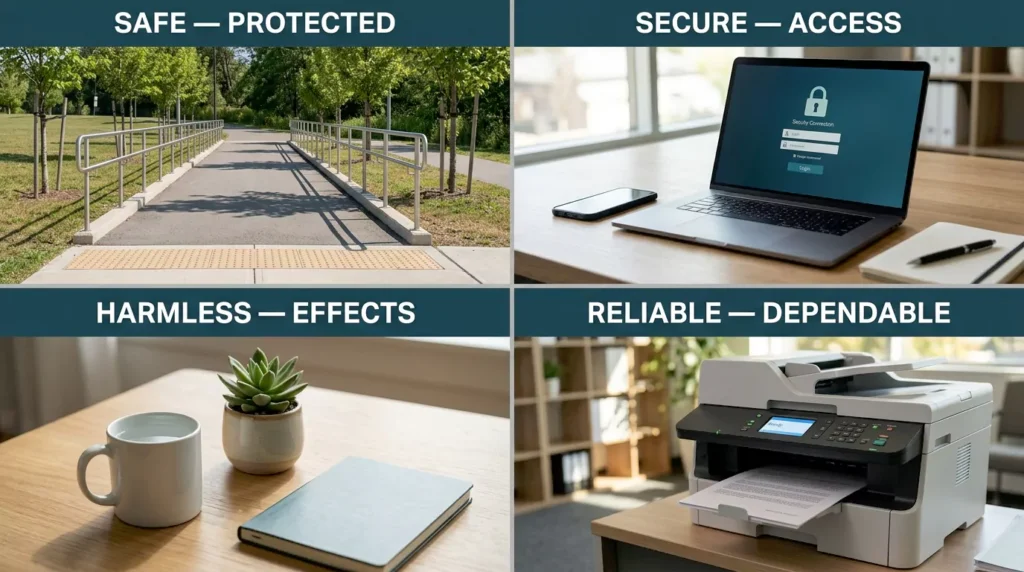
These four words overlap, but each communicates a different idea.
| Word | Main meaning | Best context | Example |
| Safe | Protected from or exposed to an acceptable level of danger | General safety | The walkway is safe to use after inspection. |
| Secure | Protected against threats, access, or loss | Security and protection | The account has secure login controls. |
| Harmless | Unlikely to cause injury or damage | Effects and consequences | The joke was harmless. |
| Reliable | Performs consistently or can be depended on | Systems, people, and services | The backup system is reliable. |
| Cautious | Careful about possible risks | Decisions and behavior | She was cautious when crossing the road. |
| Prudent | Sensible after considering risks | Judgment and planning | It was prudent to keep a backup. |
| Acceptable | Meets the relevant requirements | Choices and permissions | The proposed option was acceptable. |
| Low-risk | Has comparatively little risk | Risk comparison | The team selected a low-risk approach. |
The main distinction is that safe describes a general condition, while the other words emphasize a particular feature.
For example, a system can be reliable but not secure. It may operate consistently while remaining vulnerable to unauthorized access.
How to Choose the Right Synonym for Safe
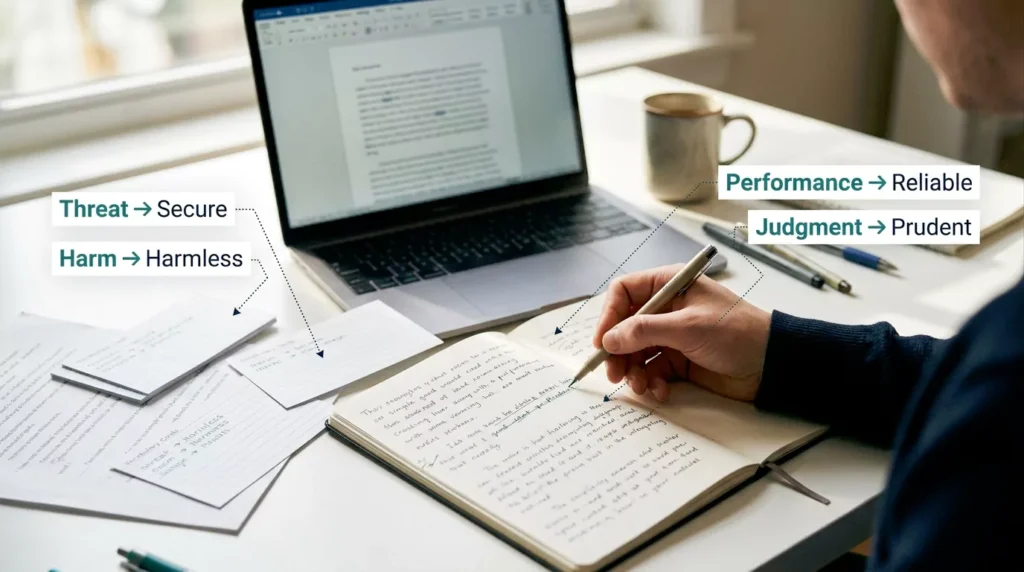
Use these steps to find a more precise alternative.
1. Identify What Needs Protection
Ask whether the sentence concerns a person, place, substance, device, decision, or activity.
For example, a safe password system is more likely to be described as secure than harmless.
2. Determine the Intended Meaning
Identify whether you mean protection from danger, lack of harmful effects, dependable performance, careful behavior, or acceptability.
- Protection from threats: secure
- Protection from injury: protected
- Low likelihood of harm: harmless, where justified
- Dependable performance: reliable
- Careful decision-making: prudent
- Permission under rules: permissible
3. Consider the Audience
Everyday readers generally benefit from simple language. Technical and professional readers may need terms tied to specific standards or evidence.
For example, safe equipment is broad. Equipment inspected according to the applicable standard provides a more specific description if that inspection has actually occurred.
4. Check the Strength of the Claim
Words such as risk-free, completely harmless, and guaranteed safe make strong claims.
Use them only when the evidence and context justify that level of certainty. In many real-world situations, lower-risk, protected, or assessed for the intended use is more accurate.
5. Read the Sentence Again
A synonym should preserve the original meaning and sound natural.
For example:
- “The children are safe.”
Depending on the situation: “The children are protected.” - “This website is safe.”
If discussing unauthorized access: “This website has security protections.” - “It is safe to assume the meeting will start on time.”
A natural alternative is: “It is reasonable to assume the meeting will start on time.”
The final example shows why context matters: reasonable describes the strength of an assumption, not physical safety.
Antonyms of Safe
Antonyms help clarify the meaning of safe. The best opposite depends on the context.
- ⚠️ Dangerous: Likely to cause harm or injury.
Example: Driving at excessive speed can be dangerous. - 🚨 Unsafe: Not sufficiently protected from danger or unacceptable risk.
Example: The inspector closed the unsafe walkway. - 🔓 Insecure: Not adequately protected against threats or unauthorized access.
Example: The outdated account settings left the system insecure. - 🧪 Harmful: Likely to cause damage or injury.
Example: The report examined the harmful effects of prolonged exposure. - 🎲 Risky: Involving a significant possibility of an undesirable outcome.
Example: Investing all the available funds in one venture can be risky. - ⚡ Hazardous: Presenting a potential source of harm or danger.
Example: Workers received training before handling hazardous materials. - ❌ Unreliable: Not consistently dependable.
Example: The unreliable connection disrupted the meeting. - 🚫 Inappropriate: Unsuitable for a particular purpose or situation.
Example: The proposed activity was inappropriate for the audience.
Remember that unsafe and dangerous are not always identical. Something may be unsafe because safeguards are inadequate, while something dangerous presents a potential source of harm even when precautions are available.
Frequently Asked Questions About Safe Synonyms
What is the best synonym for safe?
Secure is a strong alternative when you mean protected against threats or unauthorized access. Other options include protected, harmless, reliable, careful, and low-risk, depending on the context.
What is another word for safe in professional writing?
Useful alternatives include secure, protected, prudent, reliable, compliant, and appropriate. Choose the word that matches the actual meaning rather than selecting the most formal-sounding option.
What is a more formal word for safe?
Words such as secure, protected, prudent, and nonhazardous can work in formal writing. Their suitability depends on the subject and the evidence supporting the statement.
What is a synonym for safe that starts with S?
Secure is a common synonym. Other possibilities include sheltered and shielded, although each emphasizes a different type of protection.
What is a synonym for safe that starts with H?
Harmless is a useful alternative when describing something unlikely to cause harm. It does not necessarily mean that the item is secure or protected against every possible risk.
Is safe the same as secure?
No. Safe is a broad term for protection from danger or unacceptable risk. Secure usually emphasizes protection against threats, unauthorized access, or loss.
What is the difference between safe and harmless?
Safe can describe an overall condition or acceptable level of risk. Harmless specifically suggests that something is unlikely to cause injury, damage, or other harm in the relevant context.
Can reliable be used as a synonym for safe?
Sometimes, but not always. Reliable means dependable or consistent. A reliable device may still present a safety risk, so the words should not be treated as interchangeable.
What is the opposite of safe?
Common antonyms include unsafe, dangerous, hazardous, risky, and insecure. The best choice depends on whether the sentence concerns physical danger, harmful effects, or security threats.
Is risk-free another word for safe?
Not exactly. Risk-free implies that no risk exists, which is a stronger claim than safe in many contexts. Low-risk is often more appropriate when some uncertainty remains.
Conclusion
The best synonyms for safe depend on the meaning you want to communicate. Use secure for protection against threats, protected for safeguards against harm, harmless for unlikely harmful effects, and reliable for dependable performance.
For decisions and behavior, careful, cautious, and prudent can be more precise. For rules and suitability, consider acceptable, appropriate, or permissible.
Before replacing safe, check the context and the strength of your claim. The most effective word is the one that communicates your meaning clearly, naturally, and accurately.

Nadeem Akhtar has a keen interest in the way words shape clear communication. Through SimpleSynonyms, he shares easy-to-understand resources on vocabulary, synonyms, meanings, and everyday English to help readers express themselves with greater confidence.