

Finding the right synonyms for serious can make your writing more precise and natural. The best alternative depends on what you want to describe. A serious problem may be grave or critical, while a serious person may be thoughtful, solemn, or conscientious. Serious intentions may be sincere, genuine, or earnest.
This guide covers 75 alternatives to serious, including their meanings, example sentences, formal equivalents, and common usage differences. You will also learn which words work best in academic writing, professional communication, and everyday conversation.
What Does Serious Mean?
The word serious describes something important, potentially harmful, or deserving careful attention. It can also describe a person who behaves thoughtfully rather than playfully, or someone who genuinely means what they say.
The meaning changes with context.
- A serious problem: An important issue that may have significant consequences.
- A serious person: Someone who behaves thoughtfully or rarely jokes.
- A serious intention: A genuine commitment or sincere purpose.
- A serious illness: A medical condition that may require substantial attention or treatment.
- A serious discussion: A conversation focused on an important subject.
Understanding these meanings helps you choose an alternative that communicates the right degree of importance, emotion, or commitment.
Best Synonyms for Serious
The following words are useful alternatives, but they are not interchangeable in every sentence. Choose the word that best expresses your intended meaning.
| Synonym | Meaning | Example Sentence |
| Grave | Extremely serious or concerning | The committee discussed the grave consequences of the decision. |
| Severe | Very intense or harsh | The storm caused severe damage to several buildings. |
| Critical | Extremely important or requiring urgent attention | The team identified a critical weakness in the system. |
| Urgent | Requiring immediate action | We received an urgent request from the client. |
| Pressing | Needing attention soon | Finding affordable housing remains a pressing concern. |
| Alarming | Causing worry or fear | The report revealed an alarming increase in errors. |
| Dire | Extremely serious, often with potentially disastrous consequences | The organization faced dire financial circumstances. |
| Dangerous | Likely to cause harm | Driving through the flooded road was dangerous. |
| Significant | Important or meaningful | The policy produced significant changes. |
| Major | Large in scale or importance | The company announced a major restructuring. |
| Important | Deserving attention or consideration | This is an important decision for the entire team. |
| Substantial | Considerable in amount, size, or effect | The project requires a substantial investment. |
| Consequential | Likely to have important results | It was a consequential choice for the business. |
| Momentous | Extremely important, often historically or personally | Graduation marked a momentous occasion for the family. |
| Weighty | Important and deserving careful thought | The panel considered several weighty questions. |
| Acute | Intense, severe, or sharply felt | The region experienced an acute shortage of water. |
| Intent | Focused and determined | She gave the speaker an intent look. |
| Earnest | Sincere and deeply committed | He made an earnest effort to improve. |
| Sincere | Genuine in feeling or intention | Her sincere apology helped rebuild trust. |
| Solemn | Formal, serious, or emotionally restrained | Everyone observed a solemn moment of silence. |
Synonyms for a Serious Situation or Problem
When describing a difficult situation, choose a word that reflects its severity, urgency, or potential consequences.
1. Grave
Grave emphasizes the seriousness of a situation and its potentially harmful consequences.
Example: The investigation uncovered grave violations of safety regulations.
Best used for: Major concerns, consequences, risks, and formal reports.
2. Severe
Severe emphasizes intensity, harshness, or the degree of a problem.
Example: The region experienced severe flooding after several days of rain.
Best used for: Weather, damage, pain, penalties, shortages, and conditions.
3. Critical
Critical describes something essential, extremely important, or requiring immediate attention.
Example: Fixing the security vulnerability became a critical priority.
Best used for: Business decisions, technical failures, emergencies, and urgent needs.
4. Dire
Dire suggests an extremely difficult situation with potentially disastrous consequences.
Example: Without additional funding, the project faced dire prospects.
Best used for: Financial trouble, desperate circumstances, and bleak outcomes.
5. Pressing
Pressing describes an issue that needs attention soon, even if it is not immediately dangerous.
Example: Improving customer support is a pressing concern for the company.
Best used for: Work priorities, social issues, and unresolved problems.
6. Alarming
Alarming emphasizes the worry or fear that something causes.
Example: The number of workplace accidents was alarming.
Best used for: Unexpected developments, warning signs, and troubling findings.
7. Dangerous
Dangerous directly communicates the possibility of harm.
Example: Ignoring the damaged electrical wiring could be dangerous.
Best used for: Physical risks, unsafe behavior, and hazardous conditions.
8. Significant
Significant emphasizes importance or meaningful impact without necessarily suggesting danger.
Example: The new training program produced significant improvements.
Best used for: Results, changes, findings, and achievements.
9. Consequential
Consequential highlights the lasting effects or importance of an action or decision.
Example: Hiring the right manager was a consequential decision.
Best used for: Strategic choices, policy decisions, and long-term outcomes.
10. High-stakes
High-stakes describes situations in which the potential rewards or losses are substantial.
Example: The lawyers prepared carefully for the high-stakes negotiation.
Best used for: Legal proceedings, negotiations, major investments, and competitive decisions.
Synonyms for a Serious Person or Attitude

When describing a person, serious often refers to behavior, maturity, concentration, or emotional expression.
| Synonym | Meaning | Example |
| Thoughtful | Reflective and considerate | She gave a thoughtful response to the question. |
| Solemn | Grave or emotionally restrained | He remained solemn throughout the ceremony. |
| Sober | Sensible, restrained, or realistic | The report offered a sober assessment of the risks. |
| Somber | Gloomy or subdued in mood | The announcement left the room somber. |
| Focused | Concentrating on a goal or task | The focused student completed the assignment early. |
| Attentive | Paying close attention | The attentive audience listened carefully. |
| Conscientious | Careful, responsible, and diligent | A conscientious employee checks every detail. |
| Responsible | Dependable and accountable | She is a responsible leader who follows through. |
| Mature | Showing sound judgment and emotional development | He handled the disagreement in a mature way. |
| Sensible | Practical and reasonable | Choosing a backup plan was a sensible decision. |
| Levelheaded | Calm and rational under pressure | The levelheaded manager resolved the conflict. |
| Composed | Calm and in control of emotions | She remained composed during the difficult meeting. |
| Dignified | Showing self-respect and restraint | His dignified response prevented further tension. |
| Disciplined | Able to follow rules or maintain self-control | The disciplined athlete followed a consistent routine. |
| Determined | Firmly committed to achieving something | They were determined to finish the project. |
| Resolute | Unwavering in purpose or belief | The resolute director defended the decision. |
| Purposeful | Acting with a clear aim | She took purposeful steps toward her goal. |
| No-nonsense | Practical, direct, and uninterested in unnecessary distractions | The team appreciated his no-nonsense approach. |
How to Choose the Right Word for a Serious Person
Different alternatives describe different personal qualities.
- Use thoughtful when someone considers ideas or other people’s feelings carefully.
- Use solemn when someone’s expression or behavior is grave and restrained.
- Use conscientious when someone takes duties seriously.
- Use mature when someone demonstrates emotional development and sound judgment.
- Use focused when someone gives sustained attention to a task.
- Use resolute when someone remains firm in a decision.
- Use no-nonsense when someone values directness and practical results.
For example, a serious student might be focused during class, conscientious about assignments, or mature when handling criticism. Each word communicates a different strength.
Synonyms for Serious Intentions
When serious describes intentions, relationships, promises, or commitments, the intended meaning is often genuine, sincere, or deliberate.
| Synonym or Expression | Meaning | Example |
| Sincere | Genuine rather than dishonest | She expressed sincere gratitude for the support. |
| Genuine | Real and authentic | He showed genuine interest in the opportunity. |
| Heartfelt | Deeply and sincerely felt | They offered a heartfelt apology. |
| Authentic | True to one’s actual feelings or character | Her authentic enthusiasm impressed the team. |
| Wholehearted | Given with complete commitment | The volunteers offered wholehearted support. |
| Committed | Dedicated to a goal or responsibility | The organization is committed to improving access. |
| Dedicated | Devoted to a purpose or task | He is a dedicated teacher. |
| Devoted | Deeply loyal or attached | They remained devoted to their shared mission. |
| Steadfast | Firm and consistent in support or belief | She remained steadfast in her principles. |
| Unwavering | Not weakening or changing | His unwavering commitment inspired the group. |
| Intentional | Done deliberately rather than accidentally | Every change was intentional. |
| Deliberate | Carefully considered or consciously planned | The team made a deliberate effort to reduce waste. |
| Meaningful | Having significance or genuine value | They had a meaningful conversation about their future. |
| Bona fide | Genuine or authentic; often used formally | The applicant provided evidence of a bona fide business. |
| In earnest | With genuine intention and serious effort | The negotiations began in earnest on Monday. |
What Is Another Word for Serious in a Relationship?
When describing a relationship, committed, genuine, sincere, and intentional may communicate the intended meaning more precisely than serious.
Examples:
- They are in a committed relationship.
- He expressed genuine interest in building a future together.
- She wants an intentional relationship based on shared values.
- Their conversations about the future have become more meaningful.
The phrase serious relationship usually refers to a relationship involving meaningful commitment or long-term intentions. However, the exact meaning depends on the people involved.
Formal and Professional Synonyms for Serious
In professional and academic writing, precise alternatives can improve clarity and reduce repetition.
| Word | Best Context | Example |
| Important | General professional communication | This is an important consideration for the project. |
| Essential | Something necessary | Accurate documentation is essential for compliance. |
| Vital | Something extremely important to success or well-being | Clear communication is vital to effective teamwork. |
| Imperative | Something absolutely necessary or urgent | It is imperative that the team protect customer data. |
| Pivotal | Something that plays a central role | The meeting was pivotal to the final decision. |
| Paramount | Something of the highest importance | Patient safety remains paramount. |
| Noteworthy | Worth attention or recognition | The report identifies a noteworthy improvement. |
| Notable | Remarkable or worthy of notice | The analysis revealed a notable difference. |
| Profound | Deep, far-reaching, or strongly felt | The experience had a profound effect on her outlook. |
| Considerable | Large enough to matter | The proposal requires considerable preparation. |
Professional Writing Examples
Instead of writing, “This is a serious concern,” consider these alternatives:
- “This is a pressing concern that requires timely action.”
- “This is a significant issue for the organization.”
- “This is a critical risk to the project.”
- “This is a matter of paramount importance.”
- “This is a substantial challenge for the team.”
Choose based on the intended meaning. Critical suggests urgency or essential importance, while significant communicates importance without automatically implying danger.
Synonyms for Serious Medical Conditions
Medical language requires particular care because similar words can imply different levels or types of risk.
| Term | General Meaning | Example |
| Severe | Very intense or advanced in degree | The patient reported severe pain. |
| Critical | Describes an extremely serious condition requiring intensive attention in relevant medical contexts | The patient was reported to be in critical condition. |
| Acute | Describes a condition with a relatively sudden onset or short course in many medical contexts | The patient developed acute symptoms. |
| Life-threatening | Capable of causing death | The injury was life-threatening. |
| Grave | Extremely serious and potentially dangerous | The doctor explained the grave nature of the injury. |
These words are not interchangeable medical diagnoses. Acute does not automatically mean severe, and chronic does not automatically mean serious. The significance of a condition depends on its specific characteristics and clinical assessment.
For medical communication, use the clinician’s terminology when available. Do not infer a patient’s prognosis from a general synonym alone.
Serious vs. Severe vs. Grave vs. Critical
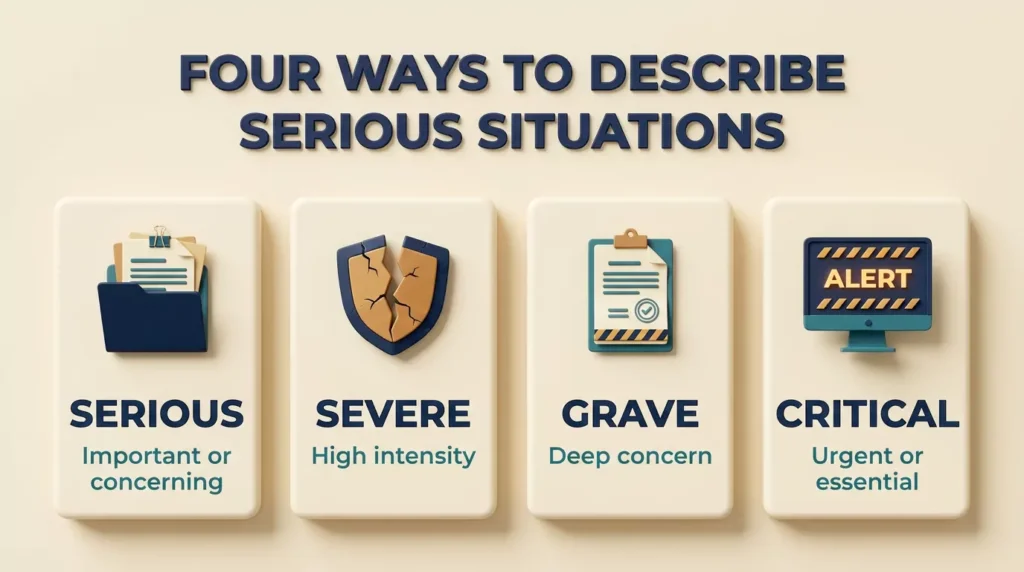
These four words often appear similar, but their emphasis differs.
| Word | Main Emphasis | Typical Example |
| Serious | General importance or potential consequences | We need to discuss a serious concern. |
| Severe | Intensity or degree | The area experienced severe damage. |
| Grave | Deep seriousness and potentially harmful consequences | The findings raised grave concerns. |
| Critical | Essential importance or a need for urgent attention | The system has a critical vulnerability. |
When Should You Use Serious?
Use serious when you need a broad, neutral description.
Example: The company is investigating a serious complaint.
When Should You Use Severe?
Use severe when emphasizing the intensity of a condition, impact, or experience.
Example: Severe weather disrupted transportation.
When Should You Use Grave?
Use grave when the situation has especially troubling implications.
Example: The discovery raised grave questions about public safety.
When Should You Use Critical?
Use critical when emphasizing urgent attention, essential importance, or a specialized meaning.
Example: Restoring the database is critical to business operations.
Other Useful Alternatives to Serious
The following five words or expressions provide additional alternatives in specific contexts.
71. Strict
Strict describes firm rules, standards, or enforcement rather than general seriousness.
Example: The laboratory follows strict safety procedures.
72. Stern
Stern describes a firm, disapproving, or uncompromising manner.
Example: The supervisor gave the team a stern warning.
73. Intense
Intense emphasizes a high degree of emotion, effort, activity, or concentration.
Example: The candidates participated in an intense debate.
74. Sobering
Sobering describes information or an experience that makes someone think seriously about a situation.
Example: The findings offered a sobering reminder of the risks.
75. Not joking
Not joking is an informal expression that makes clear someone means what they say.
Example: I’m not joking when I say we need to leave now.
These expressions have different grammatical roles and connotations. They work as alternatives only when the surrounding context supports the intended meaning.
Example Sentences Using Synonyms for Serious
Here are additional examples showing how different alternatives work in everyday and professional writing.
| Original Sentence | Alternative | Revised Sentence |
| We have a serious problem. | Critical | We have a critical problem that needs immediate attention. |
| She is a serious student. | Conscientious | She is a conscientious student who completes every assignment carefully. |
| He had serious intentions. | Sincere | He expressed sincere intentions about their future. |
| The company faces serious challenges. | Significant | The company faces significant challenges this quarter. |
| They had a serious discussion. | Candid | They had a candid discussion about the team’s difficulties. |
| The injury was serious. | Severe | The injury was severe enough to require medical attention. |
| It was a serious decision. | Consequential | It was a consequential decision with long-term effects. |
| She takes her work seriously. | Dedicated | She is dedicated to producing high-quality work. |
Notice that candid is not a universal synonym for serious. It works in the discussion example because it emphasizes honesty and openness. The same principle applies to every alternative: match the word to the meaning you want to communicate.
Common Mistakes When Choosing Synonyms for Serious
Treating All Alternatives as Interchangeable
A serious illness may be severe, but a serious student is not necessarily a severe student. The word must fit the noun and the intended meaning.
Using Critical When You Only Mean Important
Critical can imply urgency, essential importance, or a specialized meaning. If you simply mean that something deserves attention, important or significant may be more accurate.
Using Grave in Casual Situations
Grave often carries a weighty, formal tone. It may sound exaggerated when describing a minor inconvenience.
Confusing Serious With Stern
A serious person may be thoughtful or focused. A stern person is firm or disapproving. These descriptions overlap in some situations but are not equivalent.
Using Formal Words in Casual Conversation
Words such as paramount, consequential, and imperative can sound overly formal in everyday speech. Choose language that matches your audience.
Overstating Medical Severity
Terms such as critical and life-threatening communicate specific levels or types of concern. Do not use them as stylistic replacements unless the facts justify them.
Antonyms for Serious
Antonyms help clarify what serious means in different contexts.
| Antonym | Meaning | Example |
| Trivial | Of little importance | The disagreement concerned a trivial detail. |
| Minor | Limited in importance or severity | The inspection found only minor damage. |
| Lighthearted | Cheerful and not heavily serious | They enjoyed a lighthearted conversation. |
| Playful | Full of fun or a desire to play | Her playful response made everyone smile. |
| Casual | Relaxed or informal | They had a casual conversation after work. |
| Carefree | Free from worry or responsibility | The children enjoyed a carefree afternoon. |
| Humorous | Intended to entertain or amuse | His humorous remark eased the tension. |
| Frivolous | Lacking appropriate seriousness or purpose | The judge dismissed the frivolous argument. |
| Insignificant | Too small or unimportant to matter much | The difference was insignificant. |
| Flippant | Disrespectfully casual about something important | His flippant response upset the audience. |
The best antonym depends on the intended meaning. Playful contrasts with a serious attitude, while trivial contrasts with an important issue.
How to Choose the Right Synonym for Serious
Use this simple process to select a suitable alternative.
- Identify the subject. Are you describing a problem, a person, an intention, or a condition?
- Determine the intended meaning. Do you mean important, dangerous, sincere, focused, or emotionally restrained?
- Consider the intensity. Does the situation require a neutral word such as significant or a stronger word such as grave?
- Match the tone. Use natural vocabulary for everyday conversations and precise language for professional writing.
- Check the sentence. Read the complete sentence to ensure the alternative preserves the original meaning.
For example, if you are writing about a workplace problem, pressing, significant, or critical might fit. If you are describing someone’s behavior, thoughtful, conscientious, or solemn may be better.
Frequently Asked Questions
What Is the Best Synonym for Serious?
The best synonym depends on context. Grave works for a troubling situation, severe emphasizes intensity, sincere describes genuine intentions, and thoughtful describes a reflective person.
What Is a Stronger Word for Serious?
Grave, dire, and critical can communicate stronger concern in suitable contexts. Life-threatening is appropriate only when the situation genuinely poses a risk to life.
What Is a Formal Word for Serious?
Grave, consequential, paramount, and imperative are useful formal alternatives in appropriate sentences. Significant and substantial are often suitable for professional reports.
What Is Another Word for a Serious Problem?
Depending on the circumstances, you could use grave problem, critical issue, pressing concern, significant challenge, or major difficulty. Each expression emphasizes a slightly different aspect of the problem.
What Is Another Word for a Serious Person?
Thoughtful, solemn, conscientious, mature, focused, and no-nonsense can describe different types of serious behavior. Choose the word that best captures the person’s actual qualities.
What Is Another Word for Serious Intentions?
Sincere, genuine, committed, intentional, and earnest may work depending on the context. For relationships, committed or genuine often communicates meaningful intentions clearly.
Is Serious the Same as Severe?
No. Serious is a broad term for something important or concerning. Severe emphasizes intensity or degree. A situation can be serious without being severe.
What Is the Difference Between Grave and Serious?
Grave usually conveys a stronger sense of concern or potentially harmful consequences. Serious is more neutral and works across a wider range of contexts.
Can Significant Replace Serious?
Sometimes. Significant emphasizes importance or impact, while serious can also imply danger, concern, or a lack of playfulness. The words are interchangeable only when their meanings align.
What Is the Opposite of Serious?
Common opposites include playful, lighthearted, trivial, minor, and humorous. The best choice depends on whether serious describes an attitude or the importance of a situation.
Conclusion
The best synonyms for serious depend on meaning, context, tone, and intensity. Words such as grave, severe, and critical describe troubling situations, while thoughtful, conscientious, and solemn describe different personal qualities. For intentions, sincere, genuine, and committed may communicate the message more precisely.
Rather than replacing serious with the first similar word you find, consider what you want to emphasize. A carefully chosen synonym makes your writing clearer, more natural, and more effective.

Nadeem Akhtar has a keen interest in the way words shape clear communication. Through SimpleSynonyms, he shares easy-to-understand resources on vocabulary, synonyms, meanings, and everyday English to help readers express themselves with greater confidence.