

Finding the right nuances synonyms helps you express small differences more clearly. The best alternatives include subtleties, distinctions, shades of meaning, fine details, and variations. Each word carries a slightly different meaning.
Some alternatives suit academic writing, while others work better in everyday conversation. Understanding these differences helps you choose words that fit your message. This guide explains their meanings, examples, and most suitable uses.
What Does Nuances Mean?
Nuances are small differences in meaning, feeling, tone, or appearance. These differences might seem minor, but they can change how someone understands something.
For example, happiness and excitement are both positive emotions. However, happiness can feel calm, while excitement often involves stronger energy.
Recognising these subtle differences helps you communicate more accurately. It also makes your writing more expressive and precise.
The word nuance is singular, while nuances is plural. Both refer to subtle distinctions that deserve careful attention.
Best Synonyms for Nuances
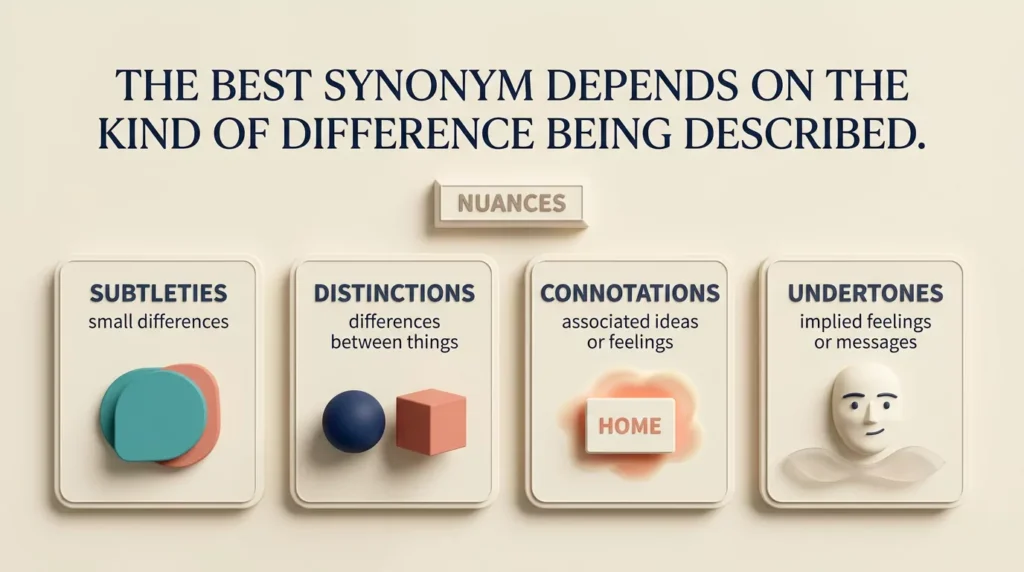
The best synonym depends on what you want to describe. Some alternatives emphasise small differences, while others focus on hidden meanings or specific details.
Here are useful alternatives with their meanings and examples.
1. Subtleties
🔎 Meaning: Small differences or details that are not immediately obvious.
Example: The reviewer noticed the subtleties in the author’s writing style.
Best use: Describing delicate differences in language, behaviour, art, or ideas.
Subtleties is often the closest alternative to nuances. Both words suggest details that require careful observation.
2. Distinctions
⚖️ Meaning: Differences that separate one thing from another.
Example: The teacher explained the distinctions between formal and informal language.
Best use: Academic writing, comparisons, definitions, and detailed explanations.
Unlike nuances, distinctions can describe obvious differences. Use it when separating concepts is more important than highlighting subtle details.
3. Shades of Meaning
🎨 Meaning: Small variations in what words or expressions communicate.
Example: The translator carefully preserved the shades of meaning in the original text.
Best use: Vocabulary, translation, literature, and language learning.
This phrase is particularly useful when two words share similar meanings but express different feelings or ideas.
4. Fine Details
🔍 Meaning: Small elements that contribute to a complete understanding.
Example: The editor examined the fine details of the report before publication.
Best use: Editing, research, design, and detailed analysis.
Fine details is a straightforward alternative for readers who prefer simple language. However, it does not always express differences in meaning.
5. Variations
🌈 Meaning: Differences or changes within a group, pattern, or form.
Example: The study explored variations in people’s responses to the same question.
Best use: Research, patterns, behaviour, methods, and results.
Variations works well when comparing different forms of something. It is less precise when describing implied meanings or emotional tones.
6. Undertones
🎭 Meaning: Feelings, meanings, or messages that exist beneath the obvious meaning.
Example: Her polite reply contained undertones of disappointment.
Best use: Dialogue, relationships, literature, and emotional communication.
An undertone is often indirect or implied. It can suggest a hidden attitude that the speaker does not express openly.
7. Connotations
💬 Meaning: Ideas or feelings associated with a word beyond its direct definition.
Example: The word carries positive connotations in this particular context.
Best use: Linguistics, advertising, literature, and persuasive writing.
Connotations focus on associations linked to words. They do not cover every kind of subtle difference.
8. Fine Distinctions
🧩 Meaning: Small but meaningful differences between related concepts.
Example: The philosopher explored fine distinctions between knowledge and belief.
Best use: Academic discussions, philosophy, legal analysis, and research.
This phrase works when two ideas appear similar but require careful separation.
9. Variations in Tone
🎙️ Meaning: Small changes in how someone sounds or communicates an attitude.
Example: The actor used variations in tone to express uncertainty.
Best use: Speech, writing, performance, and interpersonal communication.
This alternative is more specific than nuances. Use it when vocal or written tone is the main concern.
10. Intricacies
🧵 Meaning: Complex details or connected parts that require careful understanding.
Example: The documentary explained the intricacies of the political debate.
Best use: Complex systems, arguments, processes, and detailed subjects.
Intricacies suggests complexity rather than simply small differences. It works best when the subject contains several connected details.
11. Fine Points
📌 Meaning: Specific details that require attention or careful consideration.
Example: We discussed the fine points of the proposed agreement.
Best use: Meetings, discussions, negotiations, and practical explanations.
This expression suits everyday and professional communication. It often refers to particular details rather than differences in meaning.
12. Subtle Differences
🔬 Meaning: Small distinctions that may be difficult to notice.
Example: The designer compared the subtle differences between the two colour palettes.
Best use: Comparisons, descriptions, analysis, and everyday writing.
This phrase is clear and accessible. It is particularly helpful when the audience might not know more specialised vocabulary.
Nuances Synonyms by Context
Choosing an alternative becomes easier when you consider the subject. A word that works in academic writing may sound unnatural in casual conversation.
Nuances Synonyms for Academic and Professional Writing
Academic and professional writing often requires precise distinctions between related ideas. Choose words that explain the type of difference you mean.
- 📚 Distinctions: Useful for separating related concepts.
- 🔍 Subtleties: Suitable for interpreting complex arguments.
- 🧩 Intricacies: Helpful when explaining complicated systems.
- 📌 Fine points: Useful for specific details in a discussion.
- 📝 Variations: Suitable for differences in findings, methods, or results.
Example: The researcher examined subtle distinctions between the two theories.
For formal writing, avoid replacing nuances with a broad word unless it preserves your intended meaning.
Nuances Synonyms for Emotions and Personality
Emotions often overlap, but they are not always identical. The right words can describe these differences more accurately.
- ❤️ Subtleties: Small differences in emotional responses.
- 🎭 Undertones: Feelings that remain partly hidden.
- 💭 Shades of feeling: Slight variations in emotional experience.
- 🌿 Fine differences: Small changes in someone’s mood or attitude.
- 💬 Emotional cues: Signs that help others interpret feelings.
Example: Her expression revealed subtle differences between concern and disappointment.
Use undertones when an emotion is implied. Choose emotional cues when describing observable signs, such as facial expressions or gestures.
Nuances Synonyms for Language and Communication
Words can share a definition but create different impressions. These alternatives help explain how language communicates meaning.
- 💬 Shades of meaning: Small differences between related words.
- 📖 Connotations: Feelings or associations linked to a word.
- 🎙️ Variations in tone: Changes in how a message sounds.
- ✍️ Subtleties of expression: Delicate differences in communication.
- 🔎 Linguistic distinctions: Differences between language forms or meanings.
Example: The editor considered the connotations of each word before revising the sentence.
These expressions are particularly useful for writing, translation, literature, and language learning.
Nuances Synonyms for Art, Music, and Design
Creative work often communicates meaning through small changes in colour, sound, texture, or form.
- 🎨 Shades: Slight differences in colour or tone.
- 🎶 Variations: Changes in musical patterns or artistic forms.
- 🖌️ Subtleties: Delicate creative details.
- 🧵 Intricacies: Complex details within a design.
- 🌈 Gradations: Gradual changes between colours, levels, or qualities.
Example: The painter used subtle variations in colour to create depth.
Choose shades for colour, variations for changes in form, and intricacies for complex detail.
Nuances Synonyms Compared
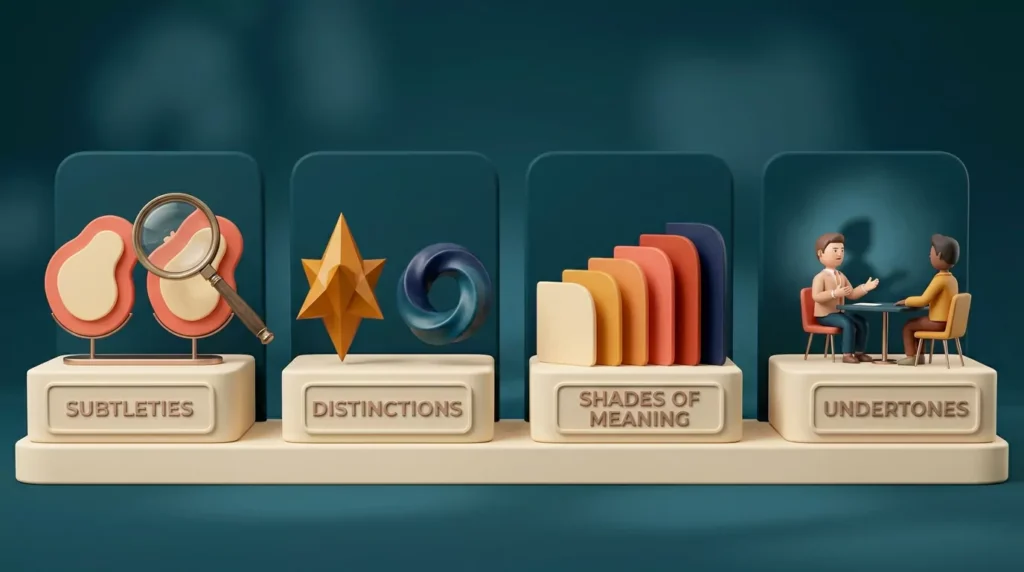
The following table highlights the main differences between common alternatives.
| Synonym | Main meaning | Best context |
| Subtleties | Small, delicate differences | General use |
| Distinctions | Differences separating concepts | Comparisons |
| Shades of meaning | Slight changes in meaning | Language |
| Fine details | Small parts of something | Editing and observation |
| Variations | Differences or changes | Research and patterns |
| Undertones | Implied feelings or messages | Emotions and dialogue |
| Connotations | Associated ideas or feelings | Word choice |
| Intricacies | Complex details | Complicated subjects |
| Fine points | Specific details | Discussions and agreements |
| Subtle differences | Hard-to-notice distinctions | General explanations |
Although these words overlap, they are not always interchangeable.
For example, connotations describes associations linked to words. Variations describes changes or differences. Undertones often refers to implied feelings.
Understanding these distinctions helps you choose more accurate alternatives.
How to Choose the Right Synonym for Nuances
Choosing the best word requires more than finding a similar definition. Consider what kind of difference you want to communicate.
1. Identify the Type of Difference
First, decide whether you mean a difference in meaning, emotion, appearance, or complexity.
- Use subtleties for delicate differences.
- Use distinctions for differences between concepts.
- Use connotations for associated meanings.
- Use undertones for implied feelings.
- Use variations for changes within a group.
This simple step narrows your options.
2. Consider Your Audience
Your readers should understand the word without unnecessary effort.
For general audiences, subtle differences and fine details are accessible choices. For academic readers, distinctions and connotations may be more precise.
Choose the simplest word that communicates your intended meaning.
3. Match the Tone of Your Writing
Different alternatives create different impressions.
Subtleties sounds thoughtful and descriptive. Distinctions sounds analytical. Undertones suggests something implied or partly hidden.
Choose the word that matches your purpose and tone.
4. Read the Sentence Again
Replace nuances with your chosen alternative. Then check whether the sentence still communicates the same idea.
For example:
Original: The writer explored the nuances of human behaviour.
Alternative: The writer explored the subtleties of human behaviour.
The second sentence preserves the idea of delicate differences.
However, replacing nuances with variations may shift the focus towards observable changes. Always consider the intended meaning.
Antonyms of Nuances
Nuances describe subtle differences or delicate details. Their opposites often suggest simplicity, uniformity, or a lack of distinction.
Useful contextual opposites include:
- Simplicity: A state without unnecessary complexity.
- Uniformity: A lack of meaningful variation.
- Sameness: The quality of being alike.
- Obviousness: A quality that is easy to notice.
- Generality: A broad description without specific details.
- Coarseness: A lack of fine detail or refinement in some contexts.
These words are not exact antonyms in every situation. Choose one according to the intended contrast.
For example, uniformity contrasts with differences between items. Generality contrasts with detailed or precise treatment.
Examples of Nuances in Sentences
Seeing the word in context makes its meaning easier to understand.
- The teacher explained the nuances of the poem.
- She understood the subtle differences between the two opinions.
- The report highlighted important distinctions between the findings.
- The translator preserved the shades of meaning in the original passage.
- His response carried undertones of frustration.
- The advertisement relied on the positive connotations of the word.
- The artist captured the intricacies of the old building.
- We discussed the fine points of the agreement.
- The research identified variations in customer behaviour.
- The editor noticed subtle differences in the author’s tone.
Each sentence emphasises a different aspect of meaning. These examples show why context matters when selecting synonyms.
Frequently Asked Questions About Nuances Synonyms
What is the closest synonym for nuances?
Subtleties is often the closest synonym for nuances. Both words describe small differences that may require careful attention. However, distinctions may work better when comparing separate concepts.
What is another word for nuances in academic writing?
Useful alternatives include subtleties, distinctions, fine distinctions, and shades of meaning. Choose the term that best describes your argument. For clear comparisons, distinctions is often appropriate.
Are nuances and subtleties the same?
They have closely related meanings, but their usage can differ. Nuances often highlights small differences in meaning, tone, or feeling. Subtleties can also refer to delicate details that are not immediately obvious.
What is the difference between nuances and distinctions?
Nuances usually refers to subtle differences. Distinctions refers to differences that separate one thing from another. A distinction can be obvious, while a nuance is often less noticeable.
Can I use variations instead of nuances?
Yes, when you mean changes or differences within a group. However, variations may not express subtle differences in meaning or feeling. Check the context before replacing one word with the other.
What are nuances in language?
Nuances in language are small differences in meaning, tone, or expression. For example, confident and arrogant can both describe self-assurance, but they carry different connotations.
How do you use nuances in a sentence?
Use nuances when discussing subtle differences that matter. For example: “The author explored the nuances of friendship.” This sentence suggests that friendship involves several delicate or complex aspects.
What is the singular form of nuances?
The singular form is nuance. Use it when referring to one subtle difference. Use nuances when discussing multiple differences or details.
Conclusion
The best nuances synonyms depend on the meaning you want to express. Subtleties is a strong general alternative, while distinctions suits comparisons. Shades of meaning works well for language, and undertones describes implied feelings.
Consider your audience, writing style, and intended message before choosing a replacement. The right word makes your writing clearer, more precise, and easier to understand.

Nadeem Akhtar has a keen interest in the way words shape clear communication. Through SimpleSynonyms, he shares easy-to-understand resources on vocabulary, synonyms, meanings, and everyday English to help readers express themselves with greater confidence.