


The best synonyms for voice depend on what you want to express. Words such as speech, opinion, tone, and expression suit different situations. Some describe how someone sounds, while others describe their ideas or writing style.
This guide explores 60 alternatives to voice, with simple meanings and practical examples. You will learn which words work in everyday conversations, professional writing, creative work, and grammar.
What Does Voice Mean?
Voice has several meanings in English. It can describe the sound produced when someone speaks or sings. It can also mean an opinion, a person’s right to express themselves, or a distinctive writing style.
In grammar, voice describes how a sentence presents an action. Active voice focuses on the person or thing performing the action. Passive voice focuses on the person or thing receiving it.
Because voice has several meanings, choosing the right synonym requires context.
60 Synonyms for Voice
The following alternatives are grouped by meaning. Some are direct substitutes, while others work only in specific contexts.
Common Synonyms for Voice
These words are useful when discussing speech, communication, opinions, or expression.
- Speech: The act or manner of speaking.
Example: Her speech inspired everyone in the room. - Utterance: Something spoken or expressed in words.
Example: His final utterance surprised the entire audience. - Expression: The communication of thoughts, feelings, or ideas.
Example: Writing provides an important form of personal expression. - Communication: The sharing of information, ideas, or feelings.
Example: Clear communication helps teams solve problems. - Statement: Something expressed clearly in words.
Example: The manager issued a statement about the changes. - Pronouncement: A formal or authoritative public statement.
Example: The director made a pronouncement about the new policy. - Declaration: A clear and often formal expression of a position.
Example: Her declaration showed strong support for the proposal. - Message: Information or meaning communicated to another person.
Example: His message encouraged people to work together. - Address: A formal speech delivered to an audience.
Example: The principal gave an address to the graduating class. - Oration: A formal and carefully prepared speech.
Example: The politician delivered an impressive oration.
Synonyms for Voice When Speaking
These alternatives describe spoken communication or the way someone delivers words. They do not all replace voice in every sentence.
- Speech delivery: The manner in which someone presents spoken words.
Example: Her speech delivery was clear and confident. - Enunciation: The clear pronunciation of individual words.
Example: Good enunciation made his presentation easier to follow. - Articulation: The clear formation of speech sounds and words.
Example: Regular practice improved her articulation. - Pronunciation: The way a word is spoken.
Example: His pronunciation improved after several lessons. - Diction: The choice and use of words, or the clarity of their delivery.
Example: The actor’s careful diction made every line understandable. - Delivery: The way someone presents a speech or message.
Example: His calm delivery helped the audience understand the topic. - Recitation: The act of repeating or presenting words aloud.
Example: Her recitation of the poem impressed the class. - Dialogue: A conversation between two or more people.
Example: The dialogue between the characters felt natural. - Conversation: An informal exchange of thoughts or information.
Example: Their conversation helped resolve the disagreement. - Discourse: Spoken or written communication about a subject.
Example: Public discourse often shapes how people understand social issues.
Synonyms for Voice as an Opinion or Personal Perspective
Voice can represent someone’s ability to share ideas, influence decisions, or express a position.
- Opinion: A belief or judgement about something.
Example: Everyone should have the opportunity to share an opinion. - Viewpoint: A particular way of understanding an issue.
Example: The article presents a different viewpoint. - Perspective: A way of seeing or interpreting a situation.
Example: Her perspective helped the team consider another solution. - Position: A person’s stated attitude or stance on an issue.
Example: The organisation explained its position on the proposal. - Standpoint: A particular position from which someone considers an issue.
Example: From a financial standpoint, the decision made sense. - Stance: A clearly expressed attitude or position.
Example: The candidate maintained a firm stance on education. - Belief: Something a person accepts as true.
Example: Her writing reflects a strong belief in fairness. - Conviction: A firmly held belief or opinion.
Example: He spoke with conviction about the need for change. - Testimony: A formal statement about facts or experiences.
Example: Her testimony helped clarify what had happened. - Representation: The act of speaking or acting on someone’s behalf.
Example: The group wanted fair representation in the discussion.
Synonyms for Vocal Sound and Quality
These words describe how a person sounds when speaking or singing. Several refer to specific features rather than the entire voice.
- Tone: The quality or character of a sound or manner of speaking.
Example: Her gentle tone made the conversation more comfortable. - Timbre: The distinctive quality that makes one sound different from another.
Example: The singer’s rich timbre made the performance memorable. - Pitch: How high or low a sound is.
Example: His pitch rose when he asked the question. - Resonance: The richness or fullness of a sound.
Example: The speaker’s resonance carried well across the hall. - Volume: The loudness or softness of a sound.
Example: Please lower your volume during the meeting. - Loudness: The quality of being loud or quiet.
Example: The loudness of his voice startled the audience. - Clarity: The quality of being clear and easy to understand.
Example: Her vocal clarity made the announcement easy to hear. - Projection: The ability to make the voice carry across a space.
Example: Strong projection helped the actor reach the back row. - Vocalisation: The production of vocal sounds.
Example: The exercise encouraged controlled vocalisation. - Phonation: The production of voiced sounds through vocal-fold vibration.
Example: The lesson explained how phonation produces voiced sounds.
Synonyms for Voice in Writing and Literature
In writing, voice often describes an author’s distinctive way of expressing ideas. Some alternatives describe related features rather than exact synonyms.
- Writing style: The characteristic way an author writes.
Example: Her writing style combines humour with clear explanations. - Narrative voice: The voice through which a story is told.
Example: The novel uses a reflective narrative voice. - Authorial voice: The distinctive expression of an author’s perspective and personality.
Example: The essay develops a confident authorial voice. - Tone: The attitude conveyed through a piece of writing.
Example: The email’s professional tone suited its audience. - Diction: The words an author chooses and how they use them.
Example: Simple diction made the passage accessible to young readers. - Style: The distinctive manner in which something is written or presented.
Example: His style makes complex ideas easier to understand. - Narration: The act or method of telling a story.
Example: The narration reveals details the characters do not know. - Point of view: The position or perspective from which a story is presented.
Example: The story uses a first-person point of view. - Expression: The way thoughts, emotions, or ideas are conveyed.
Example: Her creative expression became stronger with practice. - Authorial perspective: The author’s particular way of interpreting a subject.
Example: The article reflects the author’s perspective on modern education.
Synonyms for Voice in Grammar, Music, and Communication
These alternatives are related to particular technical or artistic meanings of voice.
- Active voice: A grammatical construction in which the subject performs the action.
Example: “The teacher explained the lesson” uses active voice. - Passive voice: A grammatical construction in which the subject receives the action.
Example: “The lesson was explained by the teacher” uses passive voice. - Vocal: Relating to the voice or its production.
Example: The singer completed several vocal exercises. - Vocal part: A musical part intended for a singer.
Example: She practised her vocal part before the concert. - Singing voice: The sound produced by someone while singing.
Example: His singing voice became stronger with training. - Vocal range: The span of pitches a singer can produce.
Example: The song suited her vocal range. - Vocal register: A group of tones produced using a particular vocal mechanism.
Example: The singer practised moving smoothly between vocal registers. - Vocal performance: The act of singing or delivering vocal music.
Example: Her vocal performance received warm applause. - Testimony: An account or statement offered as evidence or support.
Example: The witness provided testimony during the hearing. - Advocacy: Public support for a cause, person, or policy.
Example: Her advocacy helped raise awareness of the issue.
How to Choose the Right Synonym for Voice
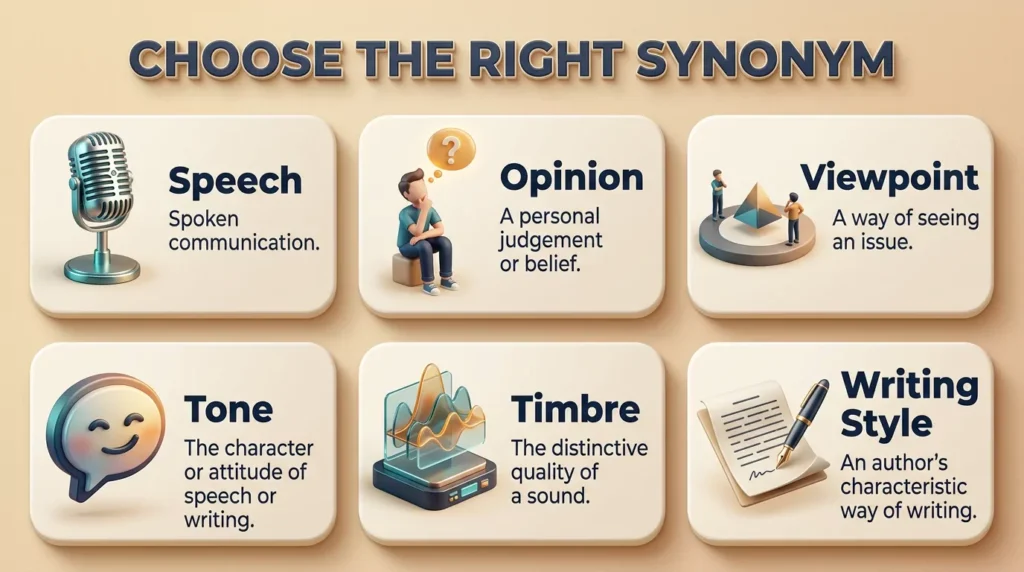
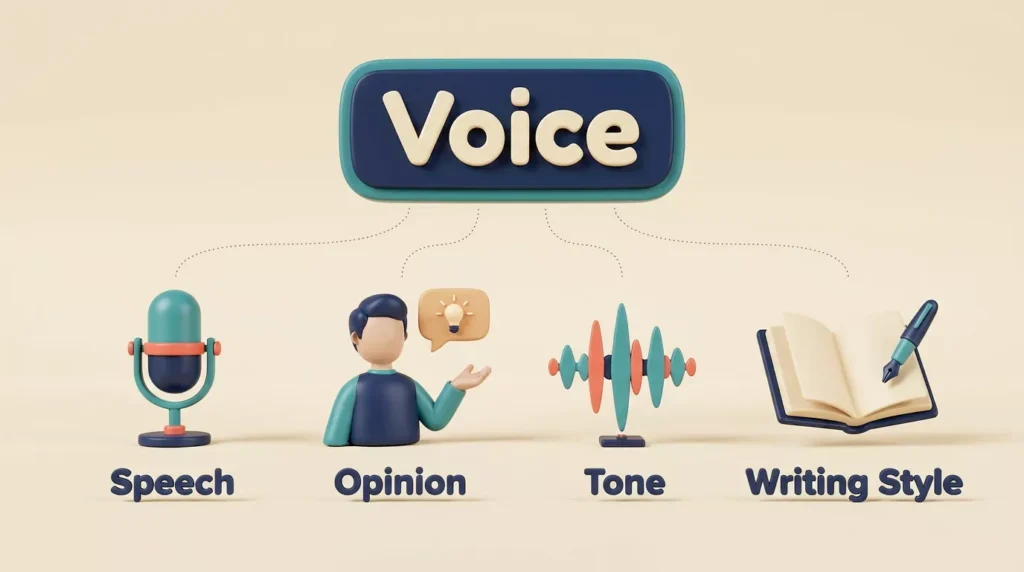
Choosing the right word depends on the meaning you want to communicate. Ask yourself what voice represents in your sentence.
When You Mean the Sound of Speaking
Use words that describe vocal qualities or spoken delivery.
- Choose tone when describing the character or attitude of a sound.
- Choose timbre when describing a distinctive sound quality.
- Choose pitch when discussing high or low sounds.
- Choose volume when discussing loudness.
- Choose enunciation when discussing clear pronunciation.
Example: Instead of “He had a pleasant voice,” you could write, “He had a pleasant tone.”
The replacement changes the focus from the whole voice to its character.
When You Mean an Opinion
Choose words that express a belief, position, or point of view.
- Choose opinion for a personal judgement.
- Choose viewpoint for a particular way of seeing an issue.
- Choose stance for a clear position.
- Choose conviction for a firmly held belief.
- Choose representation when someone speaks on behalf of others.
Example: Instead of “She shared her voice on the issue,” write, “She shared her opinion on the issue.”
When You Mean Writing Style
Choose words that describe how an author presents ideas.
- Choose writing style for an author’s overall manner of writing.
- Choose narrative voice for the voice telling a story.
- Choose authorial voice for an author’s distinctive expression.
- Choose tone for the attitude conveyed by the text.
- Choose point of view for the perspective from which a story is told.
Example: Instead of “The writer has a unique voice,” write, “The writer has a distinctive style.”
When You Mean Grammar
Use the established grammatical terms active voice and passive voice.
These terms are not interchangeable with words such as tone, opinion, or speech.
Example: “The chef prepared the meal” uses active voice. “The meal was prepared by the chef” uses passive voice.
Voice Synonyms: A Quick Comparison
| Word | Main meaning | Best use |
| Speech | Spoken communication | Public speaking and conversation |
| Opinion | Personal judgement | Expressing beliefs |
| Viewpoint | Way of seeing an issue | Discussion and analysis |
| Tone | Character of sound or writing | Speech and written communication |
| Timbre | Distinctive sound quality | Music and vocal description |
| Diction | Word choice or clarity of speech | Writing and performance |
| Expression | Communication of thoughts or feelings | Art, writing, and communication |
| Narrative voice | Voice telling a story | Fiction and storytelling |
| Enunciation | Clear pronunciation | Speaking and performance |
| Advocacy | Support for a cause | Public communication and campaigning |
Common Mistakes When Choosing Voice Synonyms
Treating Every Alternative as Interchangeable
A synonym may fit one context but sound incorrect in another. Pitch describes how high or low a sound is, not someone’s opinion.
Confusing Tone With Timbre
Tone can describe attitude or sound quality. Timbre specifically refers to a sound’s distinctive character.
Using Opinion When You Mean Writing Style
An opinion is a belief or judgement. Writing style describes how ideas are presented.
Confusing Voice With Speech
Speech refers to spoken communication. Voice can describe the sound itself or someone’s ability to express ideas.
Ignoring the Audience
Academic writing may require precise terms such as perspective or authorial voice. Everyday conversation often works better with simple words such as opinion or tone.
Frequently Asked Questions
What Is the Best Synonym for Voice?
The best synonym depends on the context. Speech suits spoken communication, opinion suits personal beliefs, and tone describes the character of speech or writing.
What Is Another Word for Voice in Writing?
Writing style, authorial voice, narrative voice, tone, and diction can be useful alternatives. Choose the term that matches the specific feature you want to describe.
What Is a Formal Synonym for Voice?
Formal alternatives include utterance, pronouncement, declaration, perspective, and testimony. Each has a different meaning, so select one that fits the sentence.
What Is a Synonym for Voice in an Argument?
Opinion, viewpoint, stance, position, and perspective may work when voice means an expressed belief. The best choice depends on the sentence and intended meaning.
What Is Another Word for a Strong Voice?
For vocal sound, consider powerful, resonant, clear, or commanding. For a strong opinion, consider firm, confident, or assertive expression.
What Is a Synonym for Voice in Literature?
Narrative voice, authorial voice, writing style, and tone are useful literary terms. They describe different aspects of how a story or text communicates.
What Is the Difference Between Voice and Tone?
Voice is the sound someone produces or a distinctive way of expressing ideas. Tone describes the character or attitude of speech or writing.
Can Expression Replace Voice?
Sometimes. Expression works when voice means communicating thoughts or feelings. It does not usually replace voice when describing vocal sound or grammatical structure.
What Is the Opposite of Voice?
There is no single antonym for every meaning of voice. Silence can contrast with spoken expression, while muteness describes an inability to speak. In grammar, active and passive are contrasting constructions rather than antonyms of voice.
How Can I Avoid Repeating the Word Voice?
Identify what voice means in each sentence. Replace it with a precise term such as tone, viewpoint, speech, or writing style when appropriate. Keep voice when it remains the clearest word.
Conclusion
Voice can refer to vocal sound, spoken communication, personal opinions, writing style, or grammatical structure. Each meaning requires different alternatives.
Words such as speech, opinion, tone, viewpoint, and expression are useful in many situations. More specific terms, including timbre, enunciation, and narrative voice, offer greater precision.
Always consider context before replacing voice. The best synonym communicates your intended meaning clearly and naturally.

Nadeem Akhtar has a keen interest in the way words shape clear communication. Through SimpleSynonyms, he shares easy-to-understand resources on vocabulary, synonyms, meanings, and everyday English to help readers express themselves with greater confidence.