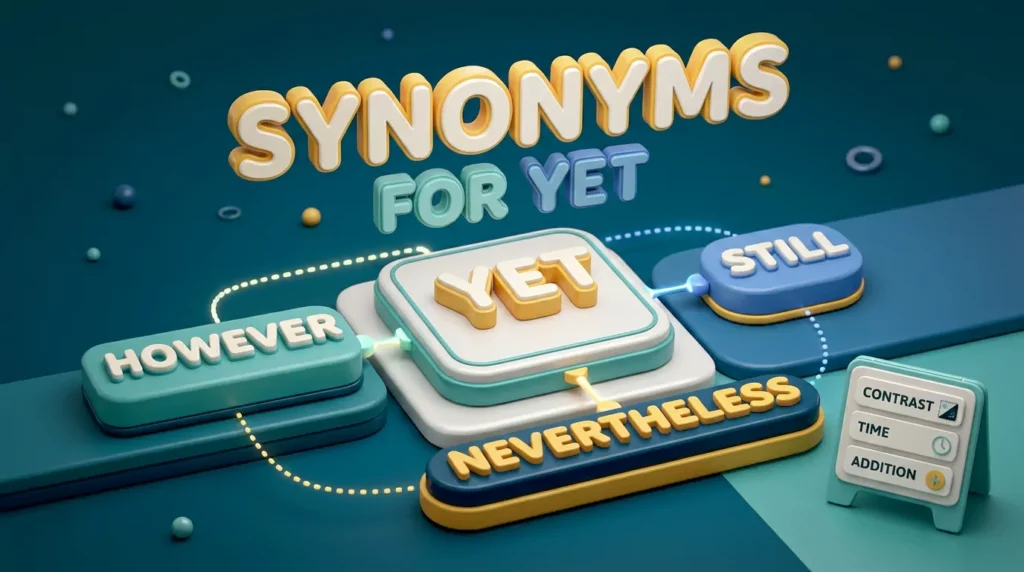

The best synonyms for yet include however, nevertheless, still, nonetheless, so far, and even so. However, the right alternative depends on the sentence. “Yet” can express contrast, describe an unfinished action, or add emphasis. Understanding these differences helps you choose accurate words for speaking, studying, and professional writing.
This guide explores 60 alternatives to yet, with clear meanings and realistic examples. You will learn which words work in different contexts and which substitutions to avoid.
What Does Yet Mean?
The word “yet” has several meanings in English. It can connect contrasting ideas, describe something that has not happened, or emphasize an additional amount or degree.
Consider these examples:
- Contrast: The task was difficult, yet she completed it.
- Time: The package has not arrived yet.
- Questions: Have you finished your assignment yet?
- Additional emphasis: The team discovered yet another problem.
Each use requires different alternatives. Words such as “however” work well for contrast, while “so far” may describe progress up to the present. Neither expression works naturally in every sentence containing “yet.”
Synonyms for Yet Meaning However or Nevertheless
When “yet” connects two contrasting ideas, it often means “but,” “however,” or “nevertheless.” These alternatives help show opposition, unexpected results, or differences between statements.
The following words and expressions work in suitable contrast sentences.
1. However
Meaning: Introduces a contrasting statement or idea.
Example: The product looks attractive. However, it is expensive.
2. Nevertheless
Meaning: Shows that something remains true despite a difficulty or opposing fact.
Example: The weather was terrible. Nevertheless, the event continued.
3. Nonetheless
Meaning: Expresses contrast while emphasizing that the result remains unchanged.
Example: The instructions were confusing. Nonetheless, she completed the task.
4. Still
Meaning: Shows that something remains true despite an opposing consideration.
Example: The journey was exhausting, but we still enjoyed it.
5. Even so
Meaning: Introduces a result that contrasts with the preceding statement.
Example: The room was small. Even so, everyone felt comfortable.
6. All the same
Meaning: Indicates that a previous fact does not change the conclusion.
Example: The offer was modest. All the same, I accepted it.
7. Despite that
Meaning: Shows that something happens despite a previously mentioned circumstance.
Example: The team faced several delays. Despite that, it met the deadline.
8. In spite of that
Meaning: Expresses contrast despite a particular difficulty or fact.
Example: The road was flooded. In spite of that, the delivery arrived.
9. Regardless
Meaning: Indicates that something remains unaffected by a particular condition.
Example: The task was challenging. Regardless, she continued working.
10. Even then
Meaning: Shows that a result remains surprising or unchanged under particular circumstances.
Example: He had plenty of time. Even then, he struggled to finish.
11. That said
Meaning: Introduces a qualification or contrasting consideration.
Example: The proposal has potential. That said, it needs further testing.
12. Having said that
Meaning: Introduces a different perspective after an earlier statement.
Example: The software is expensive. Having said that, its features are useful.
13. On the other hand
Meaning: Presents a contrasting viewpoint or alternative consideration.
Example: The apartment is affordable. On the other hand, it is far from work.
14. Conversely
Meaning: Introduces an opposite or contrasting situation.
Example: Some customers prefer email. Conversely, others prefer phone calls.
15. By contrast
Meaning: Highlights a difference between two things or situations.
Example: The first model is lightweight. By contrast, the second feels heavier.
16. But
Meaning: Connects ideas that contrast or differ.
Example: The assignment was difficult, but she finished it.
17. Although
Meaning: Introduces a fact that contrasts with the main statement.
Example: Although he was tired, he continued studying.
Usage note: “Although” usually introduces a dependent clause. It cannot replace “yet” in every sentence without changing the structure.
18. Though
Meaning: Introduces contrast and can sound more conversational than “although.”
Example: The restaurant was crowded, though the service remained quick.
19. Even though
Meaning: Emphasizes a contrast despite a particular fact.
Example: Even though the exam was difficult, she passed.
20. Notwithstanding
Meaning: Indicates that something remains true despite a stated circumstance. It is relatively formal.
Example: Notwithstanding the delays, the project was completed successfully.
Synonyms for Yet Meaning Still or Up to Now
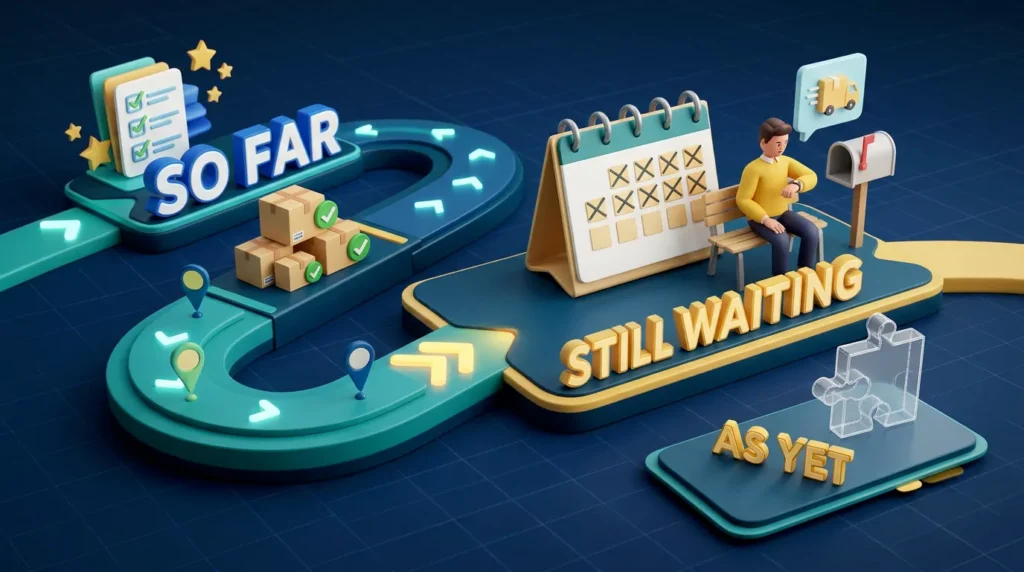
In time-related sentences, “yet” often describes something expected but not completed or a situation that continues up to the present.
These alternatives are useful when discussing progress, completion, or changes over time.
21. So far
Meaning: Describes what has happened up to the present moment.
Example: We have received five applications so far.
22. Thus far
Meaning: Means “up to this point” and often suits formal writing.
Example: The results have been encouraging thus far.
23. Until now
Meaning: Refers to a situation that has continued or remained true before the present.
Example: Until now, nobody had questioned the decision.
24. Up to now
Meaning: Describes the period extending from the past to the present.
Example: Up to now, the company has met every target.
25. To date
Meaning: Refers to everything recorded or completed up to the present.
Example: The campaign has attracted 2,000 visitors to date.
26. So far as
Meaning: Introduces a limitation or scope, depending on the sentence.
Example: So far as I know, the office remains open.
Usage note: “So far as” is not a general replacement for time-related “yet.” It is mainly useful in expressions such as “so far as I know.”
27. As yet
Meaning: Means “until now” and often appears in formal or negative statements.
Example: The committee has made no announcement as yet.
28. Hitherto
Meaning: Means “until now” and is relatively formal or literary.
Example: The research had hitherto focused on younger adults.
29. Previously
Meaning: Refers to something that happened or was true before a particular time.
Example: The building previously served as a school.
Usage note: “Previously” refers to an earlier time. It does not automatically convey the expectation often associated with “yet.”
30. By now
Meaning: Refers to something expected to have happened before the present moment.
Example: The delivery should have arrived by now.
31. Still
Meaning: Indicates that a situation continues or an expected change has not occurred.
Example: She is still waiting for the results.
32. Not so far
Meaning: Indicates that something has not happened during the period considered.
Example: We have not found any errors so far.
33. Up to this point
Meaning: Refers to progress or circumstances before the current stage.
Example: Up to this point, every test has passed.
34. Until this point
Meaning: Marks the end of a period or stage under discussion.
Example: Until this point, the investigation had remained confidential.
35. To this point
Meaning: Refers to progress or developments reached at a particular stage.
Example: To this point, the evidence supports our conclusion.
Alternatives to Yet in Negative Sentences and Questions
“Yet” commonly appears in negative sentences and questions about expected events. In these contexts, a replacement must preserve the meaning and time reference.
36. So far
Meaning: Indicates that an expected event has not occurred during the period considered.
Example: I have not received a reply so far.
37. As of now
Meaning: Describes the situation at the present moment.
Example: As of now, we have no confirmed date.
38. At present
Meaning: Refers to the current situation rather than a future expectation.
Example: The service is not available at present.
39. At this time
Meaning: Refers to the current moment or circumstances.
Example: We cannot confirm the booking at this time.
40. Up to the present
Meaning: Describes the period extending to the current moment.
Example: No major problems have appeared up to the present.
41. Until this moment
Meaning: Emphasizes the period leading to the present moment.
Example: Until this moment, I had received no updates.
42. So far as of today
Meaning: Combines a limited assessment with a specific present-day reference.
Example: So far as of today, no applications have been approved.
Usage note: This expression is often unnecessarily wordy. Prefer “as of today” or “so far” when either conveys the intended meaning.
43. At the moment
Meaning: Describes what is happening or true right now.
Example: We are not accepting new orders at the moment.
44. For now
Meaning: Describes a temporary situation that may change later.
Example: We have not made a decision for now.
Usage note: “For now” often works better when discussing temporary arrangements than when replacing “yet” in a question.
45. Not at this stage
Meaning: Indicates that something has not happened or is not appropriate at the current phase.
Example: We have not approved the proposal at this stage.
Synonyms for Yet Meaning Additional or Even More
In expressions such as “yet another problem” or “yet more evidence,” the word emphasizes an additional item or a further degree.
These alternatives depend heavily on sentence structure.
46. Another
Meaning: Indicates one more item or instance.
Example: We discovered another issue during testing.
47. One more
Meaning: Emphasizes a single additional item or action.
Example: Please give me one more minute.
48. Additional
Meaning: Refers to something added to what already exists.
Example: The project requires additional funding.
49. Further
Meaning: Indicates more information, action, progress, or development.
Example: Further evidence is needed before reaching a conclusion.
50. More
Meaning: Indicates a greater amount or an additional number.
Example: We need more information before proceeding.
51. Still more
Meaning: Emphasizes an additional amount beyond what was already mentioned.
Example: The revised report revealed still more errors.
52. Yet another
Meaning: Emphasizes one more occurrence, often with surprise or frustration.
Example: The team encountered yet another technical problem.
53. Once again
Meaning: Indicates that something happens another time.
Example: Once again, the system failed during testing.
Usage note: “Once again” refers to repetition, not simply an additional item.
54. Again
Meaning: Indicates repetition or the return of an action or event.
Example: The same question appeared again in the discussion.
55. Even more
Meaning: Emphasizes a greater quantity, degree, or intensity.
Example: The updated version is even more efficient.
Synonyms for Yet in Formal and Professional Writing
Formal alternatives can improve clarity in reports, essays, emails, and academic work. Choose the expression that matches the relationship between your ideas.
56. Nevertheless
Meaning: Presents a conclusion that stands despite an opposing fact.
Example: The sample was small. Nevertheless, the findings deserve further study.
57. Nonetheless
Meaning: Emphasizes that an outcome remains valid despite a limitation.
Example: The method has limitations. Nonetheless, it provides useful insights.
58. However
Meaning: Introduces a contrasting point or qualification.
Example: The proposal is promising. However, its costs require review.
59. Even so
Meaning: Acknowledges an opposing fact while maintaining the main point.
Example: The evidence is incomplete. Even so, the initial results are encouraging.
60. Notwithstanding this
Meaning: Introduces a point that remains valid despite a previously stated circumstance.
Example: The study has several limitations. Notwithstanding this, its findings offer useful direction.
Comparison Table: Which Alternative to Yet Should You Use?
| Intended meaning | Suitable alternative | Example |
| Contrast | However | The plan is simple. However, it is expensive. |
| Unexpected outcome | Nevertheless | The task was difficult. Nevertheless, she succeeded. |
| Continuing situation | Still | He is still waiting. |
| Progress up to now | So far | We have made good progress so far. |
| Formal time reference | Thus far | The results are promising thus far. |
| Unfinished expected event | As yet | No decision has been made as yet. |
| Additional item | Another | We need another example. |
| Additional quantity | Further | Further information is required. |
| Repeated event | Again | The issue occurred again. |
| Temporary situation | For now | We will keep the current arrangement for now. |
How to Choose the Right Synonym for Yet
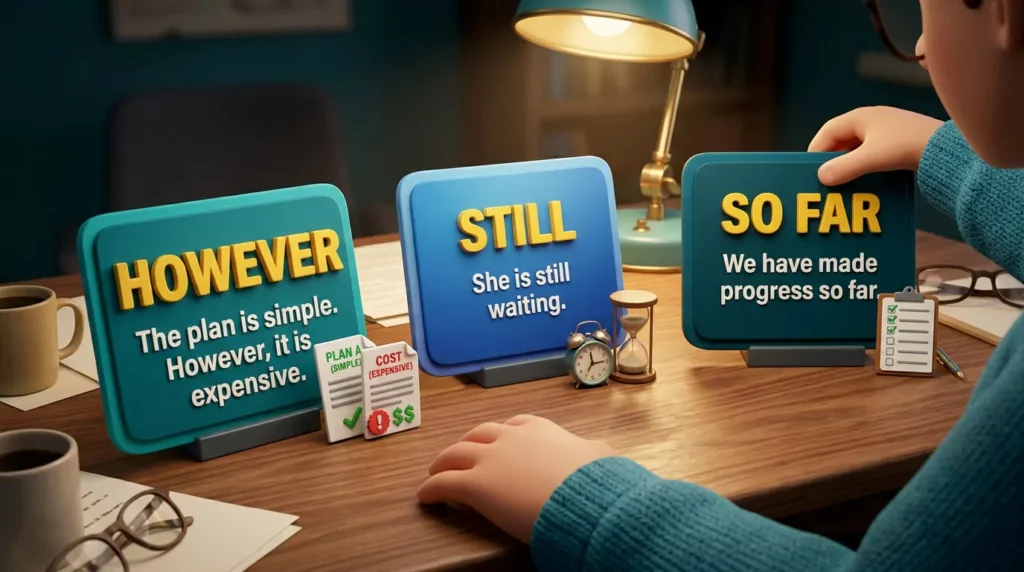
Selecting an alternative requires understanding the sentence’s intended meaning. Follow these practical guidelines.
Use however or nevertheless for contrast
Choose “however” when introducing a contrasting statement. Use “nevertheless” when emphasizing that an outcome remains valid despite an obstacle.
Example:
- Original: The task was difficult, yet she succeeded.
- Alternative: The task was difficult. Nevertheless, she succeeded.
Both versions express contrast, although the second emphasizes the unexpected success.
Use still or so far for time
Use “still” when a situation continues. Choose “so far” when describing progress up to the present.
Examples:
- Original: She has not replied yet.
- Alternative: She still has not replied.
- Original: We have completed three stages yet?
- Better alternative: We have completed three stages so far.
The last example illustrates why context matters. “So far” describes progress, while “yet” commonly appears in questions about expected completion.
Use another or further for additional information
Choose “another” for a singular additional item. Use “further” for additional information, investigation, action, or development.
Examples:
- Original: We discovered yet another error.
- Alternative: We discovered another error.
- Original: The team needs yet more evidence.
- Alternative: The team needs further evidence.
Match the level of formality
“However” and “nevertheless” suit many professional contexts. “But” and “still” often sound more conversational. “Hitherto” is formal and relatively uncommon in everyday writing.
Choose words that sound natural to your audience. Formal vocabulary does not automatically improve a sentence.
Common Mistakes When Replacing Yet
Using however without correct punctuation
Incorrect: The task was difficult, however she finished it.
Better: The task was difficult. However, she finished it.
When “however” connects two independent clauses, use appropriate punctuation. A semicolon can also connect the clauses.
Treating all alternatives as interchangeable
“Still,” “however,” and “so far” express different relationships. Replacing one with another can change the sentence’s meaning.
For example, “She is still waiting” describes continuation. “She is, however, waiting” presents a contrast with another idea.
Using although with the wrong sentence structure
Incorrect: Although the task was difficult, yet she finished it.
Better: Although the task was difficult, she finished it.
Alternatively: The task was difficult, yet she finished it.
In standard usage, avoid combining “although” and “yet” as competing contrast markers in the same clause structure.
Using formal vocabulary unnecessarily
Words such as “notwithstanding” and “hitherto” may sound unnatural in casual conversation.
Prefer simple alternatives when they communicate the same idea clearly.
Frequently Asked Questions
What is the closest synonym for yet?
“However,” “nevertheless,” and “still” are common alternatives when “yet” expresses contrast. For time-related uses, “so far” or “as yet” may be more suitable. The closest synonym depends on the sentence.
Can I use however instead of yet?
Yes, when “yet” connects contrasting ideas. However, the sentence may need different punctuation or structure. “However” cannot generally replace “yet” in sentences such as “Have you finished yet?”
What is another word for yet in formal writing?
“Nevertheless,” “nonetheless,” and “however” often work in formal writing when expressing contrast. “Thus far” and “as yet” may suit certain time-related contexts.
What is a synonym for yet in a negative sentence?
“So far,” “still,” and “as yet” can work in some negative sentences. For example, “I have not received a response yet” can become “I have not received a response so far.”
What can I use instead of yet in an essay?
For contrast, consider “however,” “nevertheless,” “nonetheless,” or “even so.” Select the expression that matches your argument and sentence structure.
Is still a synonym for yet?
Sometimes. Both words can describe an unfinished or continuing situation. However, their word order differs. “She has not arrived yet” and “She still has not arrived” are both natural.
What is the difference between yet and nevertheless?
“Yet” can connect contrasting ideas within a sentence and can also express time or additional emphasis. “Nevertheless” primarily introduces a contrasting conclusion, often across sentences.
What is the difference between yet and although?
“Yet” can connect contrasting clauses or indicate time. “Although” introduces a dependent clause expressing contrast. They are related in meaning but have different grammatical roles.
Can yet mean still?
Yes. In some negative statements, “yet” and “still” describe an expected event that has not happened. For example, “The package has not arrived yet” and “The package still has not arrived” are similar.
What is the opposite of yet?
There is no single antonym for every meaning of “yet.” In a time-related sentence, “already” may contrast with “not yet.” In other contexts, the appropriate opposite depends on the sentence.
Conclusion
The best synonyms for yet depend on what you want to express. Use “however,” “nevertheless,” or “even so” for contrast. Choose “still,” “so far,” or “as yet” for time-related meanings.
Use “another,” “further,” or “even more” when expressing addition. Remember that these alternatives are not interchangeable in every sentence.
Consider the meaning, grammar, and tone before replacing “yet.” With careful word choice, you can make your writing clearer, more natural, and more precise.

Nadeem Akhtar has a keen interest in the way words shape clear communication. Through SimpleSynonyms, he shares easy-to-understand resources on vocabulary, synonyms, meanings, and everyday English to help readers express themselves with greater confidence.