


Looking for synonyms for agree? The best alternative depends on what you mean. You might share someone’s opinion, accept a proposal, approve a decision, or reach a mutual understanding.
Words such as concur, support, consent, accept, and endorse express different forms of agreement.
This guide explains more than 75 alternatives, their meanings, and their correct usage. You will also find formal expressions, everyday phrases, comparisons, and example sentences.
What Does Agree Mean?
To agree means to have the same opinion, accept an idea, or reach a shared decision. It can also mean giving permission or accepting a proposed action. The intended meaning determines which synonym fits best.
For example, you can agree with someone’s opinion, agree on a meeting time, or agree to follow a plan. These expressions are related, but their grammatical patterns differ.
Common Synonyms for Agree
These alternatives cover several common meanings of agree. Some describe shared opinions, while others express support, acceptance, or consent.
| Synonym | Meaning | Example |
| Concur | To share the same opinion | I concur with your assessment. |
| Consent | To give permission or agree willingly | She consented to the arrangement. |
| Accept | To receive or agree to something offered | He accepted the proposal. |
| Approve | To consider something satisfactory | The manager approved the plan. |
| Support | To back an idea or decision | We support your recommendation. |
| Endorse | To express public or formal support | The committee endorsed the proposal. |
| Assent | To express agreement or approval | He assented to the terms. |
| Approve of | To regard something favorably | Her parents approve of the decision. |
| Acquiesce | To accept something without strong resistance | They acquiesced to the changes. |
| Align | To share a position or objective | Our priorities align with yours. |
| See eye to eye | To share the same opinion | We see eye to eye on this issue. |
| Be in accord | To be in agreement | Their findings are in accord. |
| Be of the same mind | To share the same view | We are of the same mind about the project. |
| Share someone’s view | To hold the same opinion | I share your view on education. |
| Be in agreement | To have the same position | Both teams are in agreement. |
Synonyms for Agree in Everyday Conversation
Everyday conversations often call for simple, natural expressions. These alternatives sound friendly and direct. Choose one that reflects your actual response.
1. Be on the same page
Meaning: To understand something similarly or share an understanding.
Example: Let’s make sure we are on the same page before starting.
2. See eye to eye
Meaning: To share the same opinion or perspective.
Example: My colleague and I see eye to eye on most issues.
3. Feel the same way
Meaning: To share someone’s feelings or opinion.
Example: I feel the same way about the proposed changes.
4. Think alike
Meaning: To have similar thoughts or opinions.
Example: We think alike when it comes to solving problems.
5. Be with someone
Meaning: To support someone’s position or understand their point.
Example: I’m with you on the need for better planning.
6. Go along with
Meaning: To accept or support a suggestion, decision, or plan.
Example: I can go along with your suggestion.
7. Be okay with
Meaning: To consider something acceptable.
Example: I’m okay with moving the meeting to Friday.
8. Have no objection
Meaning: To have no reason to oppose a proposal.
Example: I have no objection to your proposed schedule.
9. That’s right
Meaning: To confirm that a statement is correct.
Example: That’s right; we need another day to finish.
10. Exactly
Meaning: To emphasize complete agreement with a statement.
Example: Exactly, that is the problem we need to solve.
11. Absolutely
Meaning: To express strong agreement or certainty.
Example: Absolutely, we should review the results first.
12. I agree with you
Meaning: To state directly that someone’s opinion is shared.
Example: I agree with you about the importance of preparation.
13. Fair enough
Meaning: To accept someone’s point as reasonable.
Example: Fair enough; let’s consider another option.
14. Sounds good
Meaning: To express approval of a suggestion or arrangement.
Example: Sounds good. I’ll see you at ten.
15. That works for me
Meaning: To accept a proposed arrangement.
Example: Tuesday afternoon works for me.
Formal Synonyms for Agree

Formal alternatives help make academic writing, reports, business emails, and professional discussions more precise. The best choice depends on whether you share an opinion, approve a proposal, or accept a condition.
16. Concur
Meaning: To share an opinion or reach the same conclusion.
Example: I concur with the committee’s findings.
Best use: Academic discussions, formal meetings, and professional correspondence.
17. Assent
Meaning: To express agreement or approval, often formally.
Example: The board assented to the revised terms.
Best use: Formal or literary contexts.
18. Endorse
Meaning: To express support for a proposal, policy, or person.
Example: The organization endorsed the new policy.
Best use: Public statements, policies, and recommendations.
19. Affirm
Meaning: To state or confirm that something is true.
Example: The report affirms the importance of regular reviews.
Best use: Formal statements and confirmation. It does not always mean agreeing with another person.
20. Ratify
Meaning: To formally approve an agreement or decision.
Example: The members ratified the agreement.
Best use: Official agreements, treaties, and organizational decisions.
21. Validate
Meaning: To confirm that something is sound, justified, or legitimate.
Example: The findings validate our initial concerns.
Best use: Research, analysis, and evidence-based discussions.
22. Uphold
Meaning: To maintain or support a decision, principle, or ruling.
Example: The panel upheld the original decision.
Best use: Legal, institutional, and policy contexts.
23. Support
Meaning: To back a proposal, position, or recommendation.
Example: I support the proposed changes to the process.
Best use: Business communication and general formal writing.
24. Be in accord with
Meaning: To be consistent with or agree with something.
Example: The recommendation is in accord with our objectives.
Best use: Formal reports and analytical writing.
25. Be consistent with
Meaning: To match or not contradict a position or set of facts.
Example: The results are consistent with our expectations.
Best use: Research and factual comparisons. It does not necessarily mean active agreement.
26. Accept
Meaning: To agree to receive, adopt, or proceed with something.
Example: We accept the revised terms of the contract.
Best use: Offers, conditions, and proposals.
27. Approve
Meaning: To officially or personally consider something acceptable.
Example: The director approved the revised budget.
Best use: Decisions requiring approval or authorization.
28. Give one’s assent
Meaning: To formally express agreement.
Example: The members gave their assent to the proposal.
Best use: Formal writing and official proceedings.
29. Express agreement
Meaning: To communicate that a view or proposal is accepted.
Example: Several participants expressed agreement with the recommendation.
Best use: Reports and meeting summaries.
30. Share the assessment
Meaning: To hold the same judgment or evaluation.
Example: I share your assessment of the project’s risks.
Best use: Professional and analytical discussions.
Synonyms for Agree With an Opinion
When agreeing with someone’s belief, argument, or interpretation, choose a phrase that describes shared thinking. These alternatives work especially well in discussions and written arguments.
31. Agree with
Meaning: To share someone’s opinion or judgment.
Example: I agree with your explanation of the problem.
32. Concur with
Meaning: To share another person’s view or conclusion.
Example: I concur with your interpretation of the evidence.
33. Share the opinion
Meaning: To hold the same view as another person.
Example: Many researchers share this opinion.
34. Subscribe to
Meaning: To accept or support an idea, belief, or theory.
Example: She subscribes to the view that practice improves performance.
35. Support the view
Meaning: To favor a particular opinion or position.
Example: The evidence supports the view that early planning helps.
36. Endorse the argument
Meaning: To express support for an argument or position.
Example: The professor endorsed the argument in her review.
37. Echo
Meaning: To express a view similar to someone else’s.
Example: His comments echo the concerns raised by the team.
38. Share the belief
Meaning: To hold the same belief as another person.
Example: We share the belief that education should be accessible.
39. Be of the same opinion
Meaning: To hold an identical or similar opinion.
Example: The reviewers are of the same opinion about the proposal.
40. Be in agreement with
Meaning: To share a position or conclusion.
Example: I am in agreement with your recommendation.
41. Find common ground
Meaning: To identify beliefs or interests shared by different people.
Example: The two groups found common ground on education reform.
42. Agree in principle
Meaning: To accept the main idea while leaving details unresolved.
Example: We agree in principle, but the budget needs discussion.
43. Recognize the validity of
Meaning: To acknowledge that a point or argument has merit.
Example: I recognize the validity of your concern.
44. Acknowledge a point
Meaning: To recognize that someone’s argument or observation is valid.
Example: She acknowledged his point about rising costs.
45. Share the perspective
Meaning: To view a situation from a similar standpoint.
Example: Our team shares your perspective on customer service.
Synonyms for Agree to a Plan, Proposal, or Request
These alternatives focus on accepting an action, arrangement, offer, or condition. Some suggest willingness, while others indicate approval or a formal commitment.
46. Consent to
Meaning: To give permission or agree willingly to something.
Example: She consented to the proposed arrangement.
47. Accept
Meaning: To agree to an offer, proposal, or condition.
Example: He accepted the job offer.
48. Approve of
Meaning: To regard a plan or action favorably.
Example: The manager approves of the proposed schedule.
49. Go along with
Meaning: To agree to follow a suggestion or plan.
Example: The team went along with the revised timeline.
50. Sign off on
Meaning: To formally approve a plan or document.
Example: The director signed off on the final design.
51. Commit to
Meaning: To promise or dedicate oneself to an action.
Example: We committed to completing the project by June.
52. Pledge to
Meaning: To make a serious promise to do something.
Example: The organization pledged to improve its services.
53. Undertake
Meaning: To agree to take responsibility for a task.
Example: She undertook to prepare the final report.
54. Acquiesce to
Meaning: To accept a demand or situation without strong resistance.
Example: The company acquiesced to the requested changes.
55. Yield to
Meaning: To give way to another person’s demand or pressure.
Example: He eventually yielded to their request.
56. Give the go-ahead
Meaning: To authorize or permit something to proceed.
Example: The manager gave the go-ahead for production.
57. Give consent
Meaning: To provide permission or express willingness.
Example: Participants must give consent before taking part.
58. Approve a request
Meaning: To officially accept a request.
Example: The supervisor approved her request for leave.
59. Accept the terms
Meaning: To agree to stated conditions.
Example: Both parties accepted the terms of the agreement.
60. Enter into an agreement
Meaning: To formally establish an agreement with another party.
Example: The companies entered into an agreement last month.
Synonyms for Agree on a Decision or Arrangement
Use these expressions when people reach a shared conclusion, establish terms, or settle a practical question.
61. Reach an agreement
Meaning: To arrive at a shared understanding or decision.
Example: The teams reached an agreement on delivery dates.
62. Come to an agreement
Meaning: To settle a matter through mutual understanding.
Example: We came to an agreement after discussing the options.
63. Settle on
Meaning: To choose or decide on an option together or after consideration.
Example: We settled on a date for the meeting.
64. Decide together
Meaning: To make a decision jointly.
Example: The partners decided together on the new strategy.
65. Arrive at a consensus
Meaning: To reach general agreement within a group.
Example: The committee arrived at a consensus after lengthy discussion.
66. Reach a consensus
Meaning: To develop a shared position or decision.
Example: The team reached a consensus on the final design.
67. Find agreement
Meaning: To establish shared understanding or acceptance.
Example: The negotiators found agreement on several important points.
68. Reconcile differences
Meaning: To resolve disagreements and bring positions closer together.
Example: The teams reconciled their differences before signing the contract.
69. Resolve a dispute
Meaning: To settle a disagreement or conflict.
Example: Both parties resolved the dispute through negotiation.
70. Settle differences
Meaning: To resolve opposing views or conflicting interests.
Example: The representatives met to settle their differences.
71. Agree mutually
Meaning: To reach an understanding through shared agreement.
Example: The parties mutually agreed to extend the deadline.
72. Establish common ground
Meaning: To identify shared interests or positions.
Example: The discussion helped establish common ground between departments.
73. Reach a shared understanding
Meaning: To develop the same understanding of an issue.
Example: We reached a shared understanding of the requirements.
74. Come to terms
Meaning: To reach an agreement, often after negotiation.
Example: The parties came to terms after several meetings.
75. Harmonize
Meaning: To bring different views, plans, or approaches into agreement.
Example: The departments harmonized their plans for the launch.
Words That Express Partial or Reluctant Agreement
Not every agreement is enthusiastic or complete. Some words show limited support, reluctant acceptance, or a willingness to cooperate despite reservations.
76. Acquiesce
Meaning: To accept something without openly resisting it.
Example: She acquiesced to the decision despite her concerns.
77. Concede
Meaning: To admit that another person has a valid point or has won an argument.
Example: He conceded that the alternative plan was more practical.
78. Acknowledge
Meaning: To recognize a fact, point, or argument as valid.
Example: I acknowledge that your approach has advantages.
79. Recognize
Meaning: To accept or identify the truth or importance of something.
Example: We recognize the need for further discussion.
80. Grant
Meaning: To admit that a point is valid, sometimes reluctantly.
Example: I grant that the proposal has some benefits.
81. Give in
Meaning: To stop resisting and accept another person’s demand.
Example: He gave in after a long discussion.
82. Defer to
Meaning: To accept another person’s judgment or authority.
Example: I will defer to the expert’s recommendation.
83. Accept reluctantly
Meaning: To agree despite reservations or disappointment.
Example: They reluctantly accepted the revised conditions.
84. Meet halfway
Meaning: To compromise by making concessions on both sides.
Example: We met halfway to settle the disagreement.
85. Compromise
Meaning: To reach an agreement by accepting less than one’s original demands.
Example: Both sides compromised to finish the negotiations.
Differences Between Common Synonyms for Agree
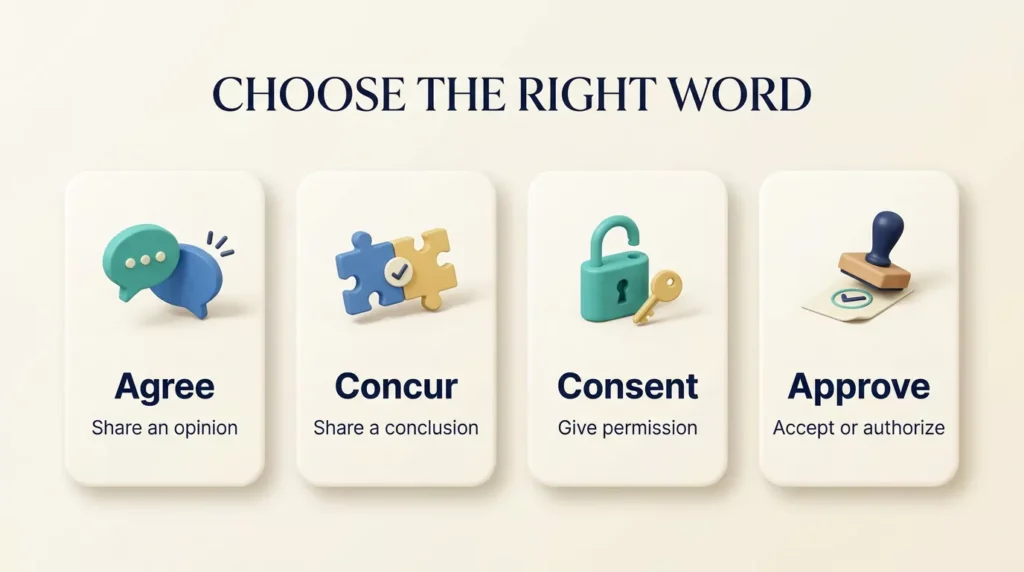
Some alternatives appear interchangeable but communicate different intentions. This table highlights distinctions that matter in professional writing and everyday communication.
| Word | Main meaning | Best context | Important distinction |
| Agree | Share an opinion or accept something | General use | Broadest and most flexible choice |
| Concur | Share an opinion or conclusion | Formal discussion | More formal than agree |
| Consent | Give permission or agree willingly | Requests and participation | Emphasizes willingness or permission |
| Approve | Consider something acceptable | Decisions and authorization | Often involves judgment or authority |
| Accept | Receive or agree to something offered | Offers and conditions | Does not always imply personal enthusiasm |
| Endorse | Publicly or formally support something | Policies and recommendations | Suggests clear support |
| Assent | Express agreement or approval | Formal contexts | Often describes a stated response |
| Acquiesce | Accept without strong resistance | Reluctant agreement | May suggest passivity or reluctance |
| Concede | Admit a point or defeat | Debates and negotiations | Often involves giving something up |
| Ratify | Formally approve an agreement | Official decisions | Usually applies to formal approval |
| Align | Share a direction or position | Goals and strategy | Does not always mean identical opinions |
| Compromise | Resolve differences through concessions | Negotiation | Usually requires both sides to adjust |
Agree vs. Concur
Both words express shared opinions. However, concur sounds more formal and often appears in professional or academic discussions.
Example: “I agree with your idea” sounds conversational. “I concur with your assessment” sounds more formal.
Agree vs. Consent
Agree can refer to shared opinions or accepted proposals. Consent specifically emphasizes permission or willingness.
Example: “I agree with your argument” expresses a shared view. “I consent to the procedure” expresses permission or willingness.
Agree vs. Approve
Agree means sharing an opinion or accepting something. Approve means considering something satisfactory or authorizing it.
Example: You can agree with a colleague’s reasoning without approving the final proposal.
Agree vs. Accept
Agree can describe shared views or a decision. Accept usually means receiving, adopting, or agreeing to an offer or condition.
Example: “I agree with your assessment” concerns an opinion. “I accept your offer” concerns an offer.
Agree vs. Acquiesce
Agree often sounds neutral or positive. Acquiesce suggests accepting something without strong resistance, sometimes reluctantly.
Example: “She agreed to the plan” sounds neutral. “She acquiesced to the plan” may suggest reluctance.
Agree vs. Concede
Agree means sharing a position or accepting something. Concede means admitting that another person has a valid point or yielding in a disagreement.
Example: “I agree that we need more time” is straightforward. “I concede that your estimate was more accurate” suggests an admission.
How to Use Agree in Sentences
The word agree commonly appears with three prepositions: with, on, and to. Each construction serves a different purpose.
| Expression | Use | Example |
| Agree with | A person, opinion, or idea | I agree with your conclusion. |
| Agree on | A topic, decision, or shared arrangement | We agreed on a meeting date. |
| Agree to | A proposal, request, condition, or action | She agreed to the changes. |
| Agree that | A statement or proposition | We agree that the deadline is realistic. |
| Agree about | A subject under discussion | They agree about the main issue. |
| Agree upon | A matter formally settled | The parties agreed upon the final terms. |
Common Mistakes to Avoid
Using the wrong preposition
Incorrect: We agreed with a date for the event.
Correct: We agreed on a date for the event.
Treating approval as identical to agreement
Incorrect in some contexts: The manager agreed the purchase without reviewing it.
Better: The manager approved the purchase.
Using consent for every type of agreement
Consent is most appropriate when permission or willingness matters. It is not a natural replacement for every opinion-based use of agree.
Assuming reluctant agreement means enthusiastic support
Acquiesce, yield, and give in can suggest resistance or pressure. Use support or endorse when genuine backing is intended.
Antonyms of Agree
Antonyms help explain the opposite of agreement. Choose one based on whether you mean an opposing opinion, refusal, or conflict.
| Antonym | Meaning | Example |
| Disagree | Have a different opinion | I disagree with that conclusion. |
| Oppose | Act against an idea or proposal | They oppose the proposed policy. |
| Object | Express opposition or concern | She objected to the new conditions. |
| Dispute | Challenge the truth or validity of something | The witness disputed the claim. |
| Reject | Refuse to accept something | The board rejected the proposal. |
| Refuse | Say no to a request or offer | He refused to sign the document. |
| Contradict | State the opposite of a claim | The evidence contradicts that explanation. |
| Dissent | Express a different or opposing view | Several members dissented from the decision. |
| Resist | Oppose or attempt to prevent something | Employees resisted the changes. |
| Conflict | Be incompatible or in opposition | Their accounts conflict with each other. |
Frequently Asked Questions
What is the best synonym for agree?
Concur is a useful formal synonym for agree. Support works when you back an idea, while accept suits offers and conditions. Consent is best when permission or willingness matters. The right choice depends on the sentence.
What is a more formal word for agree?
Concur, assent, endorse, and be in accord are formal alternatives. Concur is especially useful for professional opinions. Endorse emphasizes support, while assent expresses agreement or approval.
What is another way to say I agree?
You can say “I concur,” “That’s right,” “Exactly,” “I share your view,” or “I’m with you.” Choose a phrase that matches the situation and your intended tone.
What is a synonym for agree in an essay?
Concur, support, affirm, and share the view can work in academic writing. Use concur when expressing a shared opinion. Use support when evidence backs an argument. Use affirm when confirming a statement.
What is a synonym for agree with someone?
Concur with, share someone’s view, see eye to eye, and be of the same opinion are useful alternatives. See eye to eye sounds conversational, while concur with sounds more formal.
What is a synonym for agree to something?
Accept, consent to, approve, and commit to may fit. Accept works for offers and conditions. Consent to emphasizes permission, while commit to suggests a promise or responsibility.
What is a synonym for agree on something?
Reach an agreement, settle on, reach a consensus, and come to an agreement are useful choices. Settle on often refers to selecting an option. Reach a consensus emphasizes shared agreement within a group.
Is concur stronger than agree?
Not necessarily. Concur is generally more formal, but it does not always express stronger agreement. The strength of agreement depends on the context and the surrounding words.
Are agree and approve the same?
No. Agree can mean sharing an opinion or accepting a proposal. Approve means considering something acceptable or granting authorization. You can agree with an idea without approving an action.
What is the difference between agree and acquiesce?
Agree is a broad term for sharing an opinion or accepting something. Acquiesce means accepting a situation without strong resistance. It can suggest reluctance rather than enthusiastic support.
Conclusion
The best synonym for agree depends on your meaning, audience, and tone. Use concur for formal opinions, support for backing an idea, and consent for permission.
Choose accept for offers and conditions, endorse for clear support, and acquiesce for reluctant acceptance. When discussing shared decisions, phrases such as reach an agreement and reach a consensus may sound more natural.
Consider the surrounding sentence before replacing agree with another word. Precise word choices make emails, essays, reports, and conversations clearer. Select the alternative that expresses your intended meaning accurately.

Nadeem Akhtar has a keen interest in the way words shape clear communication. Through SimpleSynonyms, he shares easy-to-understand resources on vocabulary, synonyms, meanings, and everyday English to help readers express themselves with greater confidence.