
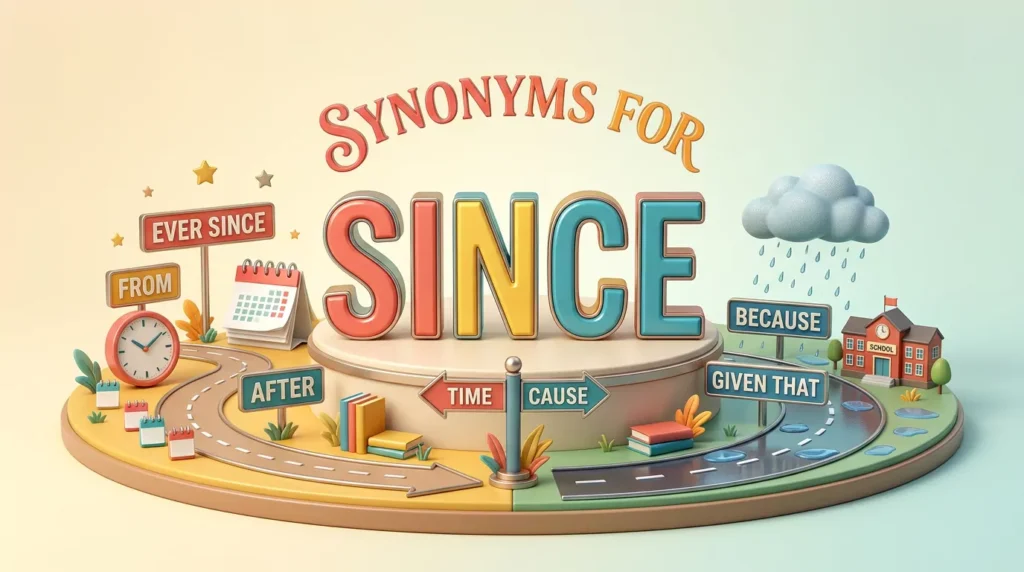

Looking for synonyms for since? The best alternative depends on whether you mean a point in time or a reason for something. Words such as because, as, from, after, and given that can work in different contexts, but they are not always interchangeable.
For example, you can replace “since Monday” with “from Monday onward” in some sentences. However, when “since” means “because,” you need a causal alternative instead.
This guide explores alternatives to since, explains their meanings, and provides practical examples for everyday conversation, academic writing, and professional communication.
What Does Since Mean?
The word since has two main meanings.
1. Since as a reference to time: It identifies when something began or how long a situation has continued.
Example: She has worked here since 2022.
2. Since as a reason: It introduces a reason or explanation for an action or situation.
Example: Since the meeting is over, we can leave.
Understanding these meanings is essential when choosing an appropriate synonym. A word that expresses time may not work when you want to explain a reason.
Quick List of Synonyms for Since
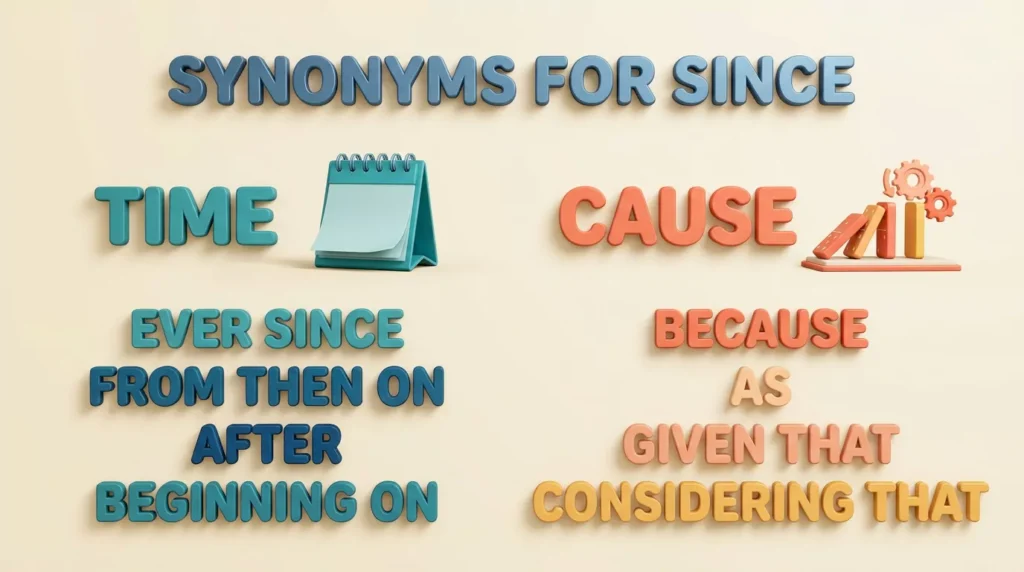
Here are useful alternatives, grouped by their intended meaning.
| Alternative | Main meaning | Best context |
| Because | For the reason that | Everyday explanations |
| As | Because or while | General writing |
| Given that | Considering the fact that | Formal writing |
| Seeing that | Because the situation is clear | Conversational writing |
| Considering that | Taking a fact into account | Professional writing |
| Inasmuch as | To the extent that or because | Formal contexts |
| On account of the fact that | Because of a particular fact | Formal explanations |
| From | Starting at a particular time | Time expressions |
| Starting from | Beginning at a specified point | Instructions and schedules |
| Beginning on | Starting on a particular date | Events and deadlines |
| Ever since | From a past point until now | Continuing situations |
| From then on | Starting at that point in the past | Narratives |
| Thereafter | After that point | Formal writing |
| Subsequently | At a later time | Reports and academic writing |
| After | Later than a specified event | Sequences of events |
| Following | After an event or point | Professional writing |
| As of | At a specified date or time | Status updates and records |
| In view of | Considering a circumstance | Formal explanations |
| Owing to | Because of | Formal writing |
| Due to | Caused by or attributable to | Professional writing |
Some alternatives are direct replacements only in particular sentence structures. Always check whether the original meaning and grammar remain intact.
Synonyms for Since When Referring to Time
When since identifies a starting point, choose an alternative that preserves the relationship between the starting point and the rest of the sentence.
1. From
From identifies the point at which something begins. Unlike since, it does not automatically indicate that a situation has continued until the present.
Example: The office has been open since Monday.
Alternative: The office has been open from Monday onward.
The second version is possible, although “since Monday” is usually more natural when describing a continuing situation.
2. Starting From
Starting from emphasizes the beginning of a period, process, or schedule.
Example: Since July, the new policy has applied to all employees.
Alternative: Starting from July, the new policy applies to all employees.
The alternative changes the sentence structure slightly. Use it when the emphasis is on the starting point.
3. Beginning On
Beginning on identifies the date when an activity, arrangement, or policy starts.
Example: Since January 1, the new schedule has been in effect.
Alternative: Beginning on January 1, the new schedule takes effect.
This alternative works particularly well in announcements, schedules, and formal instructions.
4. As Of
As of identifies the status of something at a particular date or time.
Example: Since March, the company has employed 120 people.
Alternative: As of March, the company employed 120 people.
The meaning is not identical. “Since March” emphasizes the period after March, while “as of March” describes the status at that point.
5. Ever Since
Ever since emphasizes that a situation has continued from a past event or time.
Example: Since she moved abroad, she has called her family every week.
Alternative: Ever since she moved abroad, she has called her family every week.
This expression is especially useful when the duration or continuity of an experience matters.
6. From Then On
From then on identifies the period beginning at a previously mentioned point.
Example: Since that conversation, they have worked together more effectively.
Alternative: From then on, they worked together more effectively.
The alternative often fits narratives. It may shift the emphasis away from the present and toward events that followed.
7. Thereafter
Thereafter means after that point or event. It is more formal than “after that.”
Example: Since the initial review, the team has completed several additional checks.
Alternative: Following the initial review, the team completed several additional checks thereafter.
Avoid using “following” and “thereafter” together when they express the same relationship. A cleaner version is “Following the initial review, the team completed several additional checks.”
8. Subsequently
Subsequently means at a later time. It describes sequence rather than an ongoing period.
Example: Since the first meeting, the team has revised its proposal.
Alternative: The team subsequently revised its proposal after the first meeting.
Use this word when describing what happened later, particularly in reports and formal narratives.
9. After
After identifies a time or event that precedes another event.
Example: Since the interview, she has received two job offers.
Alternative: After the interview, she received two job offers.
The alternatives differ in emphasis. “Since the interview” can describe the intervening period, while “after the interview” locates an event later in time.
10. Following
Following means after a specified event or point. It is common in professional and administrative writing.
Example: Since the merger, the company has changed its management structure.
Alternative: Following the merger, the company changed its management structure.
This wording is useful when reporting changes that occurred after an event.
11. From That Point Forward
This expression emphasizes the period that begins at a particular moment and continues afterward.
Example: Since the agreement was signed, both teams have shared their data.
Alternative: From that point forward, both teams shared their data.
Use it when the starting point is already clear from the surrounding text.
12. From That Time Onward
From that time onward emphasizes continuity after a past event.
Example: Since the policy was introduced, employees have followed the new procedure.
Alternative: From that time onward, employees followed the new procedure.
This expression is useful in historical accounts and explanations of organizational changes.
13. Beginning With
Beginning with identifies the first item, date, or stage in a sequence.
Example: Since the first quarter, the department has introduced several improvements.
Alternative: Beginning with the first quarter, the department introduced several improvements.
It is more suitable for sequences and stages than for every ongoing situation.
14. Starting On
Starting on identifies the date when something begins.
Example: Since September 1, the revised timetable has applied to all classes.
Alternative: Starting on September 1, the revised timetable applies to all classes.
Use it for dates, deadlines, programs, and scheduled changes. Check tense and context before substituting it.
15. As From
As from is used in some varieties of English to indicate when a new arrangement begins. It is especially common in formal notices.
Example: Since April 1, the revised fees have applied.
Alternative: As from April 1, the revised fees apply.
In American English, “effective April 1” or “starting April 1” may sound more natural.
16. Since Then
Since then refers to the period following a previously mentioned event.
Example: The project began in June. Since then, the team has completed three stages.
Alternative: The project began in June. From that time onward, the team has completed three stages.
“Since then” is concise and natural when the starting point has already been established.
17. In the Time Since
In the time since emphasizes changes or developments during a period after an event.
Example: Since the product launched, customer feedback has improved.
Alternative: In the time since the product launched, customer feedback has improved.
This expression is useful when discussing progress, changes, or developments.
18. Over the Period Since
Over the period since refers to developments throughout a period that began in the past.
Example: Since the program started, participation has increased.
Alternative: Over the period since the program started, participation has increased.
It suits analytical writing, although the shorter original is often clearer.
19. From the Date Of
From the date of identifies a formal starting point, often in contracts, records, and administrative documents.
Example: Since the agreement date, the terms have remained unchanged.
Alternative: From the date of the agreement onward, the terms have remained unchanged.
Use this expression when precision matters and the relevant date is clearly established.
20. Following the Start Of
This phrase refers to the period or events that come after a process begins.
Example: Since the campaign began, website traffic has increased.
Alternative: Following the start of the campaign, website traffic increased.
The alternative is especially useful in reports describing the consequences of a launch or initiative.
Synonyms for Since When Giving a Reason

When since means because, use a word or phrase that introduces a reason, explanation, or relevant fact.
21. Because
Because directly explains why something happens. It is one of the clearest alternatives to causal “since.”
Example: Since the roads were flooded, the school closed early.
Alternative: Because the roads were flooded, the school closed early.
Choose “because” when you want the reason to be explicit and unmistakable.
22. As
As can introduce a reason, particularly when the explanation is already understood or is secondary to the main statement.
Example: Since everyone has arrived, we can begin.
Alternative: As everyone has arrived, we can begin.
“As” also has a temporal meaning. Use the surrounding sentence to make your intended meaning clear.
23. Given That
Given that introduces a fact that supports a conclusion or decision.
Example: Since demand has increased, the company will expand production.
Alternative: Given that demand has increased, the company will expand production.
It works well in business reports, analytical writing, and reasoned arguments.
24. Considering That
Considering that means taking a particular fact into account.
Example: Since the deadline is approaching, we should finish the review today.
Alternative: Considering that the deadline is approaching, we should finish the review today.
Use it when the reason provides context for a recommendation or decision.
25. Seeing That
Seeing that introduces a reason that is apparent or relevant in the situation.
Example: Since you already know the process, you can help the new employee.
Alternative: Seeing that you already know the process, you can help the new employee.
This expression is conversational and may sound less formal than “given that.”
26. Now That
Now that introduces a newly established condition that makes an action possible or relevant.
Example: Since the report is complete, we can send it to the client.
Alternative: Now that the report is complete, we can send it to the client.
The emphasis shifts toward the newly completed condition rather than simply stating a reason.
27. Inasmuch As
Inasmuch as can mean “because” or “to the extent that,” depending on the sentence.
Example: Since the proposal meets the requirements, it can proceed to review.
Alternative: Inasmuch as the proposal meets the requirements, it can proceed to review.
This expression is formal and can sound stiff. Use it only when its precise meaning suits the context.
28. In View Of The Fact That
This formal phrase introduces a circumstance that supports a decision or conclusion.
Example: Since several employees are absent, the meeting will be postponed.
Alternative: In view of the fact that several employees are absent, the meeting will be postponed.
The phrase is grammatically possible but wordy. “Because several employees are absent” is usually more direct.
29. On The Grounds That
On the grounds that introduces the stated basis for an argument, decision, or claim.
Example: Since the application was incomplete, the committee rejected it.
Alternative: The committee rejected the application on the grounds that it was incomplete.
The sentence structure changes, but the reason remains clear. This expression is common in formal and legal contexts.
30. For The Reason That
This phrase explicitly identifies the reason for an action or conclusion.
Example: Since the equipment was faulty, the technician replaced it.
Alternative: The technician replaced the equipment for the reason that it was faulty.
Although understandable, the phrase is often unnecessarily long. “Because it was faulty” is usually preferable.
31. Because Of The Fact That
This expression gives a reason by referring to a particular fact.
Example: Since the shipment was delayed, the store extended the delivery estimate.
Alternative: The store extended the delivery estimate because of the fact that the shipment was delayed.
The alternative is wordy. Prefer “because the shipment was delayed” for clearer writing.
32. Owing To
Owing to identifies the cause of a situation. It is generally followed by a noun phrase or gerund rather than a full independent clause.
Example: Since heavy rain disrupted traffic, the event started late.
Alternative: Owing to heavy rain, the event started late.
Do not write “owing to the roads were flooded.” Instead, write “owing to the flooded roads” or “because the roads were flooded.”
33. Due To
Due to expresses a cause or attribution. It generally works with a noun phrase.
Example: Since a technical fault occurred, the service was interrupted.
Alternative: The service interruption was due to a technical fault.
The alternative changes the sentence structure but preserves the causal relationship.
34. Thanks To
Thanks to identifies a cause, often with a positive or appreciative tone. It can also be used sarcastically in negative situations.
Example: Since your guidance was helpful, we completed the task successfully.
Alternative: Thanks to your guidance, we completed the task successfully.
Use it when the cause is being presented as beneficial or noteworthy.
35. In Light Of
In light of means considering information or circumstances that affect a decision.
Example: Since new evidence has emerged, the team will review its conclusion.
Alternative: In light of the new evidence, the team will review its conclusion.
This expression is useful in reports, formal discussions, and decision-making contexts.
36. In View Of
In view of introduces a circumstance that should be considered.
Example: Since the weather forecast is unfavorable, the organizers will change the venue.
Alternative: In view of the unfavorable weather forecast, the organizers will change the venue.
Use this phrase when the emphasis is on the circumstances influencing a decision.
37. Because Of
Because of expresses a reason and is generally followed by a noun phrase rather than a full clause.
Example: Since the flight was canceled, we stayed overnight.
Alternative: Because of the flight cancellation, we stayed overnight.
The alternative is concise when the reason can be expressed as a noun phrase.
38. On Account Of
On account of means because of and often sounds more formal than “because of.”
Example: Since the venue was unavailable, the conference moved online.
Alternative: On account of the venue’s unavailability, the conference moved online.
It is suitable for explanations and formal notices, although simpler wording may be more readable.
39. Seeing As
Seeing as is a conversational expression that introduces a reason.
Example: Since we have enough time, we can check the figures again.
Alternative: Seeing as we have enough time, we can check the figures again.
Use it in informal conversation rather than highly formal academic or legal writing.
40. Insofar As
Insofar as means “to the extent that” and can sometimes introduce a reason or qualification.
Example: Since the policy applies to all departments, every manager must follow it.
Alternative: Insofar as the policy applies to all departments, every manager must follow it.
The meanings are not always identical. Use “insofar as” when the extent or scope of a statement matters.
41. Given
Given can introduce a circumstance or fact that supports a conclusion.
Example: Since resources are limited, the team must prioritize essential tasks.
Alternative: Given the limited resources, the team must prioritize essential tasks.
It is concise and useful in professional and analytical writing.
42. Considering
Considering can introduce a relevant circumstance without requiring the full phrase “considering that.”
Example: Since the budget is small, we need a practical solution.
Alternative: Considering the limited budget, we need a practical solution.
This version is concise and natural in reports, recommendations, and workplace communication.
43. With The Knowledge That
This phrase emphasizes that an action is performed while someone knows a particular fact.
Example: Since the risks were known, the team took additional precautions.
Alternative: With the knowledge that risks existed, the team took additional precautions.
This is not a general-purpose synonym for “since.” Use it when awareness or knowledge is important to the meaning.
44. Insofar As It Is True That
This longer expression qualifies a claim by referring to the extent to which a fact is true.
Example: Since the findings are accurate, the recommendations deserve consideration.
Alternative: Insofar as it is true that the findings are accurate, the recommendations deserve consideration.
This version introduces a qualification and may sound cumbersome. Use it only when the qualification is necessary.
Synonyms for Since in Professional and Academic Writing
Professional writing benefits from precision rather than unnecessarily complicated vocabulary. The most suitable alternative depends on whether you are describing a starting point or explaining a reason.
| Writing situation | Suitable alternative | Example |
| Explaining a conclusion | Because | Because the data is incomplete, further analysis is necessary. |
| Presenting a premise | Given that | Given that the results are consistent, the hypothesis merits further testing. |
| Explaining a decision | In view of | In view of the new requirements, the procedure has been revised. |
| Describing a cause | Due to | The delay was due to a supplier issue. |
| Describing a starting date | Effective | Effective July 1, the revised policy applies to all employees. |
| Reporting a later development | Subsequently | The committee subsequently approved the proposal. |
| Describing a period of continuity | Ever since | Ever since the system was introduced, processing has become more consistent. |
| Explaining a relevant circumstance | Considering | Considering the available evidence, the recommendation is reasonable. |
Which Alternatives Work Best in Academic Writing?
For academic writing, prioritize expressions that communicate the logical relationship clearly.
- Use because to state a direct cause.
- Use given that to introduce an established premise.
- Use considering that when a relevant fact influences an interpretation.
- Use in light of when discussing how evidence affects a conclusion.
- Use subsequently to describe a later event.
- Use from or as of when the intended time relationship is appropriate.
Avoid choosing a formal phrase simply because it sounds sophisticated. Direct wording is often easier to understand.
Since vs. Because, As, From, and After
These words can overlap with since, but each expresses a different relationship.
| Word or phrase | Main function | Example | Important distinction |
| Since | Time or cause | Since the office opened, we have served many customers. | Can express duration or reason. |
| Because | Cause | Because the office opened late, customers waited. | Primarily explains a reason. |
| As | Cause or time | As the office was closing, we left. | May be ambiguous without context. |
| From | Starting point | The office operates from 9 a.m. | Does not by itself indicate continuation until now. |
| After | Later time | We left after the office closed. | Describes sequence, not necessarily duration. |
| Given that | Reason or premise | Given that the office is closed, we will return tomorrow. | Often introduces a relevant fact. |
| Ever since | Continuing period | Ever since the office opened, business has grown. | Emphasizes continuity from a past point. |
| Following | Later event | Following the inspection, the office reopened. | Usually introduces an event or noun phrase. |
Is Because Always Interchangeable With Since?
No. “Because” usually introduces a reason, while “since” can introduce either a reason or a starting point in time.
Consider these examples:
- Time: “I have lived here since 2020.”
- Cause: “Since you are here, we can begin.”
- Cause with clearer emphasis: “Because you are here, we can begin.”
Replacing the first sentence with “because 2020” would be incorrect. The intended relationship determines the appropriate word.
Is From a Direct Synonym for Since?
Not in every sentence. “Since 2020” often indicates that something began in 2020 and has continued until now. “From 2020” identifies a starting point but may need additional wording to convey the same duration.
For example:
- Original: I have worked here since 2020.
- Alternative: I have worked here from 2020 onward.
The second sentence is understandable, although the original is more natural in many contexts.
How to Choose the Right Alternative to Since
Use the following steps to select an appropriate replacement.
Step 1: Identify the Meaning
Ask whether since refers to time or gives a reason.
- If it refers to time, consider “ever since,” “from then on,” or “beginning on.”
- If it gives a reason, consider “because,” “as,” or “given that.”
Step 2: Check the Grammar
Determine whether the alternative requires a full clause or a noun phrase.
Correct: Because the meeting was delayed, we arrived late.
Correct: Because of the delay, we arrived late.
Incorrect: Because of the meeting was delayed, we arrived late.
Step 3: Match the Tone
Choose a phrase appropriate for your audience.
- Everyday conversation: because, as, seeing that
- Academic writing: because, given that, considering that
- Business writing: in light of, given that, due to
- Narrative writing: ever since, from then on, thereafter
These categories are guidelines, not rigid rules. The best choice depends on the complete sentence.
Step 4: Preserve the Intended Time Relationship
Check whether your sentence describes a starting point, a later event, or a continuing period.
“Since the launch” can describe developments continuing after the launch. “After the launch” identifies a later period or event. The distinction matters.
Step 5: Prefer Clear Language
Avoid replacing a simple word with a long expression unless the longer phrase adds precision.
For example, “because the data was incomplete” is generally clearer than “on account of the fact that the data was incomplete.”
Common Mistakes When Replacing Since
Mistake 1: Using a Time Expression to Explain a Reason
Incorrect: From the roads were flooded, the school closed.
Correct: Because the roads were flooded, the school closed.
“From” does not introduce a causal clause in this way.
Mistake 2: Using Because Of Before a Full Clause
Incorrect: Because of the weather was poor, the event was canceled.
Correct: Because the weather was poor, the event was canceled.
Correct: Because of the poor weather, the event was canceled.
Use “because” before a full clause and “because of” before a noun phrase or equivalent construction.
Mistake 3: Confusing Since With After
“Since” can emphasize the period from a starting point until another reference point. “After” identifies something occurring later.
Example: “She has worked here since May” emphasizes duration.
Example: “She started working here after May” describes when the work began, not necessarily how long it has continued.
Mistake 4: Making Formal Writing Needlessly Complicated
Long expressions such as “because of the fact that” may be grammatically correct but often reduce readability.
Instead of writing, “The deadline changed on account of the fact that the supplier was delayed,” write, “The deadline changed because the supplier was delayed.”
Mistake 5: Ignoring Ambiguity
A sentence beginning with “Since the manager arrived, the team has been working” describes time. A sentence beginning with “Since the manager has arrived, we can begin” may express a reason.
If the intended meaning is unclear, rewrite the sentence with “because” or an explicit time expression.
Frequently Asked Questions
What Is the Best Synonym for Since?
The best synonym depends on the context. Use “because” when explaining a reason and “ever since” when emphasizing continuity from a past event. For a starting point, “from” may work with suitable additional wording.
What Is a Formal Word for Since?
“Given that,” “considering that,” and “in view of” can replace causal “since” in suitable contexts. For time-related uses, “as of,” “effective,” and “beginning on” may work when the sentence describes a date or starting point.
Can I Use As Instead of Since?
Yes, when both words express a reason or a compatible time relationship. However, “as” can be ambiguous because it has several meanings. Use “because” when you want to emphasize a reason clearly.
Is Since a Synonym for Because?
Sometimes. Both can introduce a reason, as in “Since the road was closed, we took another route” and “Because the road was closed, we took another route.” However, “since” also refers to time, as in “I have lived here since 2020.”
What Can I Use Instead of Ever Since?
Depending on the sentence, use “from then on,” “from that time onward,” or “in the time since.” These expressions differ slightly in emphasis and may require a change in sentence structure.
What Is the Difference Between Since and From?
“Since” commonly marks a starting point for a period that continues to a later reference point. “From” marks an origin or starting point but does not necessarily express continuing duration. For example, “I have studied here since 2021” is a natural way to describe a continuing situation.
Are Since and After Interchangeable?
No. “Since” can express duration or a reason, while “after” refers to a later time or event. “Since the announcement, sales have increased” emphasizes developments over a period. “After the announcement, sales increased” describes what happened later.
Which Synonyms for Since Are Best for Business Writing?
“Given that,” “because,” “in light of,” “due to,” and “effective” can be useful, depending on the meaning. Use “because” for a direct explanation, “in light of” when a circumstance informs a decision, and “effective” for a date when a policy or arrangement begins.
Conclusion
The best synonyms for since depend on whether you are expressing time or cause. Use “because,” “as,” or “given that” to introduce a reason. Choose “ever since,” “from then on,” or a suitable date expression when describing time.
Always check the meaning, grammar, and tone before replacing the word. A precise alternative makes your writing clearer without changing the message you want to communicate.

Nadeem Akhtar has a keen interest in the way words shape clear communication. Through SimpleSynonyms, he shares easy-to-understand resources on vocabulary, synonyms, meanings, and everyday English to help readers express themselves with greater confidence.