

The best synonyms for moreover include furthermore, additionally, in addition, also, and what’s more. These expressions help you add information without repeating the same transition word. However, each alternative has a slightly different tone or purpose.
Some words suit academic essays and professional reports. Others work better in everyday conversations and informal writing. This guide explains their meanings, differences, and correct usage.
What Does Moreover Mean?
Moreover means “in addition to what has already been stated.” Writers use it to introduce another point that supports or extends an earlier statement. It often appears in essays, reports, articles, and formal discussions.
For example:
“The product is affordable. Moreover, it is easy to maintain.”
Here, “moreover” introduces another benefit of the product. It connects the second statement to the first without changing the argument’s direction.
Writers often use moreover to strengthen an explanation, build an argument, or present supporting evidence. It usually signals that the next point adds value to the previous one.
Best Synonyms for Moreover
The most suitable alternative depends on your sentence, audience, and writing style.
| Synonym | Meaning or use | Example |
| Furthermore | Adds another supporting point | The plan is affordable. Furthermore, it saves time. |
| Additionally | Introduces extra information | Additionally, the service includes free support. |
| In addition | Adds another fact or benefit | In addition, the course offers practical lessons. |
| Also | Adds information in a simple way | The room is spacious and also receives natural light. |
| Besides | Adds a supporting reason or consideration | Besides, we have enough time to finish. |
| What’s more | Adds another interesting or important point | What’s more, the tickets include refreshments. |
| What is more | Introduces an additional point, often with emphasis | What is more, the results arrived early. |
| On top of that | Adds another point, often in conversation | The train was late. On top of that, it was crowded. |
| Beyond that | Extends the discussion to another point | Beyond that, the team needs better training. |
| To add to this | Introduces further supporting information | To add to this, the report identifies several risks. |
| In addition to this | Adds another related detail | In addition to this, the policy protects employees. |
| Another point is | Introduces a new argument or consideration | Another point is the lack of available parking. |
| Another important point is | Highlights an additional relevant issue | Another important point is long-term maintenance. |
| Equally important | Introduces a point of similar importance | Equally important, customers need reliable support. |
| It is also worth noting that | Introduces a detail readers should consider | It is also worth noting that prices may change. |
| Not only that | Adds another supporting or surprising fact | The phone is affordable. Not only that, it lasts all day. |
| Further | Adds information in formal or technical writing | Further, the findings support the original proposal. |
| As well | Adds another item or fact, usually within a sentence | The package includes installation as well. |
| Along with this | Connects an additional related point | Along with this, the company offers training. |
| Coupled with this | Links two connected factors | Coupled with this, lower costs improve efficiency. |
| In conjunction with this | Shows that something occurs or works alongside another thing | In conjunction with this, the team introduced new procedures. |
| Together with this | Adds a related action, feature, or consideration | Together with this, the organisation updated its guidance. |
| Likewise | Introduces a comparable point | The first team improved its results. Likewise, the second team made progress. |
| Similarly | Shows that another situation shares a feature | The method saves time. Similarly, it reduces waste. |
| In the same vein | Continues a similar idea or line of reasoning | In the same vein, the new policy supports flexible work. |
| By the same token | Connects a related point using similar reasoning | Experience matters. By the same token, practical training helps. |
| Correspondingly | Shows a related or matching change | Demand increased. Correspondingly, production expanded. |
| Indeed | Reinforces or confirms a point | The task is difficult. Indeed, it requires careful planning. |
| In fact | Adds clarification or stronger evidence | The process is simple. In fact, beginners can learn it quickly. |
| More importantly | Introduces a point considered more significant | More importantly, the change improves safety. |
| Above all | Emphasises the most important consideration | Above all, protect confidential information. |
| Beyond this | Moves the discussion to an additional issue | Beyond this, the project requires long-term funding. |
| As an additional point | Introduces another consideration | As an additional point, the agreement includes technical support. |
| Another consideration is | Introduces another factor to examine | Another consideration is the cost of future repairs. |
| It is worth adding that | Introduces a useful extra detail | It is worth adding that the service includes follow-up assistance. |
Not every expression above is interchangeable with moreover. Words such as “similarly” show comparison, while “more importantly” changes the emphasis. Choose the expression that matches your intended meaning.
Formal and Academic Synonyms for Moreover
Formal writing often benefits from transitions that connect arguments clearly. These alternatives work well in essays, research papers, reports, and professional documents.
Furthermore
“Furthermore” introduces another point that supports the preceding statement. It is one of the closest alternatives to moreover.
Example: “The study identifies several risks. Furthermore, it recommends practical solutions.”
Use furthermore when adding another relevant argument or supporting fact.
Additionally
“Additionally” introduces extra information in a direct, professional manner. It works well in reports, business writing, and academic explanations.
Example: “Additionally, the researchers examined the long-term effects.”
It is useful when you want to keep your writing concise and organised.
In Addition
“In addition” introduces another fact, reason, feature, or benefit. It sounds natural in both formal and general writing.
Example: “In addition, the programme provides individual feedback.”
Use it when you want a clear transition without adding strong emphasis.
Further
“Further” can introduce another point in formal writing. However, its meaning depends on sentence structure and context.
Example: “Further, the findings suggest a need for additional research.”
In many situations, “furthermore” sounds more natural and makes the additive meaning clearer.
Equally Important
“Equally important” introduces a point with similar importance to the preceding one. It does more than simply add information.
Example: “The design reduces costs. Equally important, it improves reliability.”
Choose this phrase when both points deserve similar attention.
Everyday Alternatives to Moreover
Everyday writing and conversation often benefit from shorter, more natural expressions. These alternatives can make your message feel less formal.
Also
“Also” is a simple way to add another fact. It works in emails, conversations, articles, and general writing.
Example: “The hotel offers breakfast and also provides free parking.”
It often fits naturally within a sentence. You do not always need a separate transition at the beginning.
Besides
“Besides” can introduce another reason or consideration. It sometimes suggests that the additional point strengthens an existing argument.
Example: “We should leave early. Besides, the roads may become busy.”
Use it carefully in formal writing because it can sound conversational.
What’s More
“What’s more” introduces another point that adds interest or strengthens the message. It is common in conversational and persuasive writing.
Example: “The course is affordable. What’s more, it includes personal feedback.”
Use this phrase when you want your writing to sound engaging rather than highly formal.
On Top of That
“On top of that” adds another point, often with a conversational tone. It may suggest that the additional detail makes a situation better or worse.
Example: “The apartment is spacious. On top of that, it is close to work.”
This expression suits informal articles and conversations better than formal research papers.
As Well
“As well” adds another item or piece of information. It usually appears near the end of a clause or sentence.
Example: “The package includes delivery as well.”
It is often more natural than moreover when adding a simple item to a list.
Alternatives for Adding Emphasis
Sometimes, writers use moreover because they want to strengthen an argument. The following expressions can add emphasis, but their meanings differ.
More Importantly
“More importantly” signals that the next point deserves greater attention than the previous one.
Example: “The device saves energy. More importantly, it reduces operating costs.”
Use this phrase only when the second point is genuinely more significant.
Indeed
“Indeed” reinforces, confirms, or emphasises a statement. It does not always introduce a separate supporting point.
Example: “The results are encouraging. Indeed, they exceed the original expectations.”
It works best when the second statement strengthens the first.
In Fact
“In fact” adds clarification, confirmation, or stronger information. It can also correct an assumption.
Example: “The task appears complicated. In fact, the basic process is straightforward.”
Use it when the next statement provides a clearer or stronger explanation.
Above All
“Above all” introduces the most important point or priority. It is not a neutral replacement for moreover.
Example: “Above all, the team must protect customer information.”
Choose it when ranking importance rather than simply adding another detail.
Not Only That
“Not only that” introduces an additional point with emphasis. It often appears in conversational and persuasive writing.
Example: “The app is easy to use. Not only that, it works offline.”
It is useful when the second point makes the first claim even more convincing.
Alternatives for Connecting Related Ideas
Some transitions are useful when the next statement develops a related idea. However, they may communicate similarity rather than simple addition.
Likewise
“Likewise” introduces a similar action, situation, or result.
Example: “The first department improved its service. Likewise, the second department updated its process.”
Use it when the relationship between the two points involves similarity.
Similarly
“Similarly” connects two points that share a feature or pattern.
Example: “The first method reduces waste. Similarly, the second method uses fewer resources.”
It is appropriate when you are comparing related findings or approaches.
In the Same Vein
“In the same vein” means that another point follows a similar line of thought.
Example: “The report supports flexible schedules. In the same vein, it recommends remote work options.”
This expression suits discussions that continue a related argument.
By the Same Token
“By the same token” introduces a related conclusion or consideration based on similar reasoning.
Example: “Clear instructions reduce errors. By the same token, clear feedback improves performance.”
It is more suitable for reasoned discussion than for adding an unrelated fact.
Correspondingly
“Correspondingly” shows that one situation changes or relates in a matching way to another.
Example: “Demand increased during the summer. Correspondingly, the company expanded production.”
Use it when the relationship between two points is connected or parallel.
Moreover Synonyms for Different Writing Situations
The best alternative depends on where and why you are writing.
| Writing situation | Suitable alternatives | Example purpose |
| Academic essays | Furthermore, additionally, in addition | Add another supporting argument |
| Research papers | Furthermore, additionally, further | Present related findings |
| Business reports | Additionally, in addition, coupled with this | Explain extra features or considerations |
| Professional emails | Also, in addition, it is worth noting that | Share another relevant detail |
| Blog posts | What’s more, besides, also | Keep explanations natural |
| Persuasive writing | More importantly, indeed, not only that | Strengthen a claim |
| Comparative analysis | Likewise, similarly, correspondingly | Connect comparable findings |
| Everyday conversation | Also, besides, on top of that | Add a point naturally |
These are general recommendations, not strict rules. A transition that works in one sentence may sound awkward in another.
How to Choose the Right Synonym for Moreover
Use these guidelines to select an appropriate replacement.
Consider the Writing Style
Choose formal transitions for academic papers and professional reports. Use conversational expressions when writing for a general audience.
For example, “furthermore” suits a research paper. “What’s more” often sounds more natural in a casual article.
Check the Relationship Between Ideas
Ask what the second sentence does.
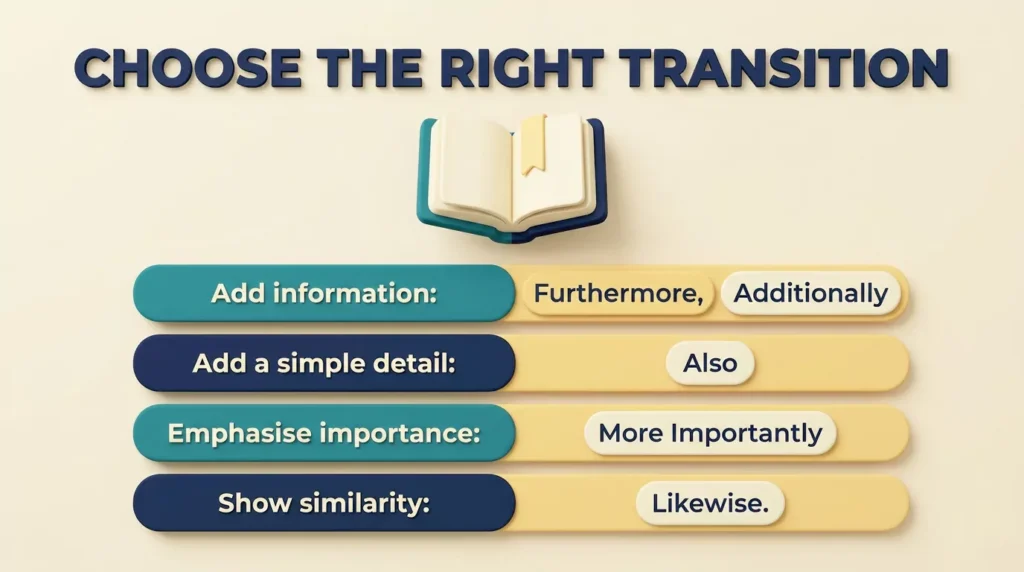
- Adds information: Use “furthermore,” “additionally,” or “in addition.”
- Adds a simple detail: Use “also” or “as well.”
- Emphasises a stronger point: Use “more importantly” or “indeed.”
- Shows similarity: Use “likewise” or “similarly.”
- Introduces another reason: Consider “besides.”
This approach helps you preserve the intended meaning.
Avoid Repeating the Same Transition
Repeated transitions can make your writing feel mechanical. However, replacing every instance of moreover is unnecessary.
Use the word when it fits. Change it when another expression sounds clearer or more natural.
Read the Sentence Aloud
A transition should connect ideas without interrupting the flow. Read the sentence aloud to check its rhythm and meaning.
If the replacement sounds unnatural, try a simpler expression. Clear writing matters more than using sophisticated vocabulary.
Moreover vs. Furthermore vs. Additionally
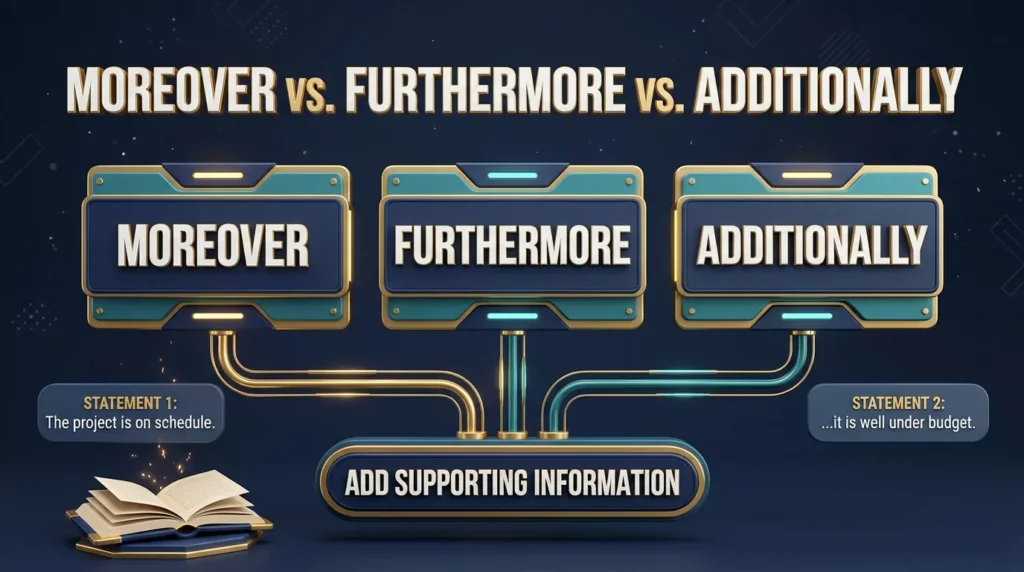
These three expressions are close alternatives. Each introduces extra information that develops the previous point.
| Word or phrase | Main function | Typical tone | Example |
| Moreover | Adds a supporting point | Formal | The proposal is practical. Moreover, it is affordable. |
| Furthermore | Adds another supporting argument | Formal | The proposal is practical. Furthermore, it reduces delays. |
| Additionally | Introduces extra information directly | Formal and neutral | Additionally, the proposal includes staff training. |
| In addition | Adds another fact or consideration | Neutral to formal | In addition, the proposal includes a review process. |
| Also | Adds information simply | General | The proposal also includes staff training. |
In many contexts, moreover and furthermore are interchangeable. Additionally and in addition can also work in similar situations.
The differences are often subtle. Sentence structure, emphasis, and natural flow matter more than choosing one supposedly superior word.
How to Use Moreover in a Sentence
Moreover usually connects a new statement to an earlier point. Correct punctuation helps readers follow the relationship between those ideas.
Use Moreover at the Beginning of a Sentence
Place a comma after moreover when it begins a sentence as a transition.
Example: “The building needs repairs. Moreover, its electrical system requires inspection.”
This structure is common in academic and professional writing.
Use Moreover to Extend an Argument
The second point should add relevant information rather than repeat the first.
Example: “The policy reduces waste. Moreover, it encourages responsible resource use.”
Both sentences support the same broader argument.
Avoid Using Moreover to Show Contrast
Moreover adds information. It does not normally signal disagreement or opposition.
Incorrect: “The product is expensive. Moreover, it is cheaper than competing models.”
Better: “The product is expensive. However, it is cheaper than competing models.”
Use “however” when you need to express contrast.
Avoid Overusing Formal Transitions
A paragraph does not need a transition at the beginning of every sentence. Sometimes, a direct statement creates a stronger connection.
Instead of writing, “Moreover, the service is reliable. Moreover, it is affordable,” try:
“The service is reliable and affordable.”
The revised sentence is shorter and easier to read.
Words That Are Not Direct Synonyms of Moreover
Some transitions connect ideas but express different relationships. Replacing moreover with these words can change your meaning.
| Transition | Meaning | Why it differs |
| However | Introduces contrast | Signals opposition rather than addition |
| Therefore | Introduces a conclusion or result | Shows a logical consequence |
| Nevertheless | Shows contrast despite a previous point | Expresses concession |
| Consequently | Introduces a result | Connects a cause to its outcome |
| Meanwhile | Shows events occurring at the same time | Focuses on timing |
| Instead | Introduces an alternative | Replaces one option with another |
| For example | Introduces an illustration | Provides evidence or an example |
| In conclusion | Signals a closing section | Summarises or ends a discussion |
These expressions can all improve writing. The important point is to match the transition to the relationship between ideas.
Common Mistakes When Using Moreover Synonyms
Treating Every Transition as Interchangeable
Words such as “however” and “therefore” have different functions. Check the logical relationship before replacing moreover.
Choosing Formal Words for Every Sentence
Long expressions can make simple writing feel unnecessarily complicated. “Also” may communicate an additional fact more clearly than a formal transition.
Repeating Transitions Too Often
Using furthermore at the beginning of every paragraph can make an essay repetitive. Vary sentence structure and use transitions only when they help.
Ignoring Punctuation
When moreover begins an independent sentence, place a comma after it.
Example: “Moreover, the updated process reduces errors.”
When a transition connects two independent clauses, follow the appropriate punctuation rules for that structure.
Using Emphasis Without a Clear Reason
“More importantly” suggests that the next point matters more. Do not use it merely because you want another transition.
Choose emphasis words only when they accurately represent your argument.
Frequently Asked Questions
What Is the Best Synonym for Moreover?
“Furthermore” is one of the closest alternatives to moreover. “Additionally” and “in addition” are also suitable in many formal contexts.
The best choice depends on your sentence and intended meaning.
What Is a More Formal Word for Moreover?
“Furthermore” and “additionally” are common formal alternatives. “In addition” also works well in academic and professional writing.
Choose the expression that fits the sentence naturally.
What Can I Use Instead of Moreover in an Essay?
You can use furthermore, additionally, or in addition when introducing another supporting point.
For emphasis, consider “more importantly.” For similar ideas, “likewise” may be more accurate.
Can I Use Also Instead of Moreover?
Yes, when both expressions add information. However, their sentence positions often differ.
“Moreover” commonly introduces a new sentence. “Also” often appears within a sentence.
For example: “Moreover, the service is reliable.” Alternatively: “The service is also reliable.”
Is Furthermore the Same as Moreover?
They have very similar meanings and often introduce additional supporting information.
Both suit formal writing. However, the best choice still depends on sentence flow and context.
Can I Start a Sentence With Moreover?
Yes. Starting a sentence with moreover is grammatically acceptable.
Example: “The findings support the proposal. Moreover, they identify further opportunities.”
Place a comma after moreover when it functions as an introductory transition.
Is Moreover Too Formal for Everyday Writing?
Moreover can sound formal in casual conversations. Words such as “also,” “besides,” and “what’s more” often sound more natural.
The right choice depends on your audience and tone.
What Is the Difference Between Moreover and However?
Moreover adds supporting information. However introduces contrast or an opposing consideration.
Example: “The plan is affordable. Moreover, it saves time.”
In contrast: “The plan is affordable. However, it requires more maintenance.”
What Is Another Way to Say Moreover in a Professional Email?
You can use “additionally,” “in addition,” or “also.” These expressions introduce extra information clearly.
For example: “Additionally, I have attached the updated schedule.”
Use a direct sentence when a transition is unnecessary.
Should I Use Moreover Repeatedly in an Essay?
No. Repeating moreover too often can make your writing feel mechanical.
Use it when it clearly connects ideas. Vary transitions and sentence structures when appropriate.
Conclusion
The best synonyms for moreover include furthermore, additionally, in addition, and also. Each offers a practical way to introduce extra information. However, context matters when selecting an alternative.
Formal essays often benefit from furthermore or additionally, while everyday writing may suit also or what’s more. Use emphasis expressions such as more importantly only when the next point deserves greater attention.
Choose similarly or likewise when you are comparing related ideas. Most importantly, make sure each transition reflects the relationship between your sentences. Clear, natural writing is more effective than using complicated words unnecessarily.

Nadeem Akhtar has a keen interest in the way words shape clear communication. Through SimpleSynonyms, he shares easy-to-understand resources on vocabulary, synonyms, meanings, and everyday English to help readers express themselves with greater confidence.