


Looking for synonyms for encounter? The best alternative depends on what you mean. You might meet someone unexpectedly, experience a difficult event, or face a serious problem.
Words such as meet, experience, confront, and come across can replace encounter in different situations.
However, each word has its own meaning and tone. This guide explores useful alternatives, explains their differences, and provides examples for everyday and professional writing.
What Does Encounter Mean?
The word encounter can function as both a verb and a noun. As a verb, it means to meet someone, experience something, or face a situation. The event may be planned, unexpected, pleasant, or difficult. As a noun, an encounter refers to a meeting or an experience.
For example, you might encounter an old friend at a café. You might also encounter technical difficulties while working. In both sentences, the word describes an event, but the context changes its meaning.
Best Synonyms for Encounter at a Glance
The following alternatives cover the most common uses of encounter. Choose a word that preserves your original sentence’s meaning.
| Synonym | Best Used For | Example |
| Meet | Meeting a person | I met an old colleague downtown. |
| Run into | Meeting someone unexpectedly | I ran into Sarah at the store. |
| Come across | Finding something or meeting someone by chance | We came across an interesting article. |
| Experience | Going through an event or situation | She experienced several setbacks. |
| Face | Dealing with a challenge | They faced unexpected delays. |
| Confront | Facing a difficult issue directly | We confronted a serious problem. |
| Discover | Finding something previously unknown | He discovered a hidden passage. |
| Find | Locating or coming upon something | I found an unusual solution. |
| Undergo | Going through a process or change | She underwent extensive training. |
| Meet with | Experiencing a result or reaction | The proposal met with resistance. |
| Come upon | Finding something unexpectedly | They came upon an abandoned building. |
| Deal with | Handling a problem or situation | We dealt with several complaints. |
Synonyms for Encountering Someone
When encounter means meeting another person, the best alternatives often suggest a particular type of meeting. Some describe planned appointments. Others suggest chance meetings or formal introductions.
1. Meet
Meet is the simplest and most versatile alternative. It can describe planned appointments, introductions, or unexpected meetings.
Example: I met my former teacher at the library.
2. Run Into
Run into describes meeting someone unexpectedly. It is informal and common in everyday American English.
Example: I ran into my neighbor while shopping.
3. Bump Into
Bump into has a similar meaning to run into. It usually describes a chance meeting rather than a physical collision.
Example: She bumped into an old friend near the station.
4. Come Across
Come across can describe meeting someone by chance. It also works when discovering information, objects, or ideas.
Example: I came across a former classmate at the conference.
5. Meet Up With
Meet up with describes arranging or having an informal meeting. It generally suggests that the people spend time together.
Example: We met up with our friends after work.
6. Cross Paths With
Cross paths with describes meeting someone, often unexpectedly or briefly. It can also suggest that two people’s lives intersect.
Example: I crossed paths with my former manager downtown.
7. Encounter in Person
This expression emphasizes a direct, face-to-face meeting. It can sound more formal than simply saying meet.
Example: The researcher encountered the witness in person.
8. Be Introduced To
Be introduced to describes meeting someone through another person. It emphasizes the introduction rather than an accidental meeting.
Example: I was introduced to the new director yesterday.
9. Visit
Visit describes going to see someone or spending time with them. It is not a direct substitute when the meeting is accidental.
Example: We visited our relatives during the holidays.
10. Confer With
Confer with means discussing something with another person, often in a professional setting. It suggests an exchange of ideas rather than a simple meeting.
Example: The attorney conferred with her client before the hearing.
Synonyms for Experiencing Something
Encounter can describe experiencing an event, condition, reaction, or situation. In these contexts, choose a synonym that reflects what happens to the subject.
11. Experience
Experience is a broad alternative. It describes going through an event, condition, or situation.
Example: The team experienced several unexpected changes.
12. Undergo
Undergo usually describes a process, treatment, change, or difficult experience. It is common in formal and professional writing.
Example: The building underwent extensive repairs.
13. Go Through
Go through is a natural expression for experiencing a process or difficult period. It often sounds more conversational than undergo.
Example: She went through a challenging period at work.
14. Live Through
Live through emphasizes surviving or experiencing an important event. It often relates to hardship, danger, or major historical events.
Example: Her grandparents lived through a major economic crisis.
15. Suffer
Suffer emphasizes pain, harm, loss, or hardship. It is unsuitable when encounter describes a neutral or positive event.
Example: The company suffered significant financial losses.
16. Endure
Endure means experiencing something difficult over time. It emphasizes patience, persistence, or the ability to withstand hardship.
Example: The hikers endured several hours of heavy rain.
17. Witness
Witness means seeing an event happen. It is appropriate when someone observes an incident rather than personally experiences its effects.
Example: Several residents witnessed the accident.
18. Observe
Observe describes watching or noticing an event, action, or condition. It is particularly useful in scientific and formal contexts.
Example: Researchers observed an unusual change in behavior.
19. Experience Firsthand
Experience firsthand emphasizes direct personal involvement. It distinguishes personal knowledge from information learned through other people.
Example: The journalist experienced the challenges firsthand.
20. Be Subjected To
Be subjected to describes experiencing something imposed by another person or external force. It often carries a negative meaning.
Example: Employees were subjected to unnecessary delays.
21. Face
Face can mean experiencing a situation that requires attention or action. It works especially well with risks, uncertainty, and difficulties.
Example: The town faced severe weather conditions.
22. Meet With
Meet with can describe receiving a response, reaction, or outcome. It often appears in formal writing.
Example: The proposal met with strong opposition.
Synonyms for Facing a Problem or Challenge

When encounter refers to a problem, obstacle, or conflict, choose an alternative that reflects the required response. Some words describe recognizing a difficulty. Others emphasize taking action against it.
23. Confront
Confront means facing a difficult problem or situation directly. It can also describe challenging another person about an issue.
Example: The organization confronted a serious staffing problem.
24. Face Up To
Face up to means accepting a difficult truth or responsibility. It often emphasizes honesty and accountability.
Example: He finally faced up to his mistakes.
25. Deal With
Deal with means handling a situation, issue, or person. It is a versatile expression for everyday and professional writing.
Example: The support team dealt with several customer complaints.
26. Tackle
Tackle suggests actively working to solve a problem. It often conveys determination and a practical approach.
Example: The council tackled the city’s housing shortage.
27. Address
Address means giving attention to an issue or taking steps toward resolving it. It is common in business and academic writing.
Example: The report addressed several safety concerns.
28. Handle
Handle emphasizes managing a task, situation, or difficulty. It often suggests control or practical competence.
Example: She handled the unexpected disruption calmly.
29. Grapple With
Grapple with describes struggling to understand or solve a difficult issue. It can suggest prolonged mental or practical effort.
Example: Researchers grappled with conflicting evidence.
30. Battle
Battle suggests struggling intensely against a problem or opposing force. It is often figurative outside literal fighting.
Example: The business battled rising operating costs.
31. Contend With
Contend with means dealing with a challenge, difficulty, or competing demand. It is particularly useful in formal writing.
Example: The region contended with severe water shortages.
32. Cope With
Cope with means managing a difficult situation or emotional burden. It emphasizes the ability to continue despite challenges.
Example: She learned to cope with the pressure of exams.
33. Navigate
Navigate means finding a way through a complicated situation. It often suggests making careful decisions amid uncertainty.
Example: The team navigated a complex legal process.
34. Overcome
Overcome means successfully defeating or resolving a difficulty. Unlike encounter, it describes a successful response rather than merely facing the problem.
Example: The team overcame several technical obstacles.
35. Manage
Manage means controlling or dealing with a situation effectively. It does not necessarily mean the problem has been completely solved.
Example: The company managed an unexpected supply shortage.
36. Address Head-On
Address head-on means tackling an issue directly rather than avoiding it. The expression emphasizes a clear and proactive response.
Example: The manager addressed the conflict head-on.
Synonyms for Unexpected Discoveries
When encounter means finding something unexpectedly, alternatives such as discover and stumble upon may be more precise. These words emphasize how someone comes across a person, object, fact, or place.
37. Discover
Discover means finding something previously unknown or unnoticed. It can describe deliberate investigation or an unexpected finding.
Example: Scientists discovered a previously undocumented species.
38. Find
Find is a simple, general alternative. It can describe locating an object, identifying information, or discovering a solution.
Example: We found a better way to organize the files.
39. Stumble Upon
Stumble upon describes discovering something by chance. It is useful when the discovery was unplanned.
Example: She stumbled upon a rare book in a secondhand shop.
40. Chance Upon
Chance upon means finding or meeting someone unexpectedly. It is slightly more formal than stumble upon.
Example: The hikers chanced upon a quiet village.
41. Come Upon
Come upon describes finding something unexpectedly. It can suit narrative writing and descriptions of exploration.
Example: They came upon an old stone bridge.
42. Turn Up
Turn up means appearing or being found, often when someone was not expecting it. It is informal and depends on sentence structure.
Example: The missing document turned up in an old folder.
43. Unearth
Unearth means discovering something hidden, forgotten, or previously unknown. It often suggests investigation or careful searching.
Example: The investigation unearthed several important facts.
44. Uncover
Uncover means revealing information or finding something concealed. It is especially useful for investigations and research.
Example: The audit uncovered several accounting errors.
45. Detect
Detect means noticing or identifying something that may be difficult to see. It often suits technical, scientific, or investigative contexts.
Example: The equipment detected a small gas leak.
46. Encounter by Chance
Encounter by chance emphasizes that a meeting or discovery happened without planning.
Example: The travelers encountered a local artist by chance.
Additional Alternatives for Encounter
The following alternatives provide more options for specific situations. Their suitability depends on whether encounter describes a meeting, an experience, a problem, or an unexpected finding.
| No. | Alternative | Meaning and Example |
| 47 | Attend | Be present at an event. Example: She attended a meeting with the director. |
| 48 | Assemble With | Gather with others. Example: The delegates assembled with the committee. |
| 49 | Interact With | Communicate or engage with someone. Example: Students interacted with visiting researchers. |
| 50 | Engage With | Take part in a discussion or activity. Example: The team engaged with local residents. |
| 51 | Consult | Seek advice or information. Example: The manager consulted an experienced engineer. |
| 52 | Confer | Discuss an issue with someone. Example: The doctors conferred before making a decision. |
| 53 | Face Off Against | Compete or oppose directly. Example: The finalists faced off against each other. |
| 54 | Clash With | Come into conflict or disagreement. Example: Her proposal clashed with company policy. |
| 55 | Run Up Against | Meet an obstacle or resistance. Example: The project ran up against budget limits. |
| 56 | Come Into Contact With | Meet, touch, or become exposed to something. Example: The material came into contact with water. |
| 57 | Be Exposed To | Experience contact with a substance, condition, or influence. Example: Workers were exposed to loud noise. |
| 58 | Come Face-To-Face With | Meet someone or confront a situation directly. Example: She came face-to-face with an unexpected challenge. |
| 59 | Experience Unexpectedly | Go through an unplanned event. Example: The travelers experienced unexpected delays. |
| 60 | Run Across | Find or meet something by chance. Example: I ran across an interesting research paper. |
| 61 | Encounter Resistance | Face opposition or reluctance. Example: The plan encountered resistance from residents. |
| 62 | Experience Difficulty | Have trouble doing something. Example: New users experienced difficulty accessing the system. |
| 63 | Face Opposition | Meet resistance from people or groups. Example: The proposal faced opposition from local businesses. |
| 64 | Meet an Obstacle | Come up against something that slows progress. Example: The team met an obstacle during testing. |
| 65 | Run Into Trouble | Begin experiencing problems. Example: The contractor ran into trouble with the schedule. |
| 66 | Come Across Evidence | Find information that supports or challenges a claim. Example: Investigators came across evidence during the review. |
Formal and Academic Alternatives to Encounter
Formal alternatives can improve precision in reports, essays, research papers, and professional documents. The best choice depends on the meaning of the original sentence.
| Alternative | Appropriate Context | Example |
| Experience | Research, reports, and general formal writing | Participants experienced different outcomes. |
| Undergo | Processes, treatments, and changes | The samples underwent further testing. |
| Confront | Problems requiring direct attention | The study confronted several methodological challenges. |
| Encounter | Technical and academic descriptions | The researchers encountered unexpected results. |
| Observe | Scientific observations | Investigators observed a consistent pattern. |
| Detect | Technical findings | The instrument detected a minor variation. |
| Identify | Recognizing a problem or feature | The assessment identified several weaknesses. |
| Face | Risks and difficulties | The industry faces increasing uncertainty. |
| Contend With | Competing challenges | The region contended with limited resources. |
| Meet With | Reactions or responses | The proposal met with considerable resistance. |
Use precise verbs instead of choosing the most complicated word. Clear academic writing depends on accuracy, not unnecessary formality.
Encounter as a Noun
Encounter can also describe a meeting or an experience. The best noun synonym depends on the nature of the event.
| Noun Alternative | Meaning | Example |
| Meeting | An occasion when people come together | Their meeting lasted an hour. |
| Interaction | An exchange between people or systems | Their interaction remained professional. |
| Contact | Communication or connection | We made contact with the supplier. |
| Experience | An event or situation someone goes through | The experience changed her perspective. |
| Incident | A particular event, often unusual or problematic | The incident was reported immediately. |
| Confrontation | A direct, often hostile disagreement | The confrontation ended quickly. |
| Encounter | A meeting or experience | Their encounter was brief but memorable. |
| Discovery | The act or result of finding something | The discovery changed the investigation. |
| Episode | A particular event within a larger period | The episode attracted public attention. |
| Exchange | A conversation or interaction between people | Their exchange remained polite. |
For example, “a chance encounter” could become “an unexpected meeting.” However, “a tense encounter” might be better expressed as “a confrontation” if the interaction involved hostility.
Encounter vs. Similar Words
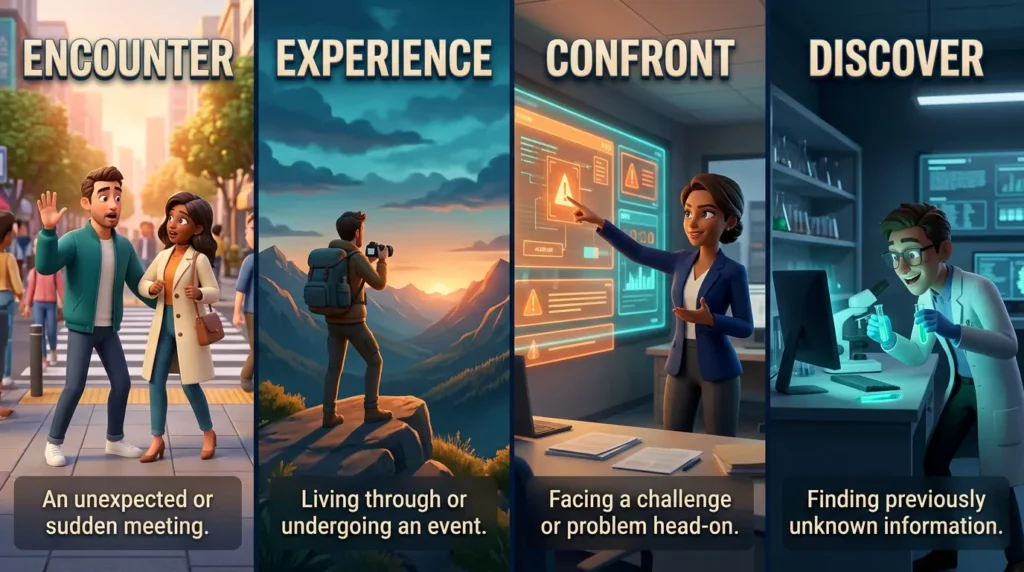
Several alternatives appear interchangeable but carry different meanings. Understanding these differences helps preserve the original message.
| Word | Main Difference | Example |
| Encounter | Meet, experience, or face something | We encountered a technical issue. |
| Meet | Usually describes meeting a person or gathering | We met the new director. |
| Experience | Emphasizes going through an event or condition | We experienced a service disruption. |
| Confront | Emphasizes facing a problem directly | We confronted the underlying issue. |
| Discover | Emphasizes finding something previously unknown | We discovered a software defect. |
| Face | Emphasizes being presented with a challenge | We faced a difficult decision. |
| Undergo | Emphasizes passing through a process or change | The system underwent testing. |
| Meet With | Often describes receiving a response or reaction | The proposal met with criticism. |
| Run Into | Usually describes an unexpected meeting or problem | We ran into a scheduling conflict. |
| Come Across | Often emphasizes accidental discovery | We came across an old report. |
When Should You Use Encounter Instead of Meet?
Use encounter when you want to emphasize an unexpected meeting, an experience, or a problem. Use meet for ordinary appointments, introductions, and planned gatherings.
For example, “I met the consultant at noon” describes a meeting. “I encountered unexpected resistance” describes an obstacle. Replacing encounter with meet in the second sentence would sound unnatural.
When Should You Use Encounter Instead of Experience?
Use experience when the main idea is going through an event or condition. Use encounter when the event involves meeting, finding, or coming up against something.
For example, “She experienced significant stress” emphasizes her condition. “She encountered resistance” emphasizes the opposition she faced.
When Should You Use Confront Instead of Encounter?
Use confront when someone faces a problem directly or challenges another person. Encounter is more neutral and does not necessarily imply action.
For example, “The team encountered a problem” reports an event. “The team confronted the problem” suggests direct action to address it.
How to Choose the Right Synonym for Encounter
Follow these steps to choose a suitable alternative.
- Identify the intended meaning. Decide whether you mean meeting, experiencing, discovering, or facing something.
- Consider the context. A social meeting needs different wording from a technical problem.
- Match the tone. Choose conversational phrases for casual writing and precise verbs for formal documents.
- Check the sentence structure. Some alternatives require different prepositions or grammatical patterns.
- Preserve the original meaning. Do not replace a neutral word with one that suggests conflict or hardship.
For example, “We encountered a new supplier” might become “We met a new supplier.” However, “We encountered a major obstacle” could become “We faced a major obstacle.”
Common Mistakes When Using Encounter Synonyms
Treating Every Alternative as Interchangeable
Words with similar meanings can express different ideas. Confront often suggests direct action, while encounter can simply describe what happened.
Using Informal Expressions in Formal Writing
Phrases such as run into and stumble upon work well in everyday conversation. Academic reports may benefit from alternatives such as experience, identify, or detect.
Ignoring Negative Connotations
Suffer, endure, and be subjected to suggest hardship. They are not suitable replacements for every neutral encounter.
Choosing a Word That Changes the Outcome
Encountering a problem does not mean solving it. Overcoming a problem means successfully dealing with it. These verbs describe different stages of an event.
Using the Wrong Grammatical Pattern
Some alternatives require specific prepositions. Common patterns include “encounter a problem,” “come across an article,” “grapple with an issue,” and “meet with resistance.”
Antonyms of Encounter
Antonyms depend on the intended meaning. There is no single opposite that works in every context.
| Antonym or Opposite Expression | Meaning | Example |
| Avoid | Stay away from something | She avoided an unnecessary confrontation. |
| Evade | Escape or avoid something difficult | He evaded the difficult question. |
| Bypass | Go around something | The team bypassed the technical issue. |
| Miss | Fail to meet or notice something | I missed the opportunity to speak with her. |
| Escape | Get free from a situation or threat | They escaped further complications. |
| Prevent | Stop something from happening | Early planning prevented delays. |
| Elude | Avoid being found, understood, or captured | The answer eluded the researchers. |
Choose an opposite that matches the original sentence. Avoid and prevent describe different actions, while miss can refer to a meeting or opportunity that did not happen.
Frequently Asked Questions
What Is the Closest Synonym for Encounter?
Meet is a close synonym when encounter refers to seeing someone. Experience works when it describes going through an event. Face is often suitable for problems and challenges.
What Is a More Formal Word for Encounter?
Experience, undergo, confront, detect, and observe can suit formal writing. The correct choice depends on the sentence. Use undergo for a process, detect for identifying something, and confront for directly facing a problem.
What Is Another Word for Encounter a Problem?
Face, confront, experience, run into, and come up against are useful alternatives. Face and confront work well in professional writing. Run into is more conversational.
What Is Another Word for an Unexpected Encounter?
An unexpected meeting, chance meeting, or chance encounter can express this idea. For a verb, use run into, bump into, or come across when the context fits.
Are Encounter and Experience Interchangeable?
Not always. Experience emphasizes going through an event or condition. Encounter often emphasizes meeting, finding, or facing something. Some sentences allow both words, but their meanings can differ.
What Is the Difference Between Encounter and Confront?
Encounter describes meeting, experiencing, or facing something. Confront emphasizes directly facing a problem or challenging someone. Confront therefore often suggests a more active response.
What Is the Noun Form of Encounter?
Encounter is both a verb and a noun. As a noun, it describes a meeting or experience. Depending on context, alternatives include meeting, interaction, contact, incident, and confrontation.
What Does Encounter Mean in Academic Writing?
In academic writing, encounter may describe researchers finding an unexpected result, participants experiencing a condition, or a study facing a challenge. Alternatives include observe, detect, experience, and confront, depending on the intended meaning.
Can Encounter Have a Positive Meaning?
Yes. An encounter can be pleasant, neutral, or difficult. Someone might encounter a helpful person, discover an interesting idea, or face an unexpected obstacle.
What Is the Opposite of Encounter?
There is no universal opposite. Avoid, evade, bypass, and miss may work in specific contexts. The right choice depends on whether encounter refers to a meeting, discovery, experience, or challenge.
Conclusion
The best synonyms for encounter depend on the situation you want to describe. Use meet, run into, or cross paths with when discussing people.
Choose experience, undergo, or live through when describing events. Use face, confront, or grapple with when writing about problems.
For unexpected discoveries, consider discover, stumble upon, or come across. Remember that similar words can differ in tone, meaning, and grammar.
Choose the alternative that communicates your intended message clearly and naturally. This approach makes everyday writing, academic work, and professional communication more precise.

Nadeem Akhtar has a keen interest in the way words shape clear communication. Through SimpleSynonyms, he shares easy-to-understand resources on vocabulary, synonyms, meanings, and everyday English to help readers express themselves with greater confidence.