


Finding the right synonyms for prove can make your writing clearer and more precise. Words such as demonstrate, verify, establish, and substantiate offer different shades of meaning.
However, not every alternative works in every situation. Some emphasize evidence, while others describe confirmation, reasoning, or performance.
This guide explains useful alternatives, their meanings, and examples. You will learn how to choose the right word for academic, professional, legal, and everyday writing.
What Does Prove Mean?
To prove means to establish that something is true, valid, or correct. This usually involves evidence, reasoning, demonstration, or reliable information. The word can also describe showing a particular quality through actions or results.
For example, a researcher may prove a theory through strong evidence. An employee may prove their ability by completing a difficult task. The best synonym depends on what someone establishes and how they establish it.
Common Synonyms for Prove
The following words are useful alternatives to prove. Their meanings overlap, but their applications differ.
| Synonym | Meaning | Example sentence |
| Demonstrate | Show something clearly through evidence or action | The experiment demonstrates the effectiveness of the method. |
| Establish | Show that something is true or firmly supported | Investigators established the timeline through records. |
| Verify | Check and confirm accuracy or truth | Please verify the figures before publishing the report. |
| Confirm | Establish that information is correct | The second test confirmed the initial result. |
| Substantiate | Support a claim with evidence | The documents substantiate her account of the incident. |
| Validate | Confirm that something is sound or acceptable | Further testing validated the findings. |
| Authenticate | Establish that something is genuine | Experts authenticated the historical document. |
| Corroborate | Support information with additional evidence | Two witnesses corroborated the driver’s statement. |
| Justify | Show that an action or claim is reasonable | The manager justified the decision with clear data. |
| Certify | Officially attest to something | The inspector certified that the equipment met requirements. |
| Attest | State or confirm something as true | The witness attested to the accuracy of the statement. |
| Bear out | Support a claim or belief | The latest figures bear out the original prediction. |
| Confirm conclusively | Establish something with decisive evidence | The final analysis confirmed the cause conclusively. |
| Authenticate | Verify the origin or legitimacy of something | The specialist authenticated the signature. |
| Demonstrate conclusively | Show something with compelling evidence | The results demonstrated conclusively that the treatment worked. |
Synonyms for Prove With Evidence

When you need to show that a claim is supported by facts, choose words that emphasize evidence. These alternatives are especially useful in research, reporting, investigations, and formal writing.
Substantiate
Substantiate means to support a statement with facts, records, or other evidence. It is useful when a claim needs stronger support.
Example: The audit substantiated the allegations of financial misconduct.
Corroborate
Corroborate means to support existing information with additional evidence. It often appears in investigations, journalism, and legal discussions.
Example: Security footage corroborated the witness’s account.
Validate
Validate means to establish that something is sound, acceptable, or supported by an appropriate process. It is common in research, testing, and professional settings.
Example: Independent testing validated the software’s accuracy.
Authenticate
Authenticate means to establish that something is genuine or comes from its claimed source. It is especially useful for documents, signatures, artwork, and digital records.
Example: The museum authenticated the painting before displaying it.
Confirm
Confirm means to establish that information is correct or that something expected has happened. It often requires less emphasis on formal proof.
Example: The laboratory confirmed the presence of the substance.
Support
Support means to provide evidence or reasons that strengthen a claim. It does not always mean the claim has been conclusively proven.
Example: The survey results support the researchers’ conclusion.
Verify
Verify means to check information against reliable evidence. It emphasizes the checking process rather than merely presenting a conclusion.
Example: The editor verified every quotation against the original source.
Synonyms for Prove an Argument or Point
When defending an opinion, explaining a theory, or making an argument, select words that emphasize reasoning and evidence.
Demonstrate
Demonstrate means to make an idea clear through facts, examples, reasoning, or a practical display.
Example: The author demonstrates why the proposed solution is more efficient.
Establish
Establish means to show that a claim or conclusion has a reliable basis. It can also mean creating a recognized fact or principle.
Example: The research established a clear link between the two factors.
Justify
Justify means to provide good reasons for a decision, action, or position. It focuses on whether something is reasonable or defensible.
Example: The report justified the additional expense through measurable benefits.
Substantiate
Substantiate emphasizes the evidence behind an argument. It is particularly useful in academic and professional writing.
Example: The researcher substantiated the argument with peer-reviewed studies.
Support
Support means to strengthen an argument through reasons, examples, or evidence. It is appropriate when the available information does not establish absolute certainty.
Example: Several independent studies support this explanation.
Defend
Defend means to provide arguments in favor of a position against criticism or opposition. It does not necessarily mean proving the position beyond doubt.
Example: The lawyer defended the decision using the available evidence.
Demonstrate the validity of
This phrase emphasizes showing that a claim or method is sound. It works well in formal and academic contexts.
Example: The experiment demonstrated the validity of the proposed model.
Synonyms for Prove Ability or Performance
Prove can also describe showing that someone has a skill, quality, or capacity. In these situations, alternatives often emphasize action and observable results.
Show
Show means to make a quality, ability, or fact apparent. It is a natural choice for everyday communication.
Example: She showed excellent leadership during the emergency.
Display
Display means to present a quality or skill through visible actions or performance. It is common in professional and descriptive writing.
Example: The candidate displayed strong analytical skills.
Exhibit
Exhibit means to show a particular quality or behavior. It often sounds more formal than show.
Example: The student exhibited impressive problem-solving skills.
Reveal
Reveal means to make something previously hidden or unknown apparent. It can describe abilities discovered through experience.
Example: The challenging assignment revealed his ability to lead a team.
Establish oneself
Establish oneself means to gain recognition or demonstrate one’s place in a field. It usually describes progress over time.
Example: The designer established herself as a respected industry expert.
Earn
Earn means to gain recognition, trust, or a reward through actions or achievements. It emphasizes the results of effort.
Example: He earned his colleagues’ trust through consistent performance.
Demonstrate competence
This phrase means to show that someone has the knowledge or skills required for a task.
Example: Applicants must demonstrate competence during the practical assessment.
Synonyms for Prove Something Is True
Some alternatives focus on confirming a fact, revealing a result, or establishing the truth of a statement.
Ascertain
Ascertain means to find out or establish something through investigation. It emphasizes discovering accurate information.
Example: The team worked to ascertain the cause of the error.
Determine
Determine means to establish a fact or reach a conclusion through examination or reasoning.
Example: The analysis determined which factor affected the outcome.
Find
Find means to discover information or reach a conclusion. It is straightforward and widely used.
Example: The investigation found no evidence of deliberate wrongdoing.
Show conclusively
This phrase means to establish something with evidence strong enough to settle the question.
Example: The final report showed conclusively that the figures were incorrect.
Resolve
Resolve means to settle a question, uncertainty, or dispute. It can be suitable when evidence clears up an issue.
Example: The additional records resolved the disagreement over the payment date.
Uncover
Uncover means to discover facts that were hidden or previously unknown. It often suggests investigation.
Example: The inquiry uncovered evidence of serious errors.
Reveal
Reveal means to make a fact or situation known. It does not always imply that the fact has been formally proven.
Example: The data revealed a previously unnoticed pattern.
Confirm the accuracy of
This phrase emphasizes checking whether information matches the facts.
Example: The independent review confirmed the accuracy of the published results.
Formal and Academic Alternatives to Prove
Academic and professional writing often benefits from precise verbs. Choose the word that accurately reflects the strength of your evidence.
| Alternative | Best use | Example |
| Substantiate | Supporting a claim with evidence | The findings substantiate the central argument. |
| Demonstrate | Showing a result through evidence or reasoning | The study demonstrates a consistent pattern. |
| Establish | Building a supported conclusion | The analysis establishes the relationship between variables. |
| Verify | Checking accuracy | The team verified the dataset before analysis. |
| Validate | Testing soundness or suitability | The researchers validated the measurement method. |
| Corroborate | Adding independent supporting evidence | A second study corroborated the original findings. |
| Confirm | Checking a result or hypothesis | The follow-up experiment confirmed the initial observation. |
| Infer | Reaching a conclusion from available evidence | Researchers inferred the likely cause from the observed pattern. |
| Evidentiate | Attempting to show or make evident | The term is uncommon and usually less natural than demonstrate or substantiate. |
| Establish conclusively | Presenting a firmly supported conclusion | The combined results established the finding conclusively. |
Use infer carefully. It means drawing a conclusion from evidence, not proving that conclusion beyond doubt. Similarly, demonstrate and substantiate may support a claim without eliminating every possible alternative explanation.
More Alternatives to Prove
The following additional words and expressions may fit particular contexts. Some are close synonyms, while others describe related steps in establishing a claim.
| Word or phrase | Meaning or typical use |
| Affirm | State or confirm something firmly |
| Assert | State something confidently, without necessarily proving it |
| Testify | Give a formal statement about facts or events |
| Witness | See an event or observe something directly |
| Evidence | Show or indicate through available facts; also a noun meaning supporting information |
| Indicate | Point toward a possible conclusion |
| Suggest | Provide a reason to consider a possibility |
| Imply | Indicate something indirectly |
| Demonstrate empirically | Show through observation or experiment |
| Establish beyond doubt | Present evidence intended to remove reasonable uncertainty |
| Make evident | Make a fact or conclusion clear |
| Show to be true | Establish the truth of a claim |
| Bear witness to | Provide evidence of an event or condition |
| Give credence to | Make a claim seem more believable |
| Lend support to | Add evidence or reasoning in favor of a claim |
| Confirm through testing | Check a claim using a test or experiment |
| Demonstrate the existence of | Show that something exists |
| Provide evidence for | Supply information that supports a claim |
| Establish the authenticity of | Confirm that something is genuine |
| Make a case for | Present reasons and evidence supporting a position |
These alternatives are not interchangeable. Assert and suggest, for example, describe statements or indications rather than conclusive proof. Testify describes giving a formal statement, while witness often describes observing an event. Select the word that matches the actual action and evidence.
Differences Between Prove and Similar Words
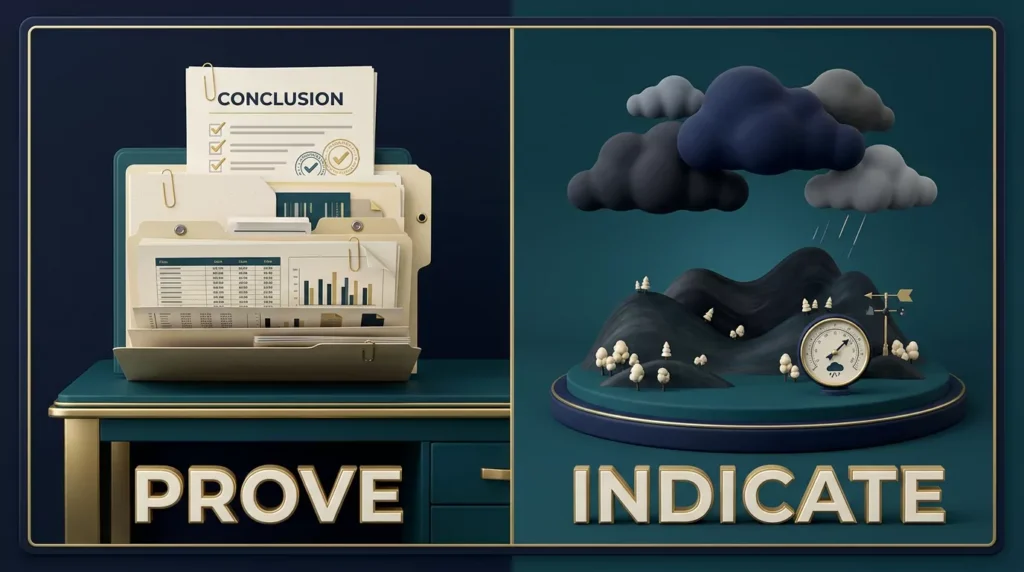
Several common alternatives appear interchangeable, but their meanings differ in important ways.
| Word | Main distinction from prove | Best context |
| Prove | Establish that something is true or valid | Claims requiring evidence or reasoning |
| Demonstrate | Show clearly through evidence, examples, or actions | Explanations, experiments, and abilities |
| Verify | Check whether information is accurate | Records, figures, identities, and results |
| Confirm | Establish that information or a result is correct | Findings, arrangements, and observations |
| Substantiate | Provide evidence supporting a claim | Arguments, allegations, and reports |
| Validate | Establish soundness or acceptability | Methods, results, and processes |
| Establish | Set out or show something as a supported fact | Relationships, principles, and conclusions |
| Indicate | Point toward a possible conclusion | Preliminary findings and observations |
| Suggest | Make a possibility seem plausible | Incomplete evidence and tentative conclusions |
| Justify | Show that a decision or action is reasonable | Decisions, spending, and arguments |
Prove vs. Demonstrate
Prove emphasizes establishing truth or validity. Demonstrate emphasizes showing how something works or why a conclusion follows.
Example: The evidence proved the claim. The experiment demonstrated how the process worked.
Prove vs. Verify
Prove means establishing that something is true. Verify means checking information for accuracy or authenticity.
Example: The investigation proved the allegation was false. The editor verified the source’s name.
Prove vs. Substantiate
Prove suggests establishing a claim as true. Substantiate means providing evidence that supports it. The evidence may strengthen a claim without settling every question.
Example: The records substantiated the complaint, but further investigation remained necessary.
Prove vs. Confirm
Prove emphasizes establishing truth. Confirm often means checking a belief, result, or piece of information against additional evidence.
Example: The analysis proved the original calculation was wrong. A second calculation confirmed the correction.
Prove vs. Indicate
Prove suggests a stronger conclusion than indicate. Something that indicates a possibility does not necessarily establish it.
Example: Dark clouds indicate possible rain, but they do not prove that rain will fall.
How to Choose the Right Synonym for Prove
Use these practical guidelines when editing your writing.
- For factual accuracy: Choose verify, confirm, or authenticate when checking information.
- For research findings: Choose demonstrate, establish, substantiate, or validate when the evidence supports those meanings.
- For an argument: Choose support, justify, defend, or substantiate according to the purpose.
- For a person’s skills: Choose demonstrate, display, exhibit, or show.
- For investigations: Choose establish, corroborate, ascertain, or uncover when the context fits.
- For uncertain evidence: Choose suggest, indicate, or imply instead of claiming something has been proven.
- For official recognition: Choose certify or attest when a formal statement or certification is involved.
Always consider the strength of the evidence. Do not use a stronger word than the facts justify.
Common Mistakes When Using Prove Synonyms
Treating every alternative as identical
Verify, substantiate, demonstrate, and confirm have related meanings. However, each emphasizes a different action. Replacing one with another can change the intended message.
Using suggest when proof is required
Suggest indicates a possibility or interpretation. It does not necessarily establish a fact. Use a stronger word only when the evidence supports it.
Using certify without official authority
Certify often implies formal attestation by an authorized person or organization. It may be inappropriate for informal observations.
Confusing an assertion with evidence
Assert means to state something confidently. It does not mean to establish that the statement is true. A convincing claim still needs suitable support.
Overstating academic findings
Research often supports, indicates, or suggests a conclusion. It may not prove a universal rule. Choose wording that reflects the study’s design and evidence.
Frequently Asked Questions
What is the closest synonym for prove?
Demonstrate, establish, and substantiate are common alternatives. The closest choice depends on the sentence. Demonstrate emphasizes showing, establish emphasizes setting out a supported fact, and substantiate emphasizes supporting a claim with evidence.
What is a formal word for prove?
Substantiate, establish, demonstrate, validate, and corroborate can work in formal writing. Choose substantiate when evidence supports a claim. Use validate when assessing soundness, and corroborate when additional evidence supports existing information.
What is another word for prove in academic writing?
Demonstrate, establish, substantiate, and support are useful in academic writing. The best choice depends on the evidence. Researchers should avoid saying that a study proves more than its methods and findings establish.
What is a synonym for prove beyond doubt?
Establish conclusively, demonstrate conclusively, and establish beyond doubt express strong certainty. Use these phrases only when the evidence genuinely warrants such confidence.
Is verify the same as prove?
No. Verify means checking accuracy or authenticity. Prove means establishing truth or validity. Verification can help establish a claim, but the words emphasize different actions.
Is demonstrate stronger than prove?
Not necessarily. Demonstrate often emphasizes showing through examples, evidence, or performance. Prove emphasizes establishing truth or validity. The strength of either word depends on the context and supporting evidence.
What is a synonym for prove someone is capable?
Demonstrate, show, display, and exhibit can describe showing ability. For example, “She demonstrated her ability to lead the project” describes capability through action.
What is the opposite of prove?
Common antonyms or contrasting expressions include disprove, refute, contradict, and challenge. Disprove means showing that something is false. Refute means arguing against a claim with evidence or reasoning. Challenge means questioning its validity without necessarily disproving it.
Conclusion
The best synonyms for prove depend on your intended meaning and the available evidence. Use demonstrate to show something clearly, verify to check accuracy, and substantiate to support a claim. Establish works well when presenting a supported fact or conclusion.
Confirm is useful for checking information, while validate emphasizes soundness or acceptability. For uncertain findings, indicate and suggest may be more accurate.
Choosing precise verbs improves clarity, strengthens arguments, and prevents exaggerated claims. Before replacing prove, consider the context, tone, and strength of the evidence.

Nadeem Akhtar has a keen interest in the way words shape clear communication. Through SimpleSynonyms, he shares easy-to-understand resources on vocabulary, synonyms, meanings, and everyday English to help readers express themselves with greater confidence.