

The best synonyms for moral include ethical, virtuous, principled, honorable, righteous, and conscientious. These words describe different aspects of right and wrong, good character, and responsible behavior. However, not every synonym fits every situation.
Some words describe a person’s character, while others describe decisions, values, or standards. Understanding these differences helps you choose the right word for essays, professional writing, and everyday conversations.
What Does Moral Mean?
The word moral relates to principles of right and wrong. It describes behavior, decisions, beliefs, and standards that guide how people should act. A moral person generally tries to make responsible choices and treat others fairly.
For example, telling the truth despite personal consequences can reflect moral courage. Treating people equally can demonstrate moral responsibility. In stories, a moral can also mean the lesson learned from an experience.
The intended meaning matters when choosing a synonym. Ethical may describe standards, while virtuous often describes good character.
Common Synonyms for Moral
These words are useful when discussing right and wrong, ethical standards, and good character.
| Synonym | Meaning | Example Sentence |
| Ethical | Consistent with principles of right and wrong | The company follows ethical business practices. |
| Virtuous | Having admirable moral qualities | She remained virtuous during difficult circumstances. |
| Principled | Guided by firm beliefs about right and wrong | He made a principled decision. |
| Righteous | Believing or acting in accordance with what is right | They supported what they considered a righteous cause. |
| Honorable | Deserving respect for integrity and fairness | She made the honorable choice. |
| Upright | Honest and morally respectable | The community trusted its upright leader. |
| Conscientious | Careful about duties and responsibilities | He was conscientious about treating everyone fairly. |
| Scrupulous | Careful to follow moral or ethical standards | The researcher maintained scrupulous practices. |
| Decent | Fair, kind, or morally acceptable | He showed decent behavior toward his neighbors. |
| Noble | Showing admirable moral qualities | Her noble actions helped the struggling family. |
| Just | Fair and morally right | The committee reached a just decision. |
| Fair-minded | Willing to consider different perspectives fairly | A fair-minded judge listened to both sides. |
| Honest | Truthful and free from deception | She gave an honest explanation. |
| Trustworthy | Deserving confidence | The trustworthy adviser protected confidential information. |
| Responsible | Accountable for choices and their consequences | A responsible leader considers the wider impact. |
| Good | Morally right or beneficial | They tried to do what was good for everyone. |
| Respectable | Considered worthy of respect | He earned a respectable reputation. |
| Sincere | Genuine in feelings or intentions | She offered a sincere apology. |
| High-minded | Guided by noble ideals | He pursued high-minded goals. |
| Worthy | Deserving respect or approval | Her actions were worthy of recognition. |
These synonyms overlap, but they emphasize different qualities. Ethical often concerns standards, while virtuous focuses on character. Principled highlights consistency between beliefs and actions.
Synonyms for Moral by Context
Ethical and Principled

Use these alternatives when discussing professional conduct, rules, personal convictions, or difficult decisions.
- Ethical: Follows principles of right and wrong. Example: The doctor explained the ethical concerns.
- Principled: Follows firm moral beliefs. Example: She took a principled stand against corruption.
- Scrupulous: Carefully follows ethical standards. Example: The accountant maintained scrupulous records.
- Conscientious: Takes duties and responsibilities seriously. Example: A conscientious employee reports mistakes.
- Righteous: Focuses on what is morally right. Example: He believed his protest was righteous.
- Upright: Consistently behaves in an honest and respectable way. Example: The town admired its upright mayor.
- Responsible: Accepts accountability for decisions. Example: Responsible leadership requires transparency.
- Accountable: Answerable for actions and decisions. Example: Public officials should remain accountable.
- Impartial: Does not unfairly favor one side. Example: An impartial mediator heard both parties.
- Equitable: Fair and appropriate to the circumstances. Example: The policy aimed for equitable access.
These words suit essays, workplace discussions, and ethical debates. However, responsible and accountable describe particular aspects of conduct rather than moral goodness itself.
Virtuous and Good-Hearted
These words emphasize kindness, generosity, compassion, or admirable character.
- Benevolent: Wants to help others. Example: A benevolent neighbor supported the family.
- Altruistic: Concerned with the welfare of others. Example: Their altruistic work benefited vulnerable children.
- Compassionate: Shows concern for suffering. Example: The compassionate nurse listened patiently.
- Kindhearted: Naturally kind and considerate. Example: A kindhearted teacher helped struggling students.
- Humane: Shows concern for human welfare and dignity. Example: The organization promoted humane treatment.
- Generous: Willing to give or share. Example: Her generous actions helped the community.
- Charitable: Willing to help people in need. Example: His charitable work supported local families.
- Considerate: Thinks about other people’s needs. Example: A considerate colleague respected everyone’s time.
- Caring: Shows concern for others. Example: The caring volunteer visited elderly residents.
- Selfless: Puts others’ needs before personal gain. Example: Her selfless efforts supported the entire team.
These words can describe moral qualities, but they are not always direct replacements for moral. Compassionate emphasizes empathy, while selfless highlights concern for others over personal benefit.
Honest and Trustworthy
Choose these alternatives when the intended meaning involves truthfulness, integrity, or reliability.
- Truthful: Accurately represents the facts. Example: The student gave a truthful explanation.
- Candid: Speaks openly and honestly. Example: The director offered a candid assessment.
- Frank: Communicates directly and honestly. Example: They had a frank discussion about the problem.
- Dependable: Can be relied upon. Example: A dependable colleague keeps commitments.
- Reliable: Can be trusted to perform consistently. Example: The reliable manager fulfilled every promise.
- Faithful: Remains loyal to a person, belief, or commitment. Example: She remained faithful to her principles.
- Sincere: Expresses genuine feelings or intentions. Example: His sincere apology restored their friendship.
- Integrity-driven: Guided by honesty and strong principles. Example: The integrity-driven team rejected dishonest practices.
- Honest-hearted: Sincere and honest in character. Example: The honest-hearted volunteer admitted the mistake.
- Straightforward: Open, direct, and easy to understand. Example: His straightforward response clarified the situation.
Honesty is one part of morality, not its entire meaning. A person can tell the truth while still acting unfairly or irresponsibly.
Religious and Spiritual Contexts
Some related words have religious or spiritual associations. Use them when that context is relevant.
- Pious: Deeply religious or devoted to religious practices. Example: The pious family observed its traditions.
- Godly: Conforming to religious ideals of goodness. Example: The story praised his godly conduct.
- Holy: Sacred or associated with religious purity. Example: The ceremony took place in a holy setting.
- Devout: Deeply committed to religious faith. Example: The devout member attended services regularly.
- Chaste: Practicing sexual restraint or abstinence. Example: The story portrayed a chaste relationship.
- Pure: Free from corruption or considered morally clean. Example: She believed he had pure intentions.
- God-fearing: Guided by reverence for God. Example: The character was described as God-fearing.
- Sanctified: Made sacred or regarded as holy. Example: The tradition was sanctified through religious practice.
- Spiritual: Relating to the spirit or spiritual life. Example: Her spiritual beliefs influenced her decisions.
- Faith-based: Grounded in religious faith. Example: The faith-based organization supported local families.
These words are related to moral ideas but have narrower meanings. Pious and devout primarily describe religious commitment, while moral applies to a wider range of situations.
Moral Principles, Values, and Decisions
These alternatives help describe beliefs, responsibilities, fairness, and acceptable conduct.
- Fair: Treats people impartially and reasonably. Example: The manager made a fair decision.
- Law-abiding: Follows the law. Example: The law-abiding residents respected public rules.
- Lawful: Permitted by law. Example: The organization followed lawful procedures.
- Public-spirited: Concerned with the public good. Example: The public-spirited volunteer organized a neighborhood project.
- Community-minded: Concerned about the welfare of a community. Example: The community-minded resident helped improve the park.
- Humanitarian: Concerned with human welfare. Example: The humanitarian organization provided emergency assistance.
- Philanthropic: Focused on charitable giving or public welfare. Example: Her philanthropic work funded educational programs.
- Justice-oriented: Focused on fairness and justice. Example: The justice-oriented group advocated equal treatment.
- Duty-bound: Motivated by a sense of duty. Example: The duty-bound officer completed the assignment.
- Morally sound: Consistent with defensible moral principles. Example: The panel sought a morally sound solution.
These terms describe different aspects of values and conduct. Lawful concerns legal requirements, while morally sound concerns whether a choice can be justified on moral grounds.
More Words and Expressions Related to Moral
The following expressions can add precision when a single-word synonym does not convey the intended meaning.
| Word or Expression | Meaning | Best Use |
| Moral integrity | Consistency between values and actions | Character and leadership |
| Ethical conduct | Behavior that follows ethical standards | Professional writing |
| Moral courage | Willingness to do what is right despite risk | Difficult decisions |
| Moral responsibility | Duty to consider right and wrong | Personal choices |
| Ethical principles | Standards that guide conduct | Policies and decision-making |
| Personal values | Beliefs that guide individual choices | Self-reflection |
| Moral conviction | A strong belief about right and wrong | Debates and personal beliefs |
| Good character | A pattern of admirable personal qualities | Character descriptions |
| Strong principles | Firm beliefs about acceptable conduct | Leadership and behavior |
| Moral judgment | An assessment of right and wrong | Ethical discussions |
These expressions are not all direct synonyms. They are useful alternatives when discussing particular aspects of morality.
How to Choose the Right Synonym for Moral
The best alternative depends on the meaning you want to express. Identify whether the sentence concerns ethical standards, good character, honesty, fairness, or religious beliefs.
| Intended Meaning | Best Word Choices | Example |
| Following ethical standards | Ethical, principled | The team followed ethical guidelines. |
| Showing good character | Virtuous, upright | She was known for her virtuous conduct. |
| Telling the truth | Honest, truthful | He gave a truthful account. |
| Treating people fairly | Just, fair-minded | They reached a just agreement. |
| Helping others selflessly | Altruistic, selfless | Her altruistic work supported the shelter. |
| Showing religious devotion | Pious, devout | The devout member attended services. |
| Taking responsibility | Responsible, accountable | The responsible choice protected the team. |
| Showing kindness | Compassionate, kindhearted | The compassionate volunteer offered support. |
| Following the law | Law-abiding, lawful | The organization followed lawful procedures. |
| Showing reliability | Trustworthy, dependable | The dependable colleague kept her promise. |
Read the entire sentence before replacing moral. The alternative should preserve the intended meaning, tone, and level of formality.
Moral vs. Ethical vs. Virtuous
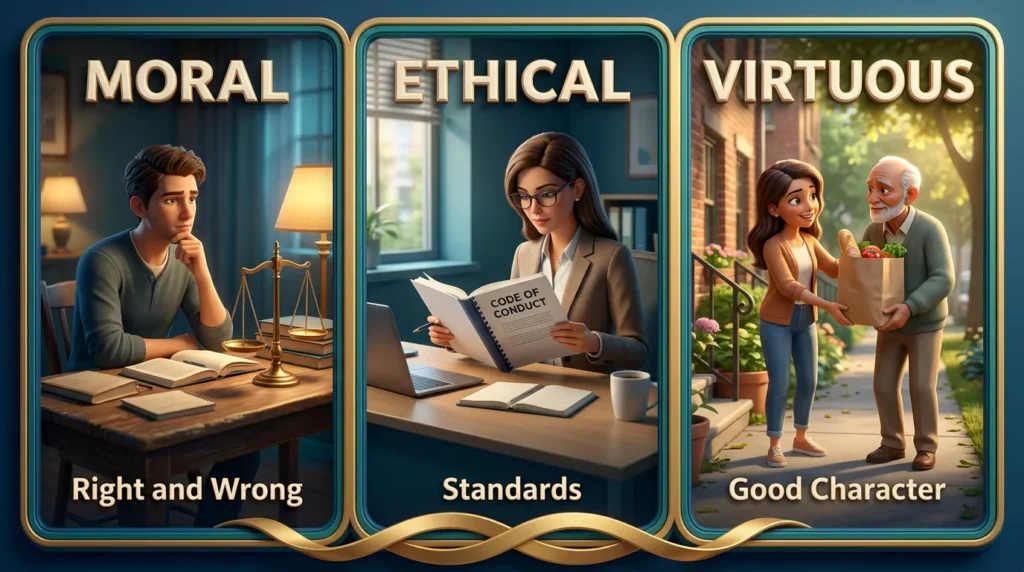
These words are closely related, but they emphasize different things.
| Word | Main Emphasis | Example |
| Moral | Principles of right and wrong | It was a moral dilemma. |
| Ethical | Standards guiding acceptable conduct | The company faced an ethical question. |
| Virtuous | Good qualities of character | She led a virtuous life. |
Moral is a broad term for ideas about right and wrong. Ethical often appears in professional, academic, and philosophical discussions. Virtuous usually describes admirable character or behavior.
For example, an ethical policy sets standards for conduct. A virtuous person demonstrates good qualities consistently. A moral dilemma involves a difficult choice about right and wrong.
Moral vs. Legal
Moral and legal describe different standards.
- Moral: Relates to principles of right and wrong.
- Legal: Relates to what the law permits or prohibits.
An action may be legal but morally questionable. An action may also be motivated by moral beliefs while violating a law. Therefore, legal is not a direct synonym for moral.
Example: A company might follow every legal requirement yet face moral criticism for treating workers unfairly.
Antonyms of Moral
Antonyms help clarify the meaning of moral. The best opposite depends on the context.
| Antonym | Meaning | Example |
| Immoral | Contrary to accepted moral principles | The investigation exposed immoral conduct. |
| Unethical | Contrary to ethical standards | The company rejected the unethical proposal. |
| Dishonest | Involving lies or deception | Dishonest reporting damaged public trust. |
| Corrupt | Dishonest, especially through abuse of power | The corrupt official accepted illegal payments. |
| Unprincipled | Lacking firm moral standards | His unprincipled behavior disappointed colleagues. |
| Unjust | Not fair or morally right | The ruling was criticized as unjust. |
| Wicked | Extremely evil or morally wrong | The story features a wicked ruler. |
| Depraved | Extremely morally corrupt | The novel depicts a depraved character. |
| Unscrupulous | Willing to ignore moral standards for advantage | An unscrupulous seller misled customers. |
| Unvirtuous | Lacking virtue | The story contrasts virtuous and unvirtuous behavior. |
Immoral and unethical are often the closest opposites. Dishonest is narrower because it specifically concerns truthfulness and deception.
Common Mistakes When Using Moral Synonyms
Treating Every Synonym as Interchangeable
Words can overlap without having identical meanings. Virtuous describes character, while ethical often describes conduct or standards. Choose the word that expresses your intended idea.
Confusing Moral With Legal
Laws and moral principles can overlap, but they are not identical. Use legal when discussing compliance with law. Use moral when discussing right and wrong.
Using Religious Words in Every Context
Pious, holy, and godly have religious associations. They are not suitable replacements in every professional or everyday sentence. Ethical or principled may fit better.
Confusing Kindness With Morality
Kindness is one moral quality, but morality also includes honesty, fairness, justice, and responsibility. Compassionate works when empathy matters. Principled works when firm standards matter.
Choosing Formal Words for Casual Writing
Scrupulous and conscientious can sound formal in everyday conversation. Good, fair, honest, or decent may be clearer in simple sentences.
Frequently Asked Questions
What Is the Closest Synonym for Moral?
Ethical is often the closest synonym when moral refers to principles of right and wrong. Virtuous works better when describing a person’s good character. The correct choice depends on the sentence.
What Is Another Word for a Moral Person?
Virtuous, principled, upright, honorable, and conscientious can describe a moral person. Virtuous emphasizes good character, while principled emphasizes consistent beliefs. Upright and honorable suggest integrity and respectability.
What Is a Synonym for Moral Behavior?
Ethical conduct, virtuous behavior, principled action, and honorable conduct are useful alternatives. Ethical conduct often suits professional writing. Virtuous behavior emphasizes good character.
What Is a Formal Synonym for Moral?
Ethical, principled, conscientious, scrupulous, and upright may suit formal writing. Choose ethical for standards, conscientious for duty, and scrupulous for careful adherence to principles.
What Is the Difference Between Moral and Ethical?
Moral concerns ideas about right and wrong. Ethical often refers to standards used to judge conduct, particularly in professional or organized settings. Their meanings overlap substantially, so context determines the best choice.
Is Righteous a Synonym for Moral?
Yes, in some contexts. Righteous describes what someone considers morally right or just. It can carry religious or strongly judgmental associations, so ethical or principled may sound more neutral.
Is Legal a Synonym for Moral?
No. Legal refers to compliance with law, while moral refers to principles of right and wrong. Something can be legal without being considered morally acceptable.
What Is the Opposite of Moral?
Immoral and unethical are common antonyms. Dishonest, unjust, corrupt, and unprincipled may also work when the intended meaning concerns deception, unfairness, corruption, or a lack of principles.
Can Good Replace Moral?
Sometimes. Good is broad and can refer to quality, usefulness, kindness, or moral value. Moral is more specific when discussing right and wrong. A good result does not necessarily represent a moral decision.
What Is a Synonym for Moral Values?
Ethical principles, moral principles, guiding beliefs, and personal values may fit. Ethical principles often suit formal writing, while guiding beliefs can sound more conversational.
Conclusion
The best synonyms for moral depend on the quality or principle you want to describe. Ethical works well for standards and decisions. Virtuous highlights good character, while principled emphasizes consistent beliefs. Honest focuses on truthfulness, and just emphasizes fairness.
Religious alternatives such as pious and godly require a suitable context. Words such as lawful and accountable describe specific aspects of conduct rather than morality itself.
Before choosing a replacement, consider the sentence’s meaning, tone, and audience. A precise synonym makes writing clearer and avoids unintended implications. When no alternative preserves the full meaning, keeping the original word moral may be the strongest choice.

Nadeem Akhtar has a keen interest in the way words shape clear communication. Through SimpleSynonyms, he shares easy-to-understand resources on vocabulary, synonyms, meanings, and everyday English to help readers express themselves with greater confidence.