
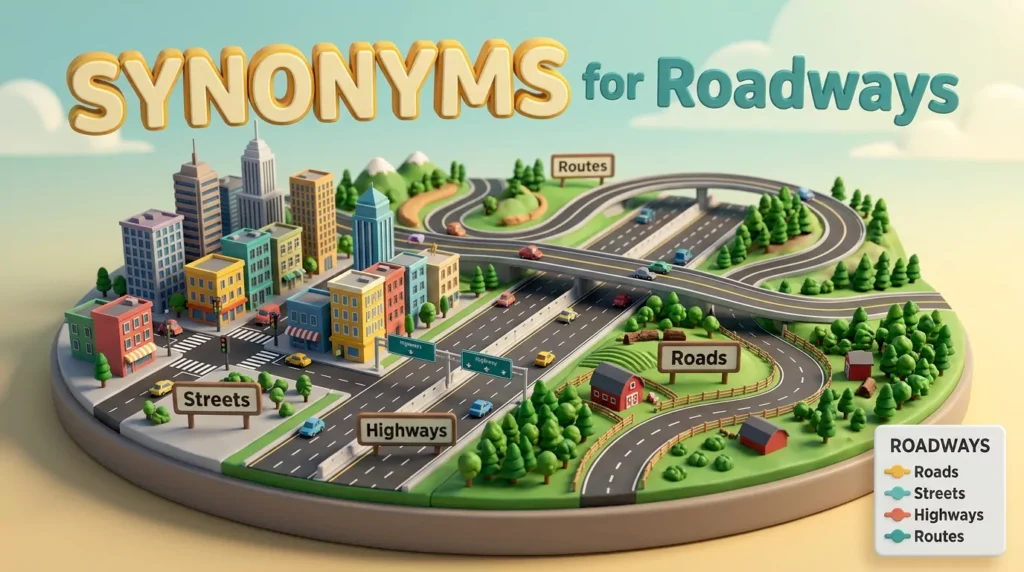

Roadways are routes or designated areas used for road traffic. Common alternatives include roads, streets, highways, thoroughfares, and routes.
However, each word has a slightly different meaning. Some describe urban streets, while others refer to major transport links or entire road systems.
Understanding these differences helps you choose the right word for essays, reports, travel writing, and everyday communication. This guide explores useful synonyms for roadways, their meanings, and practical examples.
What Does Roadways Mean?
The word roadways is the plural form of roadway. It can refer to roads or the portions of roads intended for vehicle travel. In some technical contexts, a roadway means the part of a road used by vehicles, rather than the pavement or surrounding land.
The intended meaning depends on the sentence. For general writing, roads is often the simplest alternative. For urban settings, streets may be more appropriate. For major transportation corridors, highways or expressways can communicate a more specific meaning.
Common Synonyms for Roadways
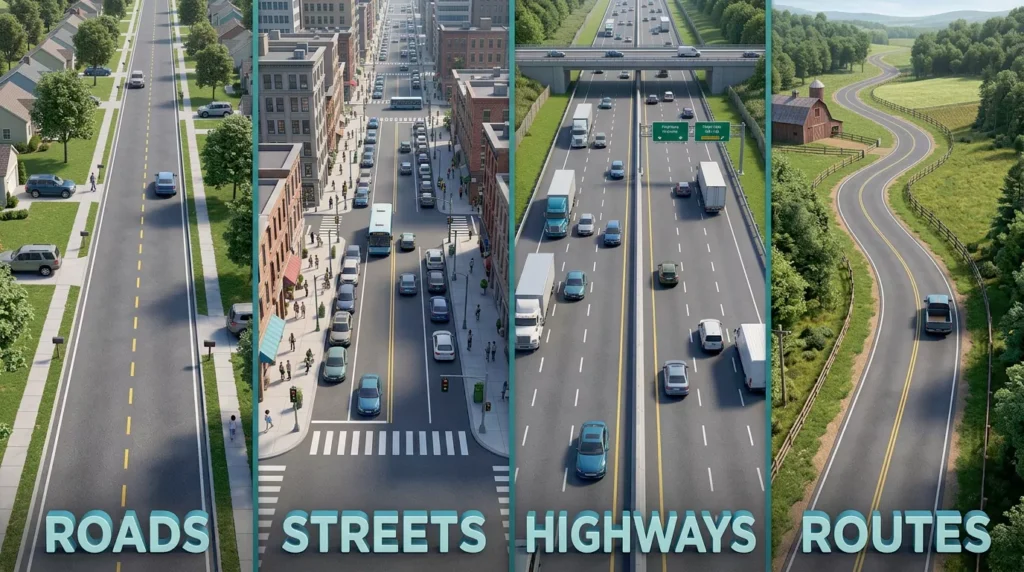
The following words are useful alternatives, but they are not interchangeable in every situation.
| Synonym or Alternative | Meaning | Example Sentence |
| Roads | General routes used for land travel | The roads were busy during the morning commute. |
| Streets | Roads commonly found in towns and cities | The streets were decorated for the festival. |
| Highways | Major public roads connecting places | Highways connect the city with nearby towns. |
| Thoroughfares | Public roads or passages carrying traffic | The city repaired several major thoroughfares. |
| Routes | Paths used to reach destinations | Several routes lead to the airport. |
| Avenues | Broad streets, often found in urban areas | The parade moved along the main avenues. |
| Boulevards | Often wide streets, sometimes with landscaped medians | Trees lined the city’s central boulevards. |
| Lanes | Narrow roads or designated traffic paths, depending on context | The village lanes were quiet at dawn. |
| Expressways | Roads designed for relatively uninterrupted traffic flow | The expressways reduced travel time between districts. |
| Freeways | High-speed roads with controlled access, especially in the United States | The freeway was crowded after work. |
| Motorways | High-speed, controlled-access roads, especially in British English | The motorway was closed after an accident. |
| Arterial roads | Major roads that carry traffic through urban or suburban areas | Arterial roads connect residential districts with business centers. |
| Access roads | Roads that provide entry to a place or facility | A new access road leads to the industrial park. |
| Bypass roads | Roads that divert traffic around a town or congested area | The bypass road kept heavy traffic outside the town center. |
| Ring roads | Roads that circle a city or urban area | The ring road helps drivers avoid downtown traffic. |
| Feeder roads | Roads that direct traffic toward larger roads or highways | Feeder roads connect nearby communities to the highway. |
| Service roads | Roads providing access to properties or facilities beside a main road | Shops along the highway use a service road. |
| Connector roads | Roads linking other roads or transportation facilities | The connector road links the two highway sections. |
| Rural roads | Roads located in the countryside | Rural roads often pass through farms and villages. |
| Urban roads | Roads within towns and cities | Urban roads require careful traffic management. |
| Residential streets | Streets serving homes and residential properties | Residential streets usually have lower speed limits. |
| Country roads | Roads through rural or countryside areas | Country roads wound through the green hills. |
| Paved roads | Roads with a finished surface, such as asphalt or concrete | Paved roads made the journey more comfortable. |
| Unpaved roads | Roads without a conventional paved surface | Unpaved roads became muddy after heavy rain. |
| Access routes | Paths or roads used to reach a location | Emergency crews used the access routes to reach the site. |
| Travel corridors | Routes that carry movement between places | The region depends on several major travel corridors. |
| Transportation corridors | Connected routes supporting the movement of people or goods | Transportation corridors support regional commerce. |
| Road networks | Connected systems of roads | The country is investing in its road networks. |
| Road systems | Organized collections of roads serving an area | Reliable road systems improve regional connectivity. |
| Public roads | Roads available for public travel, subject to applicable rules | Public roads require regular maintenance. |
| Traffic arteries | Major routes that carry substantial traffic | Traffic arteries can become congested during peak hours. |
| High-speed roads | Roads designed or designated for relatively fast travel | High-speed roads require careful entry and exit planning. |
Roadway Alternatives by Context
Everyday Words for Roadways
In everyday conversation, simple words usually sound more natural than technical terms. Roads, streets, and routes are useful when discussing travel, traffic, or directions.
- Roads: Use this general term for land routes used by vehicles.
- Streets: Choose this word for roads within towns or cities.
- Routes: Use it when describing a way to reach a destination.
- Lanes: Choose this word for narrow roads or specific traffic paths.
- Avenues: Use it for streets commonly named or designed as avenues.
Example: “The city improved its roads to make daily travel easier.”
This sentence sounds direct and natural. In a more specific urban context, you could replace roads with streets.
Formal and Technical Terms for Roadways
Formal writing often benefits from precise transportation terminology. These alternatives work well in planning documents, engineering reports, and public infrastructure discussions.
- Thoroughfares: Public passages that carry people or traffic.
- Arterial roads: Important routes carrying traffic through an area.
- Transportation corridors: Routes supporting movement between locations or regions.
- Road networks: Connected groups of roads serving a geographic area.
- Traffic arteries: Major roads carrying substantial traffic.
- Connector roads: Roads linking other routes or transport facilities.
Example: “The development plan prioritizes improvements to major arterial roads.”
This wording is suitable for a planning report. For general readers, “major roads” may be easier to understand.
Words for Major Roads and Highways
Some alternatives describe particular road designs rather than roadways in general.
- Highways: Major public roads connecting towns, cities, or regions.
- Expressways: Roads designed to reduce interruptions to traffic flow.
- Freeways: Controlled-access roads commonly associated with American English.
- Motorways: The usual British English term for major controlled-access roads.
- Bypass roads: Roads that divert traffic around built-up areas.
- Ring roads: Roads that circle a city or urban area.
Example: “The new bypass road diverted heavy vehicles away from downtown.”
A bypass is not simply another name for every roadway. Its defining purpose is to redirect traffic around a particular area.
Words for Travel Routes and Road Networks
Sometimes, the intended meaning concerns connectivity rather than the physical road itself.
- Routes: Ways to travel between starting points and destinations.
- Access routes: Ways to enter or reach a specific place.
- Travel corridors: Routes used for movement between places.
- Transportation corridors: Broader transport connections serving regional movement.
- Road networks: Connected roads across a geographic area.
- Road systems: Organized roads serving a community or region.
Example: “The regional road network connects farms, towns, and distribution centers.”
In this sentence, road network is more accurate than street. It describes multiple connected roads rather than one urban road.
Roadways vs. Roads, Streets, Highways, and Routes
These terms overlap, but their meanings and uses differ.
| Word | Main Meaning | Best Context |
| Roadways | Roads or designated areas used by road traffic | General or technical transportation writing |
| Roads | General land routes for travel | Everyday and professional writing |
| Streets | Roads commonly found in urban areas | City planning and local travel |
| Highways | Major roads connecting places | Regional travel and transportation |
| Thoroughfares | Public roads or passages carrying traffic | Formal writing and urban planning |
| Routes | Paths between locations | Navigation and directions |
| Road networks | Connected systems of roads | Infrastructure and regional planning |
| Expressways | Roads designed for relatively uninterrupted traffic | Transport infrastructure |
| Motorways | Controlled-access roads in British usage | British English and international transport contexts |
| Lanes | Narrow roads or individual traffic paths | Local roads and traffic descriptions |
Is Road the Same as Roadway?
Not always. Road generally refers to a route for travel. Roadway can refer to the road itself or, in technical contexts, the portion intended for vehicle traffic. The exact distinction depends on the document and its terminology.
Is Street a Synonym for Roadway?
Sometimes. A street is a type of road commonly associated with an urban setting. However, not every roadway is a street. Highways, rural roads, and expressways may be better descriptions in other contexts.
Is Highway a Synonym for Roadway?
A highway can be a roadway, but the terms do not have identical meanings. Highway usually identifies a major road or a road defined by a particular transportation system. Its precise legal meaning can vary by jurisdiction.
Is Route a Synonym for Roadway?
A route describes a way to travel between places. It may include several roads or other travel segments. Therefore, route is often suitable when discussing directions or connectivity, but not when describing a road’s physical surface.
Example Sentences Using Synonyms for Roadways
The following examples show how alternative words work in different contexts.
- Roads: Local roads need repairs after the winter storms.
- Streets: The narrow streets were filled with pedestrians.
- Highways: Highways connect the region’s largest cities.
- Thoroughfares: Major thoroughfares carry heavy traffic during rush hour.
- Routes: Drivers selected alternative routes to avoid congestion.
- Avenues: The city’s broad avenues feature trees and public spaces.
- Boulevards: New lighting improved safety along the main boulevards.
- Lanes: Country lanes often pass through quiet villages.
- Expressways: Expressways help motorists travel between major districts.
- Freeways: The freeway provides a direct connection to the airport.
- Motorways: Motorways carry long-distance traffic across the country.
- Arterial roads: Arterial roads connect residential areas with commercial centers.
- Access roads: An access road leads to the warehouse entrance.
- Bypass roads: Bypass roads can reduce traffic through town centers.
- Ring roads: The ring road provides an alternative to downtown streets.
- Feeder roads: Feeder roads direct local traffic toward major highways.
- Service roads: A service road provides access to roadside businesses.
- Connector roads: Connector roads link the new development with existing routes.
- Rural roads: Rural roads serve farms and small communities.
- Urban roads: Urban roads must accommodate different types of traffic.
- Residential streets: Residential streets often prioritize local access.
- Country roads: Country roads offer scenic views of the countryside.
- Paved roads: Paved roads support smoother vehicle travel.
- Unpaved roads: Unpaved roads may require extra care during wet weather.
- Access routes: Access routes help emergency teams reach remote locations.
- Travel corridors: Travel corridors connect important regional destinations.
- Transportation corridors: Transportation corridors support the movement of goods.
- Road networks: Road networks link communities and economic centers.
- Road systems: Road systems need planning, funding, and regular maintenance.
- Public roads: Public roads serve communities and support daily travel.
- Traffic arteries: Traffic arteries carry large volumes of vehicles.
- High-speed roads: High-speed roads require suitable design and traffic controls.
How to Choose the Right Alternative to Roadways
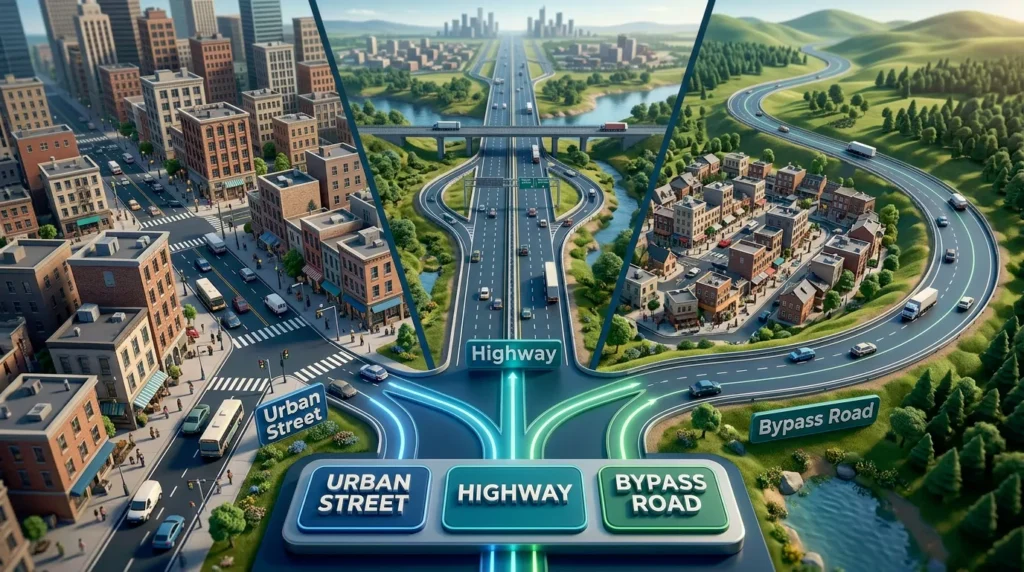
Choosing a suitable synonym depends on what you want to describe.
Consider the Physical Location
Use streets for many urban settings. Use rural roads for countryside travel. Choose highways or motorways when referring to major roads with those characteristics.
Consider the Purpose
Use access roads when the main purpose is reaching a facility. Use bypass roads when traffic travels around a built-up area. Use service roads for roads serving properties beside a main route.
Consider the Writing Style
For everyday writing, prefer familiar terms such as roads and streets. In technical documents, terms such as arterial roads and transportation corridors may communicate more precise meanings.
Avoid Repeating the Same Word
Writers sometimes repeat roadways throughout a paragraph. Replacing it with a suitable alternative can improve readability.
However, variety should never come at the expense of accuracy. If a technical document defines roadway precisely, retain that term when consistency matters.
Common Mistakes When Using Roadway Synonyms
Treating Every Alternative as Identical
A highway, a street, and a route describe different things. Replacing one with another can change the sentence’s meaning.
Using Technical Terms in Casual Writing
Words such as arterial road and transportation corridor may sound overly technical in simple conversation. Use them when the added precision is useful.
Confusing a Road With a Route
A road is a physical transportation facility. A route describes a way to travel between places. One route may include multiple roads.
Ignoring Regional Differences
American English commonly uses freeway, while British English commonly uses motorway. Local transportation terminology may vary further.
Using Roadway When Street Is More Specific
If you are describing shops, sidewalks, and buildings along an urban street, street may be clearer. Choose roadway when the road or vehicle-travel area is the focus.
Frequently Asked Questions
What Is the Best Synonym for Roadways?
Roads is often the simplest general alternative. Depending on context, streets, highways, thoroughfares, and routes may be more accurate.
What Is a More Formal Word for Roadways?
Thoroughfares, arterial roads, and transportation corridors can suit formal writing. The best option depends on the road’s function and the intended meaning.
What Is Another Word for Roadways in a City?
Streets, avenues, boulevards, and urban roads may work. Choose the word that matches the specific road type.
What Is Another Word for Major Roadways?
Highways, arterial roads, expressways, and major thoroughfares are useful alternatives. They describe different road functions, so context matters.
Can I Use Routes Instead of Roadways?
Yes, when you mean paths connecting destinations. However, routes may refer to journeys that use multiple roads rather than the roads themselves.
What Is the Difference Between a Roadway and a Highway?
A roadway is a broad term for a road or the part used by vehicles. A highway is generally a major road, although definitions vary by location and legal context.
What Is the Difference Between a Roadway and a Thoroughfare?
A roadway refers to a road or its vehicle-travel area. A thoroughfare emphasizes a public passage or road used for movement. The terms overlap, but they highlight different aspects.
What Are Some Synonyms for Roadways in Academic Writing?
Depending on the subject, consider road infrastructure, arterial roads, transportation corridors, road networks, and highways. Use the term that best matches the technical meaning.
Is Roadways Singular or Plural?
Roadways is plural. Its singular form is roadway. For example, “The roadway is closed” is singular, while “The roadways are closed” is plural.
Which Words Should I Avoid Using as Direct Synonyms?
Avoid replacing roadways automatically with lanes, routes, or transportation corridors. Each term describes a different feature or concept and may not fit every sentence.
Conclusion
The best synonyms for roadways depend on the setting, purpose, and level of detail. Roads works well as a general alternative, while streets suits many urban contexts.
Highways, expressways, and motorways describe particular kinds of major roads. Terms such as routes, thoroughfares, and road networks emphasize different aspects of transportation.
Choose words for their meaning, not simply for variety. When writing about infrastructure, navigation, or urban planning, precise terminology improves clarity. For everyday communication, simple alternatives are often the most effective.

Nadeem Akhtar has a keen interest in the way words shape clear communication. Through SimpleSynonyms, he shares easy-to-understand resources on vocabulary, synonyms, meanings, and everyday English to help readers express themselves with greater confidence.