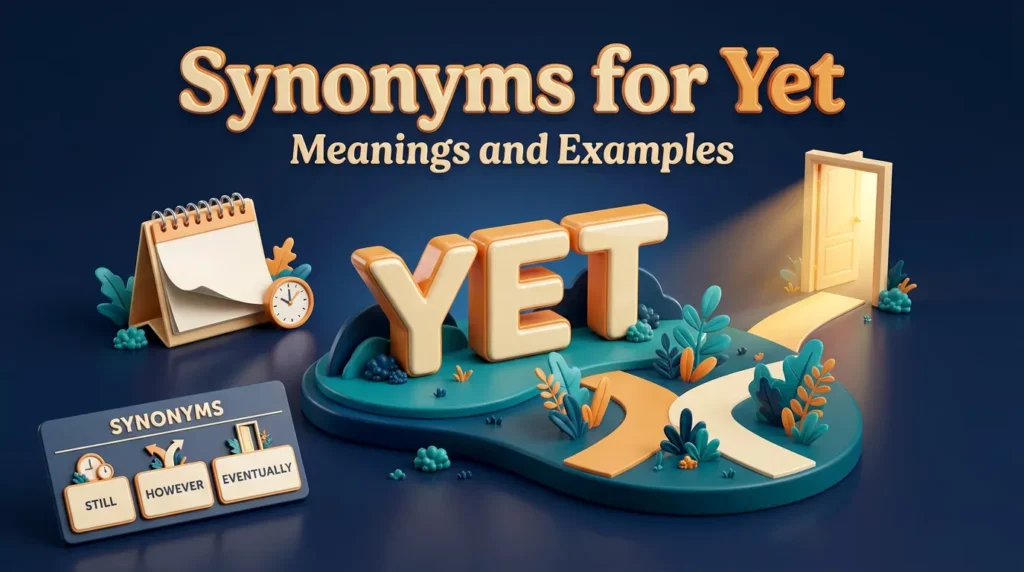

The best synonyms for yet depend on how you use the word. You might mean still, nevertheless, until now, or at some future time. Each meaning requires different alternatives.
For example, you can replace “yet” with “nevertheless” to show contrast. You can use “still” to describe something continuing. Words such as “eventually” work when discussing future events.
This guide explores more than 60 alternatives to yet. It includes definitions, example sentences, formal alternatives, and practical usage tips.
What Does Yet Mean?
The word “yet” has several meanings in English. Its meaning changes according to the sentence and context.
It commonly expresses continuation, contrast, time, or emphasis.
Here are four common uses:
- Continuation: She has not finished her work yet.
- Contrast: The task was difficult, yet she completed it.
- Future possibility: The best results are yet to come.
- Emphasis: The situation became yet more complicated.
Understanding these meanings helps you choose the right alternative.
Not every synonym works in every sentence. Some alternatives also require different grammar or punctuation.
Best Synonyms for Yet by Meaning

1. Synonyms for Yet Meaning Still or Until Now
Use these alternatives when something continues or has not happened up to the present.
1. Still
Meaning: Continuing to happen or remain true.
Example: She is still waiting for the results.
2. So far
Meaning: Up to the present moment.
Example: The project has progressed well so far.
3. Thus far
Meaning: Up to this point, usually in formal writing.
Example: The investigation has revealed no major problems thus far.
4. Up to now
Meaning: Until the present time.
Example: Up to now, nobody has reported an issue.
5. Until now
Meaning: Continuing or remaining true before the present moment.
Example: Until now, we have received no complaints.
6. Up to this point
Meaning: Through the current stage of a process.
Example: Up to this point, the plan has worked well.
7. To date
Meaning: Until the present time, especially in reports.
Example: To date, the company has launched five products.
8. As yet
Meaning: Until now, often used in negative sentences.
Example: No final decision has been announced as yet.
9. Even now
Meaning: Despite the passage of time or changing circumstances.
Example: Even now, she remembers that important lesson.
10. Up until now
Meaning: Continuing until the present moment.
Example: Up until now, the team has avoided major delays.
11. Up to the present
Meaning: Through the current time.
Example: Up to the present, the records show steady growth.
12. At present
Meaning: At the current time.
Example: At present, the office remains closed.
Note that “at present” describes the current situation. It does not always replace “yet” directly.
2. Synonyms for Yet Meaning Nevertheless or However
Use these alternatives when two ideas contrast. They often replace “yet” in sentences showing an unexpected result.
13. Nevertheless
Meaning: Despite what has just been stated.
Example: The journey was exhausting; nevertheless, everyone enjoyed it.
14. Nonetheless
Meaning: Despite the previous point.
Example: The proposal faced criticism; nonetheless, the committee approved it.
15. Even so
Meaning: Despite the circumstances already mentioned.
Example: The weather was poor. Even so, we continued our journey.
16. However
Meaning: Introducing a contrasting statement.
Example: The task seemed simple. However, it required careful planning.
17. All the same
Meaning: Despite what has been mentioned.
Example: The offer was expensive. All the same, she accepted it.
18. Despite that
Meaning: Even though the previous situation existed.
Example: The deadline was tight. Despite that, the team delivered excellent work.
19. In spite of that
Meaning: Regardless of the previous difficulty or circumstance.
Example: He lacked experience. In spite of that, he performed well.
20. Notwithstanding
Meaning: Despite a particular fact or circumstance.
Example: Notwithstanding the delays, the project finished successfully.
21. Regardless
Meaning: Without being affected by a particular circumstance.
Example: The weather remained uncertain. We continued regardless.
22. For all that
Meaning: Despite everything that has been mentioned.
Example: The process was demanding. For all that, it was worthwhile.
23. Be that as it may
Meaning: Acknowledging a point before presenting a different view.
Example: Be that as it may, we must consider the available evidence.
24. That said
Meaning: Introducing a qualification or contrasting consideration.
Example: The design looks attractive. That said, it needs improvement.
25. But
Meaning: Introducing a contrasting idea.
Example: The room was small, but it felt comfortable.
26. Though
Meaning: Introducing a contrast or qualification.
Example: The book was lengthy. It was enjoyable, though.
27. Although
Meaning: Introducing a fact that contrasts with another statement.
Example: Although the task was difficult, she completed it.
28. Even though
Meaning: Introducing a strong contrast between two facts.
Example: Even though he was tired, he continued working.
29. Despite this
Meaning: Regardless of the situation just described.
Example: The first attempt failed. Despite this, we tried again.
30. At the same time
Meaning: Introducing another consideration that may contrast with the first.
Example: The plan is ambitious. At the same time, it remains achievable.
These alternatives do not always share identical grammatical roles. Choose the expression that fits your sentence structure.
3. Synonyms for Yet Meaning at Some Future Time
In expressions such as “the best is yet to come,” yet refers to something expected in the future.
The following alternatives can express a similar idea in suitable contexts.
31. Eventually
Meaning: At some point in the future, after a period of time.
Example: With consistent effort, she eventually achieved her goal.
32. Someday
Meaning: At an unspecified time in the future.
Example: Someday, he hopes to publish his first novel.
33. One day
Meaning: At some future time.
Example: One day, you may look back on this experience with pride.
34. In time
Meaning: After enough time has passed.
Example: In time, the new system became easier to use.
35. Sooner or later
Meaning: At some point, whether soon or after a delay.
Example: Sooner or later, every project needs a clear direction.
36. In due course
Meaning: At the appropriate time.
Example: The committee will announce its decision in due course.
37. At some point
Meaning: At an unspecified moment.
Example: We will need to review the plan at some point.
38. Later
Meaning: At a time after the present moment.
Example: She plans to discuss the proposal later.
39. Later on
Meaning: At a subsequent time.
Example: We can examine the details later on.
40. Ultimately
Meaning: Finally, after considering events or developments.
Example: Ultimately, the team chose the most practical solution.
These alternatives are not direct replacements for every use of “yet.” For example, “not finished yet” does not mean “not finished eventually.”
4. Synonyms for Yet Meaning More or Additional
Sometimes, yet adds emphasis or indicates an additional amount or example.
The following alternatives may work in sentences involving addition, emphasis, or increasing intensity.
41. Even
Meaning: Used to emphasise something unexpected or notable.
Example: The revised plan was even more ambitious.
42. More
Meaning: To a greater amount or degree.
Example: We need more evidence before making a decision.
43. Further
Meaning: Additional or to a greater extent.
Example: The team requested further information.
44. Additionally
Meaning: Introducing another point or item.
Example: Additionally, the report includes practical recommendations.
45. Moreover
Meaning: Introducing further supporting information.
Example: The approach saves time. Moreover, it reduces unnecessary costs.
46. What is more
Meaning: Introducing an additional or especially important point.
Example: The course is affordable. What is more, it offers flexible lessons.
47. Still more
Meaning: An additional amount or degree.
Example: The revised design offers still more flexibility.
48. Yet another
Meaning: One more example, often suggesting repetition.
Example: The editor requested yet another revision.
49. Once more
Meaning: One more time.
Example: Please review the instructions once more.
50. Again
Meaning: Another time or on a repeated occasion.
Example: She checked the figures again.
51. To an even greater extent
Meaning: To a higher degree than before or than another example.
Example: The updated process improves efficiency to an even greater extent.
52. More than ever
Meaning: To a greater degree than at any previous time.
Example: Clear communication matters more than ever.
Some of these expressions replace the meaning of “yet” only in particular sentence patterns. For example, “yet another” expresses an additional item, while “nevertheless” expresses contrast.
5. Additional Alternatives for Specific Sentence Contexts
The following expressions can provide useful alternatives when the sentence concerns timing, contrast, or a continuing situation.
53. Meanwhile
Meaning: During the same period that something else happens.
Example: The team prepared the presentation. Meanwhile, the manager reviewed the budget.
54. In the meantime
Meaning: During the waiting period before something else happens.
Example: The results are pending. In the meantime, we can prepare the next stage.
55. While
Meaning: During the time that something happens, or to introduce a contrast.
Example: While the first option is cheaper, the second is more reliable.
56. Whereas
Meaning: Introducing a contrast between two facts.
Example: The first design is simple, whereas the second is more detailed.
57. But then
Meaning: Introducing a contrasting thought or a qualification.
Example: The decision seemed unusual. But then, the circumstances were exceptional.
58. All the while
Meaning: Throughout the same period.
Example: She remained calm all the while.
59. Before long
Meaning: After a short period of time.
Example: Before long, the new routine felt natural.
60. Up to this moment
Meaning: Until the current moment.
Example: Up to this moment, the evidence has supported our conclusion.
These are context-specific alternatives, not universal substitutes. Always consider the intended meaning before changing the original word.
Synonyms for Yet in Different Writing Contexts
Choosing the right alternative depends on your audience, tone, and purpose.
Everyday Conversation
In everyday speech, simple expressions often sound the most natural.
Useful choices include:
- Still
- But
- Even so
- Though
- Later
- So far
Examples:
Original: I have not eaten yet.
Alternative: I still have not eaten.
Original: The film was long, yet enjoyable.
Alternative: The film was long but enjoyable.
Formal and Professional Writing
Formal writing benefits from precise transitions and expressions.
Useful choices include:
- Nevertheless
- Nonetheless
- However
- To date
- Thus far
- In due course
- Notwithstanding
Examples:
Original: The proposal has not been approved yet.
Alternative: The proposal has not been approved to date.
Original: The results were unexpected, yet encouraging.
Alternative: The results were unexpected; nevertheless, they were encouraging.
Use “to date” when reporting progress. Use “nevertheless” when showing contrast.
Academic Writing
Academic writing requires logical connections between ideas.
Useful choices include:
- However
- Nevertheless
- Although
- Even though
- Thus far
- To date
- Despite this
Examples:
Original: The evidence is limited, yet the findings are important.
Alternative: The evidence is limited; nevertheless, the findings are important.
Original: Researchers have not established a clear relationship yet.
Alternative: Researchers have not established a clear relationship to date.
Ensure the alternative accurately reflects the evidence and intended relationship.
Creative Writing
Creative writing may use more expressive alternatives.
Useful choices include:
- Still
- Even so
- All the same
- Though
- One day
- Eventually
Examples:
Original: She was afraid, yet she opened the door.
Alternative: She was afraid, but she opened the door.
Original: His greatest success was yet to come.
Alternative: His greatest success was still ahead of him.
The best choice preserves the mood and meaning of the original sentence.
Yet vs. Still vs. However
These three words can overlap, but they serve different purposes.
| Word | Main function | Example |
| Yet | Expresses contrast, continuation, or an expected future event | The task was difficult, yet rewarding. |
| Still | Shows continuation or an unchanged situation | She is still working. |
| However | Introduces a contrasting statement | The task was difficult. However, she completed it. |
When Should You Use Yet?
Use “yet” to express contrast, an unfinished action, or something expected.
Example: The package has not arrived yet.
When Should You Use Still?
Use “still” when an action or situation continues.
Example: The package is still missing.
When Should You Use However?
Use “however” to introduce a contrasting statement.
Example: The package was delayed. However, it arrived safely.
These words are sometimes interchangeable, but their grammar and emphasis differ.
How to Choose the Right Synonym for Yet
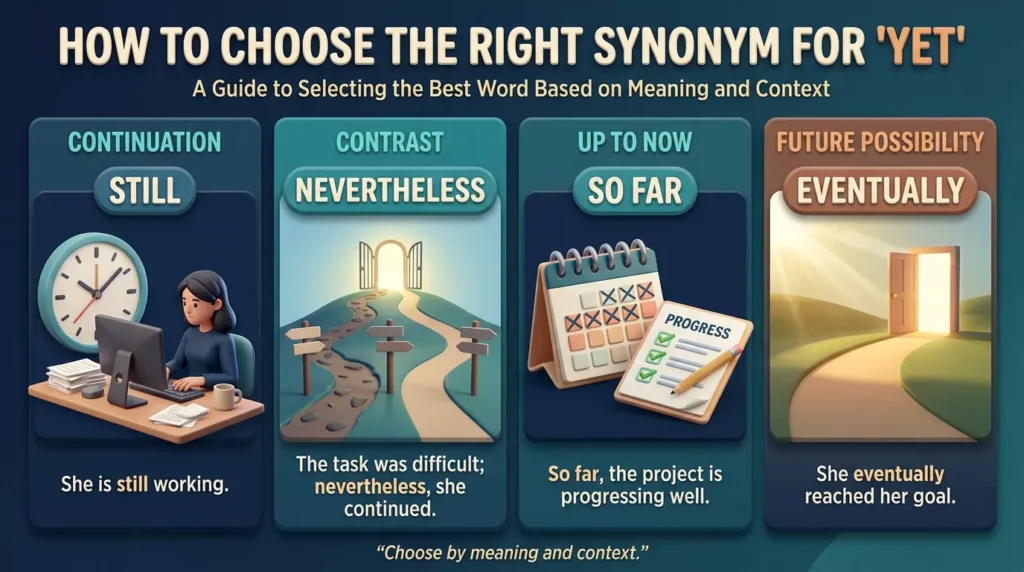
Follow these practical steps when editing your writing.
1. Identify the Intended Meaning
Ask yourself what “yet” means in the original sentence.
- Continuation: Consider “still.”
- Contrast: Consider “nevertheless” or “however.”
- Time up to now: Consider “so far” or “to date.”
- Future possibility: Consider “eventually” or “one day.”
- Additional emphasis: Consider “even more” or “yet another.”
2. Match the Tone
Choose an alternative that suits your audience.
For casual writing, “but” may sound natural. For formal reports, “nevertheless” may be more appropriate.
3. Check the Sentence Structure
Some alternatives require different punctuation or grammatical patterns.
For example:
Original: The task was difficult, yet manageable.
Correct alternative: The task was difficult but manageable.
Another option: The task was difficult. Nevertheless, it was manageable.
4. Preserve the Original Meaning
Do not replace a word simply to avoid repetition.
For example, “eventually” does not mean “nevertheless.” One refers to time; the other introduces contrast.
Choose accuracy over variety.
5. Read the Sentence Aloud
A sentence should sound natural after editing.
If the alternative makes the sentence awkward, keep the original word or choose another expression.
Common Mistakes When Replacing Yet
Treating Every Alternative as Interchangeable
Words can share one meaning without sharing every meaning.
For example, “however” can express contrast. It cannot replace “yet” naturally in every sentence about an unfinished action.
Confusing Time With Contrast
Consider these sentences:
- She has not replied yet.
- She was tired, yet she continued.
The first sentence concerns time. The second expresses contrast.
“Still” may suit the first sentence. “Nevertheless” may suit the second.
Ignoring Punctuation
Compare these examples:
- The task was difficult, yet rewarding.
- The task was difficult; nevertheless, it was rewarding.
- The task was difficult. However, it was rewarding.
Each alternative requires appropriate punctuation and sentence structure.
Using Overly Formal Words in Casual Writing
“Notwithstanding” may sound unnatural in an everyday conversation.
Use simple alternatives when they communicate the idea clearly.
Changing the Meaning to Avoid Repetition
Not every repeated word needs replacing. Repetition is acceptable when the word is accurate and natural.
Frequently Asked Questions
What Is the Best Synonym for Yet?
The best synonym depends on the context. “Still” often works for continuation, while “nevertheless” expresses contrast. “So far” can describe progress up to the present.
What Is Another Word for Yet in a Sentence?
Consider “still,” “however,” “nevertheless,” “nonetheless,” or “so far.” Check the sentence meaning before choosing an alternative.
What Is a Formal Word for Yet?
“Nevertheless,” “nonetheless,” “however,” and “notwithstanding” can suit formal writing. “To date” and “thus far” work in suitable sentences about progress.
Can I Use However Instead of Yet?
Yes, when “yet” introduces a contrasting idea. However, the sentence may need different punctuation or restructuring.
For example:
Original: The task was difficult, yet rewarding.
Alternative: The task was difficult. However, it was rewarding.
Are Yet and Still the Same?
They sometimes express similar meanings, but they are not identical.
“Still” commonly describes a continuing situation. “Yet” can express continuation, contrast, or an expected future event.
What Is the Difference Between Yet and Nevertheless?
“Yet” can connect contrasting ideas within one sentence. “Nevertheless” usually introduces a statement that acknowledges an earlier point but contrasts with it.
Example: The plan was risky, yet worthwhile.
Alternative: The plan was risky. Nevertheless, it was worthwhile.
What Can I Use Instead of Not Yet?
Depending on the sentence, you can use “still not,” “not so far,” or “not to date.”
Example: The decision has not been announced yet.
Alternative: The decision has not been announced to date.
These alternatives may change the tone or emphasis, so check the context.
What Does Yet to Come Mean?
“Yet to come” describes something expected in the future.
Example: Her greatest achievements are yet to come.
A natural alternative is: Her greatest achievements are still ahead of her.
Is Yet Appropriate in Academic Writing?
Yes. “Yet” can express contrast or an unfinished situation in academic writing. Alternatives such as “however” and “nevertheless” may also suit formal contexts.
How Many Synonyms Does Yet Have?
There is no single definitive number because the word has several meanings and grammatical functions. Many words and expressions can replace it in particular contexts, but they are not all direct synonyms.
Conclusion
The best synonyms for yet depend on the meaning you want to express. Use “still” for continuation, “nevertheless” for contrast, and “so far” for progress up to the present.
For future events, consider expressions such as “eventually” or “one day.” For additional emphasis, “even more” or “yet another” may fit.
Always check the meaning, grammar, and tone before replacing a word. The right alternative makes your writing clearer and more natural.

Nadeem Akhtar has a keen interest in the way words shape clear communication. Through SimpleSynonyms, he shares easy-to-understand resources on vocabulary, synonyms, meanings, and everyday English to help readers express themselves with greater confidence.