

Subtle means not obvious, loud, strong, or easy to notice. The best synonyms for subtle include nuanced, understated, faint, slight, indirect, delicate, and understated. Each word has a slightly different meaning, so your choice depends on the context.
For example, a faint smell is difficult to detect. A nuanced argument contains several layers of meaning. An understated design looks attractive without drawing much attention.
This guide explores 55 alternatives to subtle, including their meanings, example sentences, and best uses. You will learn how to choose the right word for academic writing, professional communication, descriptions, and everyday conversation.
What Does Subtle Mean?
The word subtle describes something difficult to notice, understand, or identify immediately. It can refer to small changes, indirect messages, delicate differences, or restrained styles.
For example, a subtle change in color may be visible only under certain lighting. A subtle hint may communicate an idea without stating it directly.
The meaning depends on the noun being described. A subtle smell is faint, while a subtle argument may be nuanced. A subtle joke might rely on indirect humor or a hidden meaning.
55 Synonyms for Subtle by Meaning and Context
The following alternatives are grouped by their main meanings. Some work as direct replacements, while others suit specific situations.
Synonyms for Subtle Meaning Nuanced or Complex
Use these words when describing ideas, arguments, differences, or interpretations.
- Nuanced: Showing small but meaningful differences.
Example: The report offers a nuanced view of the problem. - Sophisticated: Showing complexity, refinement, or advanced understanding.
Example: Her analysis presents a sophisticated interpretation of the results. - Refined: Improved, polished, or carefully developed.
Example: The designer created a refined visual style. - Complex: Containing several connected parts or ideas.
Example: The novel explores complex relationships between its characters. - Layered: Having several levels of meaning or detail.
Example: His layered explanation revealed the issue’s deeper causes. - Intricate: Containing many carefully connected details.
Example: The painting features an intricate pattern. - Shaded: Expressing slight differences in meaning, feeling, or tone.
Example: Her response contained shaded criticism rather than direct blame. - Qualified: Limited or adjusted by important conditions or exceptions.
Example: The researcher gave a qualified endorsement of the proposal. - Discerning: Showing careful judgment and an ability to notice differences.
Example: A discerning reader can recognize the author’s hidden assumptions. - Perceptive: Showing an ability to understand things others may miss.
Example: His perceptive comments revealed a weakness in the argument.
Synonyms for Subtle Meaning Slight or Faint
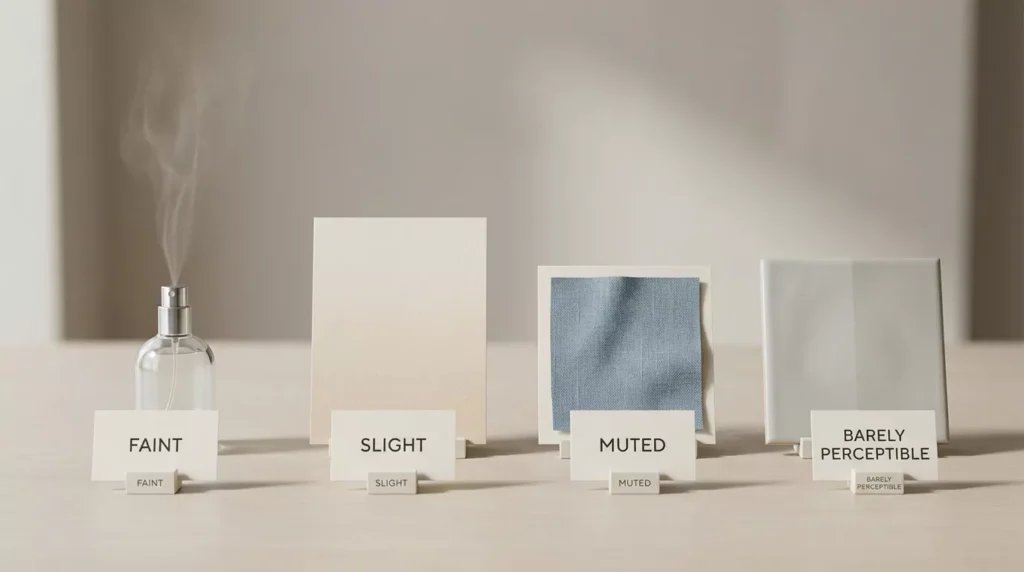
These words describe weak signals, small changes, or things that are difficult to perceive.
- Faint: Weak in strength, sound, smell, or visibility.
Example: A faint fragrance lingered in the hallway. - Slight: Small in degree or amount.
Example: We noticed a slight difference between the samples. - Gentle: Soft, mild, or not forceful.
Example: The painting uses gentle shades of blue. - Delicate: Fine, sensitive, or easily affected.
Example: The fabric has a delicate pattern. - Barely perceptible: Almost impossible to notice.
Example: A barely perceptible movement caught her attention. - Minimal: Very small in amount or degree.
Example: The updated design makes minimal use of color. - Mild: Not severe, strong, or intense.
Example: The room had a mild scent of lavender. - Muted: Softened in intensity, brightness, or expression.
Example: The website uses muted colors for a calm appearance. - Soft: Gentle in appearance, sound, or effect.
Example: Soft lighting gave the room a welcoming atmosphere. - Inconspicuous: Not attracting attention or standing out.
Example: The small camera remained inconspicuous on the shelf.
Synonyms for Subtle Meaning Indirect or Implied
Choose these words for hints, suggestions, messages, and meanings that are not stated openly.
- Indirect: Communicated without saying something plainly.
Example: He made an indirect reference to the disagreement. - Implicit: Suggested or understood without being directly expressed.
Example: Her email contained an implicit warning about the deadline. - Implied: Communicated through suggestion rather than explicit wording.
Example: His response implied that the offer was unacceptable. - Oblique: Indirect or not expressed in a straightforward way.
Example: She made an oblique reference to their earlier conversation. - Veiled: Partly hidden or disguised, often in language.
Example: The comment sounded like a veiled criticism. - Innuendo-laden: Containing indirect suggestions, often negative or suggestive.
Example: The exchange became innuendo-laden as the discussion continued. - Tacit: Understood without being formally stated.
Example: The team reached a tacit agreement about the changes. - Unspoken: Communicated or understood without words.
Example: An unspoken tension filled the meeting room. - Suggestive: Indicating or hinting at something without proving it.
Example: The evidence was suggestive but not conclusive. - Allusive: Referring indirectly to a person, event, or idea.
Example: The poem uses allusive language to reference classical myths.
Synonyms for Subtle Meaning Understated or Restrained
These alternatives suit design, fashion, behavior, humor, and personal expression.
- Understated: Attractive or effective without being showy.
Example: Her outfit had an understated elegance. - Restrained: Controlled and deliberately limited in expression.
Example: The actor gave a restrained performance. - Unobtrusive: Not distracting or demanding attention.
Example: The unobtrusive background music supported the presentation. - Discreet: Careful to avoid attracting attention or revealing information.
Example: The assistant made a discreet inquiry about the schedule. - Modest: Not excessive, showy, or ambitious in presentation.
Example: The room has modest decorations and simple furniture. - Tasteful: Showing good judgment without excessive decoration.
Example: The restaurant features tasteful interior design. - Elegant: Graceful and pleasing without unnecessary complexity.
Example: The invitation uses an elegant, understated layout. - Reserved: Not openly expressive or demonstrative.
Example: His reserved manner made his approval difficult to read. - Tactful: Careful to avoid upsetting or embarrassing others.
Example: She offered tactful feedback about the presentation. - Measured: Deliberate, controlled, and carefully considered.
Example: He gave a measured response to the criticism.
Synonyms for Subtle Meaning Slightly Noticeable or Fine
These words work for small distinctions, delicate qualities, and carefully observed details.
- Fine: Delicate, precise, or difficult to distinguish.
Example: The artist captured fine differences in skin tone. - Delicate-toned: Having a soft, restrained, or sensitive tone.
Example: The room’s delicate-toned palette created a peaceful mood. - Nuanced-looking: Appearing to contain small differences or variations.
Example: The fabric has a nuanced-looking mix of neutral shades. - Underplayed: Presented with less emphasis than might be expected.
Example: The film’s ending is deliberately underplayed. - Subdued: Quiet, restrained, or reduced in intensity.
Example: The stage featured subdued lighting. - Gradual: Developing slowly rather than happening suddenly.
Example: A gradual shift in tone changed the conversation. - Incremental: Happening through small steps or changes.
Example: Incremental improvements made the process more efficient. - Minor: Small or relatively unimportant in scale.
Example: The editor made minor changes to the wording. - Nuance-rich: Containing several meaningful distinctions or shades of meaning.
Example: The novel offers a nuance-rich portrait of family life. - Precise: Exact and carefully defined.
Example: The writer chose precise wording to avoid confusion.
Additional Alternatives for Specific Contexts
These words may replace subtle in certain sentences, but their meanings are more specific.
- Cryptic: Difficult to understand because the meaning is hidden.
Example: His cryptic message left everyone guessing. - Evasive: Avoiding a direct answer or clear commitment.
Example: The spokesperson gave an evasive response. - Diplomatic: Tactful when handling sensitive situations.
Example: She used diplomatic language to resolve the disagreement. - Imperceptible: Too slight or faint to be noticed easily.
Example: The temperature change was almost imperceptible. - Insinuating: Suggesting something indirectly, often unpleasantly.
Example: He made an insinuating remark about her decision.
Best Synonyms for Subtle in Different Situations
The most suitable replacement depends on what you are describing. Use this table to find the closest alternative.
| Context | Best synonym | Example phrase |
| A complex argument | Nuanced | A nuanced argument |
| A quiet design | Understated | An understated design |
| A weak smell | Faint | A faint smell |
| A small change | Slight | A slight change |
| A hidden message | Implicit | An implicit message |
| A tactful comment | Diplomatic | A diplomatic comment |
| A hidden criticism | Veiled | Veiled criticism |
| A soft color palette | Muted | Muted colors |
| A small visual difference | Imperceptible | An imperceptible difference |
| A controlled response | Measured | A measured response |
| A difficult clue | Cryptic | A cryptic clue |
| A careful suggestion | Indirect | An indirect suggestion |
| A complex interpretation | Layered | A layered interpretation |
| A quiet performance | Restrained | A restrained performance |
| A precise distinction | Fine | A fine distinction |
Subtle vs. Nuanced vs. Understated vs. Faint

These four words are useful alternatives, but they describe different qualities.
| Word | Main meaning | Best use | Example |
| Subtle | Not immediately obvious | General descriptions | A subtle hint |
| Nuanced | Containing meaningful differences | Ideas and arguments | A nuanced analysis |
| Understated | Expressed without showiness | Style and behavior | Understated elegance |
| Faint | Weak in intensity | Smells, sounds, and colors | A faint sound |
Use nuanced when an idea contains several layers or distinctions. Choose understated when something avoids excessive display. Use faint when a sensation is weak. Keep subtle when the broader meaning is enough.
How to Choose the Right Synonym for Subtle
Consider What You Are Describing
Start by identifying the quality you want to communicate. A subtle scent may be faint, while a subtle argument may be nuanced. A subtle design may be understated. Choosing by context makes your writing more precise.
Consider the Tone
Some alternatives sound more formal than others. Implicit, oblique, and nuanced often fit analytical writing. Faint, slight, and soft suit everyday descriptions. Diplomatic and tactful work well when discussing communication.
Check the Exact Meaning
Do not replace subtle with a word simply because it appears in a synonym list. An implicit message is not always faint. A restrained performance is not necessarily complex. The replacement should preserve your intended meaning.
Read the Sentence Again
Read the revised sentence aloud or in context. Check whether the new word sounds natural. If it changes the tone or meaning, try another alternative.
Common Mistakes When Using Synonyms for Subtle
Some related words describe only one part of subtle’s meaning. Using them incorrectly can make a sentence confusing.
- Using faint for complex ideas: A faint argument sounds unnatural when you mean a nuanced argument.
- Using discreet for every hidden detail: Discreet often describes careful behavior or privacy, not every hard-to-notice feature.
- Using cryptic for all indirect messages: Cryptic suggests that something is difficult to understand.
- Using delicate for every small change: Delicate often suggests sensitivity, fragility, or refinement.
- Using understated for weak effects: Understated usually suggests deliberate restraint, not accidental weakness.
- Using implicit for faint sensations: Implicit concerns meaning that is understood without direct expression.
Always check the noun, intended meaning, and tone before choosing a replacement.
Antonyms of Subtle
Antonyms help clarify what subtle means by showing its opposite qualities.
| Antonym | Meaning | Example |
| Obvious | Easy to notice or understand | The mistake was obvious. |
| Noticeable | Easy to see or detect | There was a noticeable change. |
| Pronounced | Strong or clearly marked | The color showed a pronounced difference. |
| Explicit | Stated clearly and directly | The instructions were explicit. |
| Overt | Open and not concealed | The criticism was overt. |
| Blatant | Very obvious, often offensively so | It was a blatant attempt to mislead. |
| Conspicuous | Attracting attention | The bright sign was conspicuous. |
| Obtrusive | Noticeably intrusive or distracting | The music became obtrusive. |
Choose an antonym based on the intended contrast. Explicit opposes indirect meaning, while pronounced opposes a slight difference.
Frequently Asked Questions
What is the best synonym for subtle?
Nuanced is a strong choice when describing complex ideas or meaningful differences. Understated suits restrained style, while faint describes weak sensations. The best synonym depends on the sentence.
What is another word for subtle in writing?
Useful alternatives include nuanced, implicit, indirect, understated, delicate, and refined. Use nuanced for complex arguments and implicit for meanings that are not directly stated.
What is a professional word for subtle?
Nuanced, implicit, understated, and measured often work in professional writing. For example, a nuanced assessment can acknowledge different factors without oversimplifying the issue.
What is a synonym for a subtle hint?
Indirect hint, implicit suggestion, and oblique reference may fit, depending on the sentence. An implicit suggestion communicates meaning without stating it openly.
What does subtle mean in simple words?
Subtle means not easy to notice or understand immediately. It can describe a small change, a quiet style, or a message expressed indirectly.
Are subtle and nuanced the same?
Not exactly. Subtle often means difficult to notice or recognize. Nuanced emphasizes small but meaningful differences. A subtle clue may be hard to spot, while a nuanced argument includes several shades of meaning.
What is the difference between subtle and understated?
Subtle is broader and can describe hidden meanings, faint sensations, or small differences. Understated usually describes something deliberately restrained, such as a design, performance, or style.
What is the opposite of subtle?
Common antonyms include obvious, explicit, pronounced, conspicuous, and blatant. The best opposite depends on whether subtle describes appearance, intensity, or communication.
Conclusion
The best synonyms for subtle depend on the meaning you want to express. Choose nuanced for complex ideas, understated for restrained style, and faint for weak sensations.
Use implicit for unstated meanings and tactful for sensitive communication. Words such as delicate, muted, slight, and indirect also work in specific contexts. Avoid treating every alternative as interchangeable.
Check the sentence, tone, and intended meaning before choosing a replacement. This approach helps you write more clearly and express precise differences.

Nadeem Akhtar has a keen interest in the way words shape clear communication. Through SimpleSynonyms, he shares easy-to-understand resources on vocabulary, synonyms, meanings, and everyday English to help readers express themselves with greater confidence.