
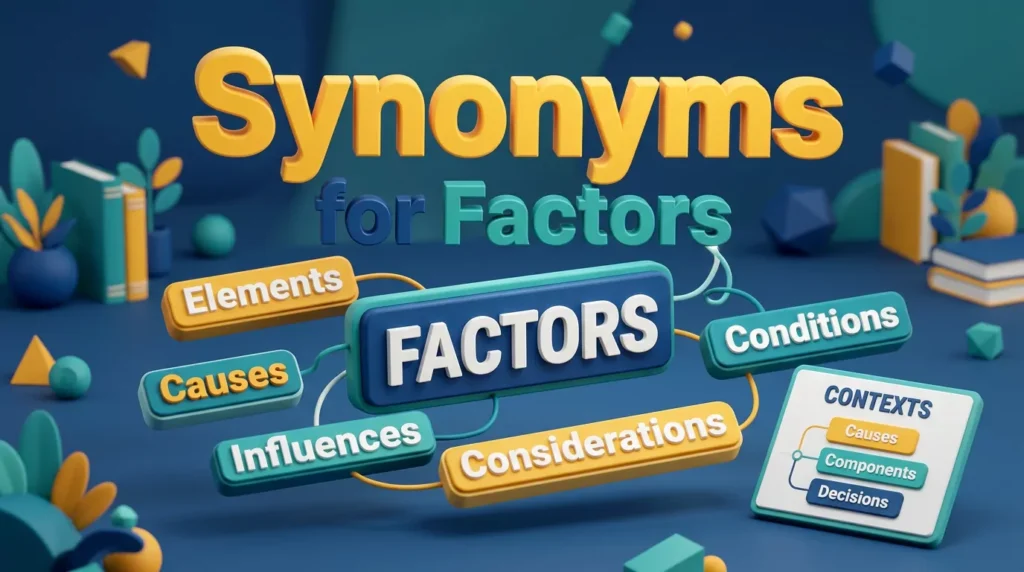

Finding the right synonyms for factors can make your writing clearer and more precise. The best alternative depends on what you want to describe. Some words refer to causes, while others describe influences, conditions, or parts of a larger situation.
Common alternatives include elements, aspects, causes, influences, contributors, conditions, variables, and considerations. However, these words are not interchangeable in every sentence.
This guide explains their meanings, provides practical examples, and helps you choose the right word for academic, professional, and everyday writing.
What Does Factors Mean?
The word factors refers to circumstances, conditions, elements, or influences that affect a situation or outcome. These may contribute to a result, shape a decision, or explain why something happens.
For example, several factors can influence a student’s academic performance. These might include study habits, teaching quality, sleep, and access to learning materials.
In this sentence, factors describes several influences rather than one direct cause.
The word is common in research, business, education, health discussions, and everyday communication. Choosing a more specific alternative can help readers understand exactly what you mean.
Common Synonyms for Factors
The following words offer useful alternatives, depending on the context.
| Synonym | Meaning | Example |
| Elements | Parts that make up a whole | Trust and communication are essential elements of teamwork. |
| Aspects | Particular parts or features of something | We examined several aspects of the proposal. |
| Causes | Reasons why something happens | Researchers investigated the causes of the decline. |
| Influences | Things that affect actions or outcomes | Family influences can shape a child’s habits. |
| Contributors | People or things that help produce a result | Poor planning was one contributor to the delay. |
| Conditions | Circumstances in which something happens | Working conditions affected employee satisfaction. |
| Variables | Factors that can change or vary | Researchers controlled the main variables. |
| Considerations | Matters that deserve attention | Cost and safety are important considerations. |
| Reasons | Explanations for an event or decision | Several reasons explain the change in policy. |
| Components | Parts of a larger system | Training is one component of the programme. |
| Features | Noticeable or important characteristics | Accessibility is a key feature of the design. |
| Characteristics | Qualities that describe something | Researchers studied the characteristics of successful teams. |
| Circumstances | Conditions surrounding an event | Personal circumstances influenced her decision. |
| Determinants | Things that strongly influence an outcome | Income can be a determinant of housing choices. |
| Drivers | Forces that promote change or progress | Innovation is a major driver of business growth. |
| Contributors to | Things that help produce a result | Stress was one contributor to the problem. |
| Influencing forces | Forces that shape events or behaviour | Cultural norms are influencing forces in consumer behaviour. |
| Motivators | Things that encourage action | Recognition is a strong motivator for some employees. |
| Criteria | Standards used to judge or select something | Price and quality were the main selection criteria. |
| Variables affecting | Conditions that influence a result | Researchers measured variables affecting crop growth. |
| Attributes | Qualities or properties of something | Reliability is an important attribute of the product. |
| Ingredients | Parts that help create a result | Preparation is a key ingredient in success. |
| Ingredients of success | Conditions that help achieve an outcome | Persistence is one ingredient of success. |
| Considerations affecting | Matters that influence a decision | Budget considerations affected the final choice. |
| Circumstances surrounding | Conditions connected to an event | We reviewed the circumstances surrounding the incident. |
| Pressures | Forces that encourage or constrain behaviour | Financial pressures influenced the household’s decisions. |
| Determining conditions | Conditions that help establish an outcome | Soil quality was one determining condition. |
| Influential elements | Elements that have a noticeable effect | Leadership is an influential element in team performance. |
| Contributing conditions | Conditions that help produce an outcome | Weather and soil were contributing conditions. |
| Causes and influences | Reasons and forces affecting an outcome | The report explored the causes and influences behind the trend. |
Some entries above are phrases rather than single-word synonyms. They can be more precise when the surrounding sentence needs additional context.
Synonyms for Factors by Context
1. Alternatives for Causes and Contributing Factors
Use these words when explaining why an event happens or why a problem develops.
- Causes: Direct reasons something happens.
- Contributors: Things that help produce an outcome.
- Triggers: Events that start a reaction or process.
- Reasons: Explanations for an event or decision.
- Conditions: Circumstances that allow an event to occur.
- Determinants: Variables or conditions that strongly shape an outcome.
- Underlying causes: Deeper reasons behind a visible problem.
- Contributing circumstances: Conditions that help explain an event.
Example: “The investigation identified several contributing factors behind the accident.”
Possible rewrite: “The investigation identified several contributing circumstances behind the accident.”
Use causes when the evidence supports a causal relationship. Use contributors when several influences combine to produce an outcome.
2. Alternatives for Influences and Decision-Making
Use these words when discussing things that shape opinions, choices, behaviour, or results.
- Influences: Things that affect a person or outcome.
- Drivers: Forces that encourage change or action.
- Pressures: Forces that push someone toward a decision.
- Motivators: Things that encourage a particular action.
- Considerations: Matters that affect a choice.
- Determinants: Conditions that strongly shape a result.
- Impacts: Effects that something produces.
- Forces: Influences that shape behaviour or change.
Example: “Several factors influenced the customer’s final decision.”
Possible rewrite: “Several considerations influenced the customer’s final decision.”
The second sentence works especially well when discussing options, priorities, and trade-offs. However, impacts usually describes effects rather than the things producing them.
3. Alternatives for Elements and Components
Use these words when describing parts, qualities, or features of a larger subject.
- Elements: Basic parts of a whole.
- Components: Parts that form a system or product.
- Aspects: Particular sides or dimensions of a subject.
- Features: Distinctive characteristics or functions.
- Attributes: Qualities or properties.
- Characteristics: Traits that describe something.
- Parts: Individual sections of a whole.
- Ingredients: Things that help create a result.
- Constituents: Parts that form a larger whole.
- Dimensions: Different aspects of a complex subject.
Example: “Communication and trust are important factors in teamwork.”
Possible rewrite: “Communication and trust are important elements of teamwork.”
Here, elements is more natural because the sentence describes parts of an effective working relationship.
4. Alternatives for Research and Academic Writing
Academic writing often needs precise terms that distinguish causes, measurements, conditions, and study variables.
Consider these alternatives:
- Variables: Quantities or conditions that can change.
- Determinants: Factors that help explain or shape an outcome.
- Predictors: Variables used to estimate an outcome.
- Explanatory variables: Variables used to explain variation in another variable.
- Conditions: Circumstances under which a study takes place.
- Parameters: Defined quantities or limits within a model or system.
- Attributes: Properties measured or examined.
- Influences: Forces that affect a result.
- Contributing factors: Conditions that help produce an outcome.
Example: “The study examined factors affecting student achievement.”
Possible rewrite: “The study examined variables associated with student achievement.”
Use associated with when a study identifies a relationship but does not establish causation. Do not replace factors with causes unless the evidence supports a causal claim.
5. Alternatives for Business and Professional Writing
Business writing often benefits from specific words that describe performance, priorities, risks, and decisions.
Useful alternatives include:
- Considerations: Matters that require attention.
- Criteria: Standards used to evaluate options.
- Drivers: Forces behind growth or change.
- Conditions: Terms or circumstances affecting an outcome.
- Variables: Changing values or circumstances.
- Determinants: Conditions that strongly affect results.
- Influences: Things that shape decisions.
- Components: Parts of a process or system.
- Risks: Possibilities of loss or harm.
- Priorities: Matters receiving the greatest attention.
Example: “Several factors influenced the company’s expansion plans.”
Possible rewrite: “Several business considerations influenced the company’s expansion plans.”
This version sounds more specific because it identifies the factors as matters considered during planning.
How to Choose the Right Synonym for Factors
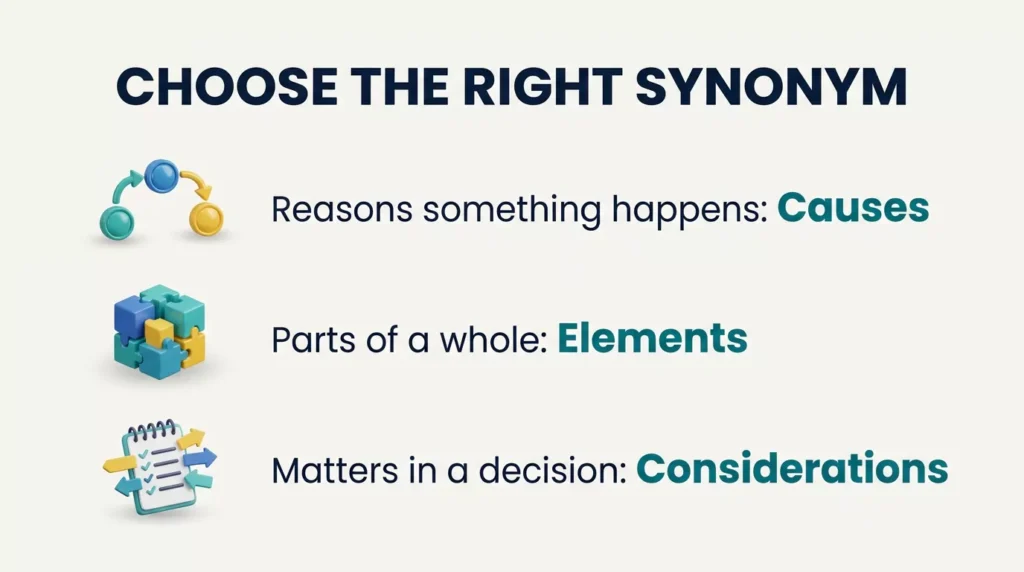
The best synonym preserves the intended meaning while improving clarity. Before replacing factors, ask what role the word plays in your sentence.
| If you mean… | Consider using… | Example |
| Reasons something happens | Causes, reasons | We investigated the causes of the delay. |
| Things that affect an outcome | Influences, determinants | Several influences shaped the outcome. |
| Parts of a larger whole | Elements, components | Trust is an essential element of teamwork. |
| Matters considered during a decision | Considerations, criteria | Cost was a major consideration. |
| Things that change in research | Variables, predictors | Researchers measured several variables. |
| Forces behind growth or change | Drivers, pressures | Innovation is a driver of growth. |
| Qualities that describe something | Attributes, characteristics | Reliability is a key attribute. |
| Conditions surrounding an event | Circumstances, conditions | The circumstances affected the result. |
Always read the revised sentence aloud. A synonym may be correct in meaning but awkward in a particular sentence.
Factors vs. Causes vs. Influences vs. Elements

These words overlap, but each has a different emphasis.
| Word | Main emphasis | Best use |
| Factors | Broad conditions or influences | General explanations |
| Causes | Reasons an event happens | Causal explanations |
| Influences | Things that shape an outcome | Behaviour and decision-making |
| Elements | Parts of a whole | Systems and relationships |
| Considerations | Matters requiring attention | Decisions and planning |
| Variables | Conditions that can change | Research and analysis |
| Determinants | Conditions that strongly shape an outcome | Formal analysis |
For example, imagine a company investigating declining sales.
- Factors: Several factors contributed to declining sales.
- Causes: The company investigated the causes of declining sales.
- Influences: Economic conditions influenced customer spending.
- Elements: Product quality was an important element of the sales strategy.
- Considerations: Pricing was an important consideration during the review.
- Variables: Researchers examined variables associated with sales performance.
- Determinants: Customer demand was one determinant of sales performance.
Each version changes the emphasis. Choose the word that matches the relationship you want to communicate.
Examples of Factors and Their Synonyms in Sentences
The following examples show how alternatives work in different writing situations.
| Original sentence | Alternative sentence |
| Several factors affected the outcome. | Several influences affected the outcome. |
| We considered all the factors before deciding. | We considered all the relevant considerations before deciding. |
| Cost is a major factor in the decision. | Cost is a major consideration in the decision. |
| Many factors caused the delay. | Several causes contributed to the delay. |
| Environmental factors affect plant growth. | Environmental conditions affect plant growth. |
| Several factors explain the difference. | Several reasons help explain the difference. |
| Key factors drive business growth. | Key drivers support business growth. |
| Researchers examined the factors affecting performance. | Researchers examined the variables associated with performance. |
| These factors are important to success. | These elements are important to success. |
| Multiple factors influenced the result. | Multiple influences shaped the result. |
| Several factors affected employee satisfaction. | Several workplace conditions affected employee satisfaction. |
| The team reviewed factors affecting quality. | The team reviewed considerations affecting quality. |
Some rewrites are more natural than others. Avoid adding unnecessary words, such as “relevant considerations” when “considerations” already expresses the intended meaning.
Common Phrases and Better Alternatives
Many writers use factors in repeated phrases. More specific wording can improve precision.
| Common phrase | Possible alternative | Example |
| Key factors | Main influences, critical elements | We identified the main influences on demand. |
| Contributing factors | Contributing conditions, contributors | The report discussed contributing conditions. |
| Risk factors | Risk indicators, conditions that increase risk | Researchers examined conditions that increase risk. |
| Success factors | Drivers of success, ingredients for success | Preparation is an important ingredient for success. |
| Factors affecting | Influences on, conditions affecting | We studied conditions affecting crop growth. |
| Factors influencing | Influences shaping, drivers of | The report examined drivers of consumer demand. |
| Several factors | Several influences, multiple considerations | Several considerations shaped the decision. |
| Important factors | Key considerations, major influences | Cost remains a key consideration. |
| External factors | Outside influences, external conditions | External conditions affected the schedule. |
| Internal factors | Internal conditions, organisational influences | Organisational influences affected staff performance. |
| Economic factors | Economic conditions, market forces | Market forces influenced customer demand. |
| Personal factors | Personal circumstances, individual considerations | Personal circumstances affected her choice. |
These alternatives are suggestions, not universal replacements. For example, risk factors is an established term in medical and research contexts. Replacing it may reduce clarity or alter its technical meaning.
Common Mistakes When Using Synonyms for Factors
Treating Every Synonym as Identical
Causes, elements, and considerations describe different relationships. Replacing one with another can change the meaning.
Using Causes Without Evidence
A factor may be associated with an outcome without directly causing it. Academic and scientific writing should preserve this distinction.
Choosing Formal Words Unnecessarily
Words such as determinants and constituents may sound overly technical in everyday writing. Prefer familiar alternatives when they communicate the same idea.
Repeating the Same Word Too Often
Repeated use of factors can make an article feel monotonous. However, repeating a precise technical term is often better than using an inaccurate synonym.
Ignoring Established Expressions
Some phrases have recognised meanings in specific fields. Terms such as risk factors and independent variables should not be changed casually.
Antonyms and Contrasting Terms for Factors
The word factors has no single direct antonym that works in every context. However, several contrasting terms may help express the opposite idea.
| Contrasting term | Meaning | Example |
| Irrelevancies | Matters unrelated to the issue | We removed irrelevant details from the report. |
| Nonessential elements | Parts that are not necessary | The team removed nonessential elements. |
| Insignificant influences | Effects that have little importance | The analysis excluded insignificant influences. |
| Constants | Values or conditions that remain unchanged | Researchers kept the constants stable. |
| Outcomes | Results rather than contributing conditions | The study measured outcomes instead of influences. |
These are contextual contrasts, not exact antonyms. The best choice depends on whether you mean the opposite of importance, relevance, change, or causation.
Frequently Asked Questions
What is the best synonym for factors?
Elements is a useful general alternative when describing parts of a whole. Influences works when discussing effects on outcomes. Causes is suitable when explaining why something happens. The best choice depends on context.
What is another word for factors in academic writing?
Useful academic alternatives include variables, determinants, explanatory variables, conditions, and influences. Choose the term that matches your research design and evidence. Do not imply causation when your study establishes only an association.
What is a formal word for factors?
Determinants, variables, considerations, and contributing conditions can work in formal writing. Each has a distinct meaning. Use the most precise term rather than the most complicated one.
What are synonyms for key factors?
Possible alternatives include key influences, critical elements, major determinants, primary drivers, and essential considerations. Choose according to whether you mean causes, important components, or decision-making priorities.
What are synonyms for contributing factors?
Alternatives include contributors, contributing conditions, underlying influences, and circumstances that helped produce an outcome. Use causes only when the evidence supports a causal relationship.
What can I use instead of factors affecting?
Depending on the sentence, use influences on, conditions affecting, variables associated with, or elements shaping. For example, “factors affecting performance” could become “conditions affecting performance.”
Are factors and causes the same?
No. A cause produces or helps produce an event. A factor is a broader term for something that may affect an outcome. Some factors are causes, but others describe conditions, influences, or components.
Is factors suitable for academic writing?
Yes. Factors is common in academic writing because it is broad and flexible. More specific terms can improve precision when discussing causal relationships, research variables, or measured conditions.
What is the difference between factors and considerations?
Factors are circumstances or influences affecting a situation. Considerations are matters taken into account when making a decision. A factor may influence a decision without being deliberately considered.
How can I avoid repeating factors in an essay?
Identify the intended meaning in each sentence. Replace factors with terms such as influences, conditions, variables, or considerations when appropriate. Retain the original word when a replacement would change the meaning.
Conclusion
Choosing the right synonyms for factors makes your writing more accurate and easier to understand. Words such as elements, influences, causes, conditions, variables, and considerations provide useful alternatives for different situations.
However, each word carries a distinct meaning. Use causes when explaining why something happens, elements when describing parts of a whole, and considerations when discussing decisions.
In academic writing, distinguish association from causation. In professional writing, prefer clear and specific terms. Always check the complete sentence before making a replacement. The strongest word choice is the one that communicates your intended meaning without confusion.

Nadeem Akhtar has a keen interest in the way words shape clear communication. Through SimpleSynonyms, he shares easy-to-understand resources on vocabulary, synonyms, meanings, and everyday English to help readers express themselves with greater confidence.